Category Archives: The Free Press Journal

2021: A year of Love, Labour and Loss

Love is a mystery. Love is unitive. Love is how we connect as human beings with one another and with the whole universe together. Love is how we learn, become better, and make the world a better place to live for us and others. Love needs freedom to breathe, equality to thrive, and openness to flow and grow. Love is personal, political, philosophical, sexual, social, historical, metaphysical, transcendental, et al. Sadly, we have only one word to describe such a complex emotion. The ancient Greeks had six different words, but even that’s not enough. 2021 taught me new ways to describe the complexity of love and its various hues. Love lost on many counts, but it miraculously sprang on a few occasions like a phoenix. My LOVE vocabulary was defined and redefined by people who touched my life one way or another this year.

shillpi a singh

LOVE IS FOOD FOR THE SOUL: Farmers and Agripreneurs

“Why do farmers farm, given their economic adversities on top of the many frustrations and difficulties normal to farming? And always the answer is: Love. They must do it for love. Farmers farm for the love of farming. They love to watch and nurture the growth of plants. They love to live in the presence of animals. They love to work outdoors. They love the weather, maybe even when it is making them miserable. They love to live where they work and to work where they live. If the scale of their farming is small enough, they like to work in the company of their children and with the help of their children. They love the measure of independence that farm life can still provide,” said Wendell Berry.

Retracing actor extraordinaire Manoj Bajpayee’s brand endorsements in 2021 makes one marvel at the ingenuity of his choices. He endorsed products and services that matter to an ordinary person, be it home, finance, farm, food, and rightly so. “I was born and brought up in a village, and I have always flaunted being a farmer’s son with immense pride. It is the core of my being, my work and how I choose to do what I do,” he says. A proud farmer’s son, he endorsed Krish-e App by Mahindra because the product reflects his identity, and he could relate to it. “Moreso, because I find technology a great enabler, and Krish-e has leveraged it to its advantage to help farmers reduce costs, increase productivity, and ultimately farmers’ income,” says the actor, who won the National Award for his searing performance in Devashish Makhija’s Bhonsle this year. With his endorsement, Bajpayee set the tone for the changing narrative in the agriculture sector that’s gravitating towards tech and seeing the active participation of young agripreneurs.  

LOVE IS FOOD FOR THE SOUL: Actor Manoj Bajpayee
To read more, https://adnaama.in/2021/11/06/the-ad-ventures-of-mr-b/
Farmer’s pride

IT professional Muhaimin Sheik decoded the perfect work-from-home balance during the lockdown, much to his delight. A native of Ramanathapuram, Pottagavayal village in Tamil Nadu, Sheik returned home to be with his family during the pandemic last year and has stayed in the village ever since then. Hailing from a family of farmers, he wasn’t as deeply involved in the process as he is now, and the WFH, in a way, helped him reconnect with his roots. “I spend five days coding and two days farming. I start my weekdays with a stroll down the farm before logging in for work. One day someone asked me, ‘You are educated and working with a software firm, so why do you want to do this? The company pays you well, right?’ I replied, ‘Yes, it does, but I can’t eat the money. I can eat rice only’,” says Sheik.    

A native of Ramanathapuram, Pottagavayal village in Tamil Nadu, IT professional Muhaimin Sheik at his farm.

CEO of Athvas Horti Fed Producer Company Ltd Asiya Nazir from Kupwara in Kashmir runs a farmer producer organisation and sells to wholesale and retail buyers on a tech-enabled Harvesting Farmers Network (HFN) platform. “I sell walnut, almonds, apple jam, honey and saffron on HFN mobile app directly to buyers across India. The tech-enabled market linkage is a massive relief for farmers like me,” says Nazir.

CEO of Athvas Horti Fed Producer Company Ltd Asiya Nazir from Kupwara in Kashmir

On the other hand, Raghu Dharanipathi of Kapila Agrofarms in Siddipet, Telangana, has benefitted tremendously by feeding corn silage (Cornvita by SAGO) to his cattle for the last three years. “Sago has been one of the best both in terms of quality of the product and customer service. Milk production of our dairy cattle consistently improved by 10-15% in the last three years,” says Dharanipathi. 

The story of Ajit Sorate,a large farmland owner from Baramati, Maharashtra, who faced challenges due to a lack of knowledge about the advanced implements available in the market, is no different. Thanks to Krish-e advisory, his plantation costs have been drastically reduced. Earlier, Sorate used to utilise 16 acres for sugarcane and 12 acres for maize cultivation. This year, after registering on the Krish-e app, he has planted sugarcane, from which he expects over 35% more output. “Krish-e app comes with Mahindra’s promise and has a smooth functioning where I can avail proper advice on soil testing, primary tillage and intercropping to help in scientific mapping of the crop,” he says.  

Back story

Krish-e is a new business vertical from Mahindra Group that provides technology-driven services that are progressive, affordable, and accessible to farmers. “We launched Krish-e and Nidaan apps in October 2021, keeping in mind the ever-evolving needs of the modern farmers. These apps leverage a combination of agronomy, data and farming expertise to improve farmer’s income per acre,” says Hemant Sikka, President, Farm Equipment Sector, Mahindra & Mahindra Ltd. 

HFN founder Ruchit Garg, who launched a mobile app in November 2021, had been actively helping smallholders’ farmers from across the country market and sell their harvest through a dedicated Twitter page during the first wave of COVID19. Farmers used to message crop details to him, and he used to broadcast those details on Twitter, and the farmers’ produce used to find buyers in no time. Buoyed by the consumer response, he decided to have a dedicated mobile app for farmers. “HFN Kisan mobile app is world’s only mobile app which provides full-stack services to not only farmers in horticulture, but also to farmers involved in fishery, poultry and livestock,” says Garg. 

Hyderabad-based agri-tech startup SAGO Speciality Feeds was started by three passionate agripreneurs — former NABARD employee Chandrasekhar Singh, his nephew Saikiran and son Anurag —  in 2019. At SAGO, they have deployed fermentation biology to develop and manufacture silage from corn crops and use microbial inoculants for making silage. The technology helps produce high-quality feed for cattle and enables efficient year-long storage of green fodder. “Silage is a highly nutritious and balanced feed for cattle, sheep and other ruminants, and it can also be used as a biofuel feedstock for anaerobic digesters. It doesn’t contain any synthetic additives or chemicals. Silage also helps reduce the volume of feed as it is highly compressed, thereby decreasing the overall cost and meeting the nutritional requirement,” says Singh.  

Agri-tech startup SAGO Speciality Feeds was started by three passionate agripreneurs — former NABARD employee Chandrasekhar Singh, his nephew Saikiran and son Anurag —  in 2019.
Growth in numbers 

The numbers are promising, and best elucidate the success story. Garg recounts how the app helped a Bangalore farmer sell 20,000 kg of grapes in just three days and how a farmer from Bihar got a weekly brinjal subscription from a nearby hotel by using the app. “We have at least one farmer from each Indian state/UT on our platform,” he adds with pride. 

Ruchit Garg, founder of HFN Mandi and HFN mobile app.

The high-quality corn silage is produced at SAGO’s plant in Banswara, Rajasthan. “More than 1,200 farmers produce corn crop for us annually. Over 230 dairy farms, involving over 12,000 dairy cattle, are fed with our corn silage annually. Sago has created an efficient and sustainable agricultural production ecosystem covering Gujarat, Rajasthan, and Telangana and significantly improved the livelihood of the farming community involved,” elucidates Singh. 

The Krish-e and Nidaan apps have received more than six lakh downloads. With an omnichannel approach, Krish-e is has been able to make a considerable difference to farming outcomes. “Through Krish-e, Mahindra is creating a nation of ‘Champion Farmers’. To date, Krish-e has increased the yield of farmers by up to Rs 15,000, brought down the cost of farming by about 8-12% and increased profit by up to Rs 6000 per acre. It reflects the passion of those progressive farmers who have adopted new practices to improve their outcomes,” adds Sikka. 

Plans in the offing

SAGO plans to expand into other speciality feeds for animals such as Aflatoxin free corn for pet feed and Quality Protein Maize for poultry feed. “These are a couple of products in the pipeline to be launched in the next two years. We are preparing to foray into the value-added food sector, focused on Functional Foods,” says Singh. 

Mahindra Group’s biannual event – Krish-e Champion Awards – is aligned with the Kharif and Rabi seasons. These Awards recognise and felicitate farmers and institutions, who have risen above the ordinary, by thinking innovatively and driving a positive change in agriculture. “Through the Krish-e Champion Awards, we aim to inspire millions of farmers and agripreneurs to build a promising future for the country. These Awards celebrate the progress of these farmers who took this first and very important step with us,” emphasises Sikka. 

Like most other fields, technology in agriculture is a must, believes Garg, adding that it impacts every aspect of agriculture, from seed to market. “Agriculture requires a mix of digital and physical approaches for building a scalable and sustainable business model,” says Garg, who is planning to launch a network of brick-and-mortar HFN Kisan Centers. “These will be farmer-owned and operated. We plan to open 17,000 such centres across India,” he adds. 

Young farmer Sheik sums up the tenacious spirit of others of his ilk and states, “There are many ways to earn money, but there is only one way to earn food, and that’s through agriculture.” True that! We owe a lot to the farmers. It is about time we realise it too. 

Kisan Diwas is observed on December 23 in remembrance of former PM Chaudhary Charan Singh, who was committed to the wellbeing of the farmers. I met farmers and agripreneurs, who have leveraged technology, to do the same to celebrate the day. The article was published in The Free Press Journal on December 19, 2021.
https://www.freepressjournal.in/weekend/kisan-diwas-2021-how-farmers-and-agripreneursare-making-the-most-of-technology-that-is-at-their-disposal

2021: A year of Love, Labour and Loss

Love is a mystery. Love is unitive. Love is how we connect as human beings with one another and with the whole universe together. Love is how we learn, become better, and make the world a better place to live for us and others. Love needs freedom to breathe, equality to thrive, and openness to flow and grow. Love is personal, political, philosophical, sexual, social, historical, metaphysical, transcendental, et al. Sadly, we have only one word to describe such a complex emotion. The ancient Greeks had six different words, but even that’s not enough. 2021 taught me new ways to describe the complexity of love and its various hues. Love lost on many counts, but it miraculously sprang on a few occasions like a phoenix. My LOVE vocabulary was defined and redefined by people who touched my life one way or another this year.

SHILLPI A SINGH

LOVE IS DESIRE

It was not too long ago when lonely widow Usha Parmar (Ratna Pathak Shah) in Alankrita Srivastava’s Lipstick Under My Burkha scorched the screen with her burning desire for intimacy. Parmar sought refuge in Hindi pulp novels out of desperation, fantasised about escapades with a young man and, in return, was rebuked and ridiculed for her overt sexuality because her actions were unfitting her age. Subtly, Parmar’s character hints that sexuality, desire, activity and intimacy in the elderly don’t come with an expiry date. While age-related medical issues have a considerable role to play, the social and cultural aspects too have a bearing on them.

LOVE IS DESIRE

Senior psychotherapist and counsellor Padma Rewari recalls how she recently offered consultation to a 52-year-old woman, well past her menopause, who didn’t want to put a pause button on her sex life, much to her husband’s chagrin. “The woman went deep into depression after her husband body-shamed her and made fun of her overtures. She didn’t know how to deal with her need for intimacy, which was a social and cultural taboo for her husband. His behaviour made her feel so low about herself that she developed suicidal tendencies,” says Rewari.

LOVE IS DESIRE AND IT DOESN’T HAVE AN EXPIRY DATE.

Cause of concern
One partner’s overt and other partner’s inert reaction to the other’s needs was the cause of the problem in Rewari’s patient. Although sexuality is a fundamental driving force, human sexuality is frequently misunderstood and often neglected in the case of the elders. “Sexuality and senior citizens seems a weird proposition. There is a mental block. People often suppress those desires and feelings because it is not age-appropriate behaviour,” says Rewari.
It is assumed that older people lose their sexual desires or are physically unable to perform. It is common for older men to fear the loss of sexual prowess, while older women may also express sexual desire but may fear their interest is undignified and disgraceful. “You become a senior citizen as soon as you cross 50. Ageism has a tremendous impact on the subconscious mind. It makes one slowly withdraw and retire when it comes to sexual activity, and expressing the desire and need for intimacy is a strict no-no. It is taboo. If one partner still has such desires, and the other partner doesn’t show such feelings or desires, it leads the partner (who has it still) on a guilt trip,” adds Rewari.
Niyatii N Shah, sexuality educator, intimacy coach and counsellor, has come across many cases where one of the partners and, in some cases, the couple approached her for help. “I have had both types of clients. Many of them seek advice through social media. A few of the most common reasons I have come across are lack of respect, no sexual satisfaction, boredom and abuse,” says Niyatii.

Dealing with the issue
The sexuality, desire, activity and intimacy in the elderly seems to be waning partly because of medical complications and partly because of a general loss of interest due to social or cultural reasons. “It’s a mix of both but mainly because of loss of interest and emotional baggage. Most of the time, partners are very supportive if there’s a medical reason. Intimacy counselling looks into why the couples are not intimate anymore and helps them live a fuller life that they desire from each other,” informs Niyatii. 
During a recent webinar organised by Boston Scientific, psychiatrist, clinical sexologist, and sex and intimacy coach Dr Anita Shyam, who regularly meets such couples, said, “I also follow a simple formula in patients — seek a detailed sexual and relationship history. So that pretty much gives me a more comprehensive view of the issue. Is it an organic cause? Or is it a psychological cause? Is it a social cause or whether it is a relationship problem?”
If there is an organic cause, she refers them to the physicians who specialise in that field, but if it is a psychological cause, she digs deeper to ascertain the reason. “Is this person suffering from anxiety or depression? Or is he or she into drugs and alcohol? Sometimes even the partner can have a problem. The partner must be suffering from medical issues, desire disorders or depression that could lead the man to have ED. If not, then the couple must be having a relationship problem. So, I look holistically at the three parts of the triangle — the individual, the partner and the relationship,” she says.

The article was published in The Free Press Journal on December 12, 2021.
https://www.freepressjournal.in/weekend/love-sex-and-age-does-desire-have-an-expiry-date-no-many-older-adults-will-say

A problem area
A marked increase in life expectancy over the past century has meant that individuals over the age of 65 form an increasingly large proportion of the population. Yet, very little attention has been paid until recently to treating sexual dysfunction in older adults. Older individuals are generally erroneously viewed as asexual people who have lost their interest in sex and their capacity for sexual behaviour. Calling for the need for more attention in psychiatric training to deal with sexuality in the elderly, Rewari adds, “The chain of ignorance needs to break. We need to change the way we think about older people and how they treat each other once they reach a certain age. We say age gracefully but without suppressing the fantasy or the feeling of sexual desires. Leave the guilt out, which plays on every human mind. These are conditioned behaviours and patterns which we have seen all through, but it is normal to have the flame of desire and need for intimacy burning even if you are past a certain age.”
People often refuse to believe that they are depressed and stressed. And sometimes, they could even be on a list of psychiatric medications. “Stress is a major factor for any of the psychological and several medical problems. There are four phases in a sexual cycle. Stress affects the desire, if the desire is affected, it’s going to affect the arousal, it affects the orgasm and also the resolution. It plays a major role in even in an individual’s life and in the relationship, causing a lot of relationship and sexual problems in couples,” says Dr Shyam.

Health issues
While women could blame menopause, older men could have many physical problems because of diabetes, hypertension, high cholesterol and smoking that could affect their sexual capabilities. “There are many issues that men may have. A libido problem means he doesn’t feel the urge for sex. He may have an arousal problem and he’s not attracted to his partner, he may have an erection problem. Then sometimes, he has a problem with early orgasm or premature ejaculation. All of which are different and need different treatments,” says Dr Rupin Shah, consultant andrologist and microsurgeon.
India is the diabetes capital and 50-70% of men with diabetes will eventually develop erectile dysfunction due to the disease. “Lifestyle is vital because, as I tell patients, sex happens when you are at the peak of your health, then you have the greatest urge, the greatest energy, the greatest capability. As your general health diminishes, your sexual abilities decrease, even though that desire may be there. So the middle-aged executive who’s overweight, not exercising, overeating sugar, smoking 10 cigarettes a day is going to have a lifestyle-induced sexual problem,” adds Dr Shah. 

Why it matters
There was an upsurge in teleconsultation in such cases during the pandemic-induced lockdown. It was because it is comfortable and convenient for the couple or individual to discuss the issue over a phone rather than in person. The key remains communication. “Always communicate how you feel with your partner. Seek professional help, talk to friends, understand what spouses think in general, and seek medical help if required,” emphasises Niyatii.
Communication and conversation become more important as one grows older. “The bond needs to be stronger, and as the empty nest syndrome hits, the couple needs to be there for each other. A relationship which is healthy and respectful needs to be maintained so that the couple live happily,” says Rewari, signing off.

Ask me to define my love for you and I’ll say it’s captured in every beautiful memory of our past, detailed out in vivid visions of our dreams and future plans, but most of all it’s right now, at the moment where everything I’ve ever wanted in my life is standing right in front of me.

Leo Christopher

Inheriting six yards of elegance

A full-page dedicated to women, heirloom and nostalgia in The Free Press Journal edition dated December 5, 2021.

https://www.freepressjournal.in/featured-blog/inheriting-six-yards-of-elegance-keepers-of-the-sari-tradition-give-a-glimpse-of-their-prized-possessions

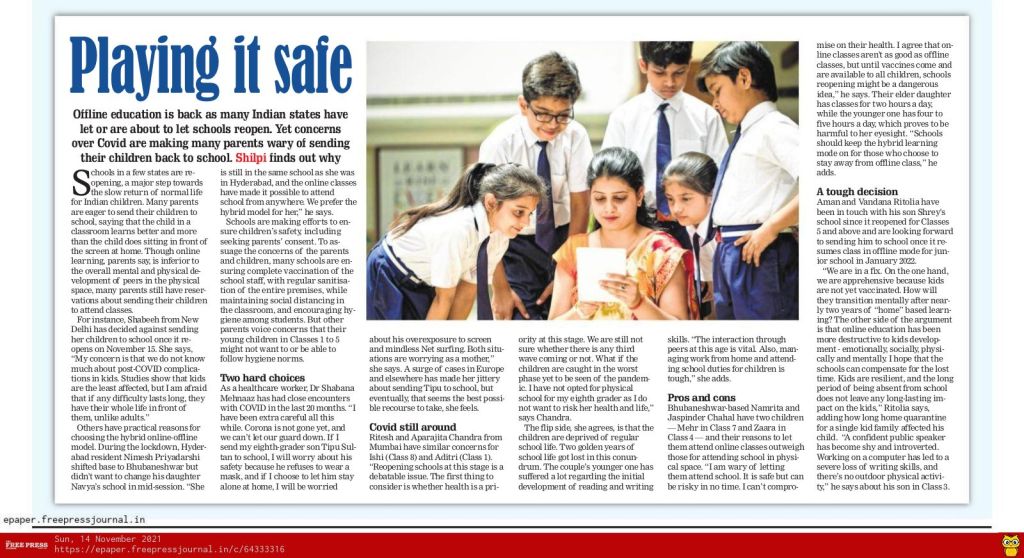
School reopening: Parents play it safe

The article was published in the edition dated November 15, 2021.
https://www.freepressjournal.in/entertainment/playing-it-safe-heres-what-parents-say-about-sending-kids-unvaccinated-to-school-amid-the-pandemic

While some parents have no qualms about letting their children return to learning in the physical space, many others are wary. I spoke to a few of them to know the reasons behind their decision.

The drop in COVID-19 cases and rising vaccination figures bode well for wary parents and their children across the country. Gradually schools are reopening, with a few of them opting for a hybrid model — offline and online — for students who don’t wish to attend physical classes can log in and take virtual lessons.  

The much-awaited move marks the slow return of normal life for children. While some parents still have reservations about reopening schools and sending their children to attend classes in the physical space, most of them agreed that what the child could do sitting in a classroom can never match what the child does sitting in front of the screen at home.    

Apart from poor quality, a worried parent Shabeeh from New Delhi, who isn’t sending her children to school once it reopens on November 15, says, “My concern is that we do not know much about post-COVID complications in kids. Studies show that kids are the least affected, but I am afraid if any complication arises, and lasts long, it would be difficult to manage.”

For a few others, the hybrid model suits them best. During the lockdown, Hyderabad resident Nimesh Priyadarshi shifted base to Bhubaneshwar but didn’t want to change his daughter Navya’s school in mid-session. “She is still in the same school as she was in Hyderabad, and the online classes have made it possible to attend school from anywhere. We prefer the hybrid model for her, though the school has resumed offline classes for others as well,” he says.   

Before opening their doors and resuming teaching within the four walls of the learning space, the schools had taken ample precautions, including seeking parents’ consent. To assuage the concerns of the parents and children, the schools had ensured complete vaccination of the school staff, with regular sanitization of the entire premises, while maintaining social distancing in the classroom, encouraging hygiene among students, etc. A quick roundup of those sending their children to school versus those who don’t want to, and why.  

Online classes meant zilch learning 

Noida based Amitesh, and Priyamvada Srivastava had sent their children Aadyant and Aarya to attend classes in the physical space when the school had reopened briefly in November last year. “We had no apprehensions this time around. No doubt, online learning was convenient. Kids could attend classes while being stationed here in Noida or Patna or Kolkata, and they did. But when it came to learning, there were no takeaways for children. My son told us that offline is real learning after returning home on the first day, November 8. We were relieved to see this return to normalcy,” he says. There were three children in Aadyant’s class 7 and four in Aarya class 5 on Day 1, but slowly the strength is increasing. Online and offline classes follow different timetables and timings, and there are different teachers assigned for each. “Children are responsible and particular about COVID protocols because any miss could have severe consequences,” she adds.  

Good to see children reclaiming their space 

Patna residents Divesh and Deepa Sehara have been sending their son Milind Dev (Class 8) to school on alternate days from September 6, and every day after Dussehra break. Deepa says, “I was happy about school reopening. Children had forgotten about what life was all about before the pandemic. Their world shrank to a mere phone or a laptop. School is not just about studying; it is also about overall mental and physical growth. So it was a relief to see him back to where he rightfully belongs, the school.” Sehara duo has faith in the precaution being taken by the school, giving them peace that second home is as safe as their child’s first. 

Let children return to their school routine

Dr Nisheeth Kumar, who has been working from home since the lockdown started in March 2020, was pleased with the move to reopen schools. His twin sons, Aditya and Arnav, 7, are in Class 2. They have been going to school for about a month in Patna. “Children have been exposed to testing times for a long duration, and with the situation showing improvement, I think it made sense to let kids resume schools and attend classes in the offline mode. Overexposure to screens has taken a visible toll on children. I am glad schools have reopened, and kids are back to where they belong. My children seemed quite eager to be back to school, and my wife, Rashmi and I heartily welcomed this move,” Dr Kumar states. 

If children can go everywhere else, then why not school?

Priya and Rahul Singh from Bhopal had one nagging issue with the reopening of schools. “The only constraint for us was that children are not vaccinated yet. At the same time, we know that children have strong immunity to recover against infection compared to adults. When parents take their children to malls, markets, and other public places, why not to school?” Rahul asks. Duo’s daughter Rupal is in Class 8, and her school is running and about for all classes, from 1-12, both in online and offline modes. “People in public places can be careless with COVID norms, but not in school. Everyone has to follow them. I feel that little ones in Classes 1-5 are too young to follow norms, so the school should consider excusing them from the offline mode in this session,” Priya adds.

Caught between the devil and deep sea 

As a healthcare worker, Dr Shabana Mehnaaz in Ranchi has had close encounters with COVID in the last 20 months. “I have been extra careful all this while. Corona is not gone yet, and we can’t let our guards down. If I send my eight grader son Tipu Sultan to school, I will worry about his safety because he refuses to wear a mask, and if I choose to let him stay alone at home, I will be worried about his overexposure to screen and mindless Net surfing. Both situations are worrying as a mother,” she says. A surge of cases in Europe and elsewhere has made her jittery about sending Tipu to school, but eventually, that seems the best possible recourse to take, she feels.

The worst is over, but COVID is not gone yet

Ritesh and Aparajita Chandra from Mumbai have similar concerns for Ishi (Class 8) and Aditri (Class 1). “Reopening schools at this stage is a very debatable issue. The first thing to consider is whether health is a priority at this stage. We are still not sure whether there is any third wave coming or not. What if the children are caught in the worst phase yet to be seen of the pandemic. I have not opted for physical school for my eighth grader as I do not want to risk her health and life,” says Aparajita. The flip side, she agrees, is that the children are deprived of regular school life. Two golden years of school life got lost in this conundrum. The couple’s younger one has suffered a lot regarding the initial development of reading and writing skills. “The interaction through peers at this age is vital. Also, managing work from home and attending school duties for children is tough,” Ritesh adds.

Both propositions have pros and cons

Bhubaneshwar based Namrita and Jaspinder Chahal have two children – Mehr in Class 7 and Zaara in Class 4 – and their reasons to let them attend online classes outweigh those for attending school in physical space. “I am wary of letting them attend school. It is safe but can be risky in no time. I can’t compromise on their health. I agree that online classes aren’t as good as offline classes, but until vaccines come and are available to all children, schools reopening might be a dangerous idea,” Namrita says. Their elder daughter has classes for two hours a day, while the younger one has four to five hours a day, which proves to be harmful to her eyesight. “Schools should keep the hybrid learning mode on for those who choose to stay away from offline class,” Jaspinder adds.

The decision to return to school is tough 

Aman and Vandana Ritolia from Bengaluru have been in touch with his son Shrey’s school since it reopened for Classes 5 and above earlier this year and are looking forward to sending him to school once it resumes class in offline mode for junior school in January 2022. “We are in a fix. On the one hand, we are apprehensive because kids are not yet vaccinated. How will they transition mentally after nearly two years of “home” based learning? The other side of the argument is that online education has been more destructive to kids development – emotionally, socially, physically and mentally. I hope that the schools can compensate for the lost time. Kids are resilient, and the long period of being absent from school does not leave any long-lasting impact on the kids,” Aman says, adding how long home quarantine for a single kid family affected his child. “A confident public speaker has become shy and introverted. Working on a computer has led to a severe loss of writing skills, and there’s no outdoor physical activity. All of it is bad,” adds Vandana about her son who is a Class 3 student at a private school in Bengaluru.

Kids are responsible and will stick to norms 

Durgapur based Rajiv and Indu Dalmia have two kids — Viha in Class 9 and Vedant in Class 3, while one goes to school, the other is attending online school still. “It has been over 500 days since the schools shut due to the pandemic. Having lost a year and a half of learning with adverse effects on kids physical and mental well-being, the benefits of opening schools with precautions far outweigh the risks,” says Indu. With everything else being open — theatres, malls, restaurants, airports, etc., the huge gatherings during festivals, it is high time to consider reopening schools for lower classes too with necessary precautions and restrictions, she argues. “Children are losing touch with the basic foundation of their lives, and that’s a huge cost to pay in the long term,” says Rajiv.

United We Celebrate

My Diwali Special for The Free Press Journal in its edition is dated October 31, 2021.
https://www.freepressjournal.in/weekend/diwali-2021-from-kashmir-to-kerala-the-united-colours-of-celebration-kindle-hope-and-joy

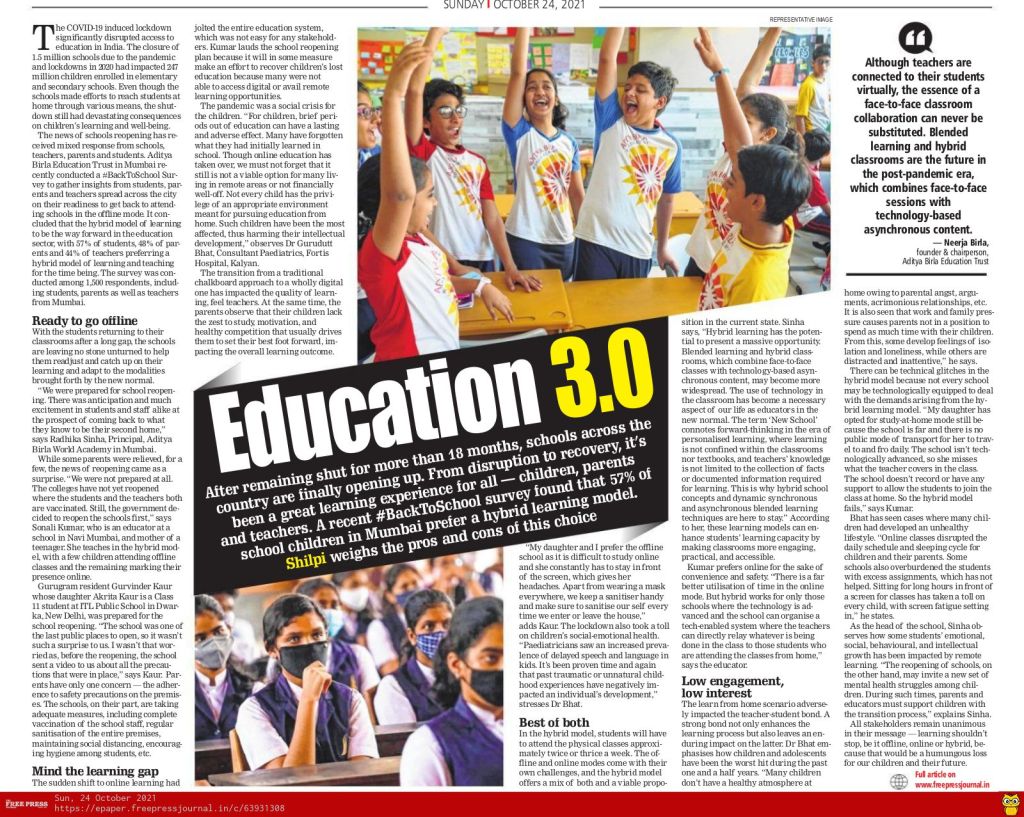
Education 3.0

https://www.freepressjournal.in/weekend/back-to-school-neither-offline-nor-online-because-education-30-is-all-about-hybrid-learning
The article was published in The Free Press Journal in its eduition dated October 24, 2021.

A Pillar of the Post

https://www.freepressjournal.in/weekend/india-post-undergoes-a-tech-tonic-makeover-to-match-the-pace-of-changing-times
The article was published in The Free Press Journal in the edition dated October 17, 2021.

During National Postal Week that concluded on October 16, I spoke to women working in the Mumbai Postal Region, at different levels of hierarchy, about what it means to be part of the world’s largest postal network.

On the occasion of National Mails Day on October 16, 2021, India Post, Mumbai Region, took a tech-tonic leap and launched a new mobile application, Know Your Postman. The mobile application is a brainchild of Swati Pandey, Postmaster-General (PMG) of Mumbai Region. The unique android application designed and created by Mumbai Postal Region will enable Mumbaikars to get the details of their beat postman when searched by locality, area, post office name and Pin Code; more than 86,000 localities of Mumbai city and suburb are readily available in the database. There are 89 delivery post offices in Mumbai city, around 2,000 postmen/women with mobile devices, and around 2 to 2.5 lakh accountable mails, which includes speed posts, registered posts, Aadhar cards, passports, etc. that are delivered every day.

“Know Your Postman is an initiative towards digitisation of the postal network that will enable the working population of Mumbai to directly communicate with their beat postman and facilitate delivery as per their convenience.”

Swati Pandey, Postmaster-General, Mumbai region

Earlier, the postal department was synonymous with letters, parcels, money orders, telegrams, etc. But today, India Post is much more than these, remaining relevant by adding a plethora of services under its wings. A significant part of it deals with financial inclusion vis-a-vis savings. For the unversed, the Post Office Savings Bank provides some of the best small scale savings schemes to individuals. India Post also delivers old-age pensions at customers’ doorsteps, does Aadhar enrolment and updation work in post offices, and has a formidable clientele on the Business Development wing. 

Besides these, the India Post Payment Bank instantly transfers money to any part of the country if the Aadhar card is linked with the customer’s bank account. “So, the bouquet of services that we provide in present days makes us completely relevant, and we are the leading organization in public service across the country,” says Pandey, adding how postmen and postwomen, who are the brand ambassadors of India Post, have undergone a major makeover in the present era and are matching the pace of changing times.

Being a postwoman

Postwoman Radhika Milind Parkar, 58, shares a deep bond with India Post. Parkar’s father was a postmaster, while his uncle and aunt served in the post office, so joining the postal network was the obvious choice. “I had joined as an Extra Department Stamp Vendor in 1982 at a salary of Rs 90. My first posting was at Malabar Hill Post Office. I have always felt at home in the Post Office,” she recounts.

Her salary had touched Rs 500 by the time she appeared for the Departmental Exam in 1990, cleared it and joined as a postwoman at Grant Road PO. “I was posted there till 2008, and have been at Mahim PO since then,” she says. A mother of two boys, one of whom is specially-abled, Parkar thanks her stars for bagging this job and staying put all through. She is one of the three postwomen at Mahim Bazar all-women Post Office.

The ratio of the postwoman to the postman in the country is approximately 10% to 15%, but change is round the corner. “Of late, I have seen that women are approaching this field with enthusiasm and sit for exams held by the department of post to become a postwoman, and that’s so heartening,” says Sub Postmaster Amrita Jogi of Mahim Bazar all-women Post Office.

Currently, women are manning nine post offices across Mumbai city and suburb. “Earlier, there were fewer postwomen, considering the outdoor mode of work that included door-to-door visits and long working hours. However, with time more and more women have started joining the service, and in present days the ratio has reduced,” says Pandey, Indian Postal Services officer and administrative head of 229 post offices across Mumbai city and suburb..

The face of India Post

Pandey was instrumental in launching the Smartest Postmen Campaign and Digital Identity of Postmen. Talking about the initiative, she observes how the image of the postmen/postwomen has undergone a tech-tonic shift over the years. “We visualize a postman as a lean, grey-moustached, old man delivering letters to us, but the real fact is that young, smart, tech-savvy cool gentlemen have long replaced that old, grey-moustached men with smartphones in bikes and two-wheelers delivering mails to us. Postmen and postwomen are the brand ambassadors of India Post who have undergone a major makeover in the present era. These two campaigns were initiated to change the viewpoint of people towards post offices and postmen,” she says.

The smartest postmen campaign awards the title to one postman and one postwoman from every post office in Mumbai city and suburb based on their smart approach, proper dress up and chutzpah, while the Digital Identity of Postmen is an effort to emphasise the digitalization of India Post, where you can scroll on the mobile application and get details of your beat postmen. “Both the initiatives are to change the face of postmen/postwomen before the public and make them feel better in look and smarter at work,” says the PMG.

The uniform is their prized possession. “The khaki salwar-kameez with the India Post logo is my identity. It gets me immense respect from people. I am familiar with the nook and corner of Mahim, and the people I have been serving are like my extended family members. A few of them even call me to check my well-being on the days when they don’t see me around in the area,” she says, beaming with pride talking about people in and around her service area, who are the biggest asset that she’s accumulated over the years. She starts the round at 10 am, goes door-to-door on foot, distributes mail, and trudges back to the post office by 3 pm, and calls it a day by 4 pm. “The goodwill earned by me is my actual gratuity. I will be able to live off that alone after I retire in another two years,” she adds.

Empowering women

Jogi, who had joined as Postal Assistant at Tulsiwadi PO in 1993, is today at the helm of affairs at the all-women Post Office in Mahim Bazar inaugurated on the eve of Republic Day last year. In all these years, she has seen India Post adapt to the changing times and adopt newer ways to serve the customers. “All postal business transactions are made available with proper display of services at Mahim Bazar PO. All types of saving bank services, Multipurpose Counter Machine services, India Post Payment Bank services, Common Service Centre services, Aadhar services, etc., are offered here and are provided by women staff only,” she says.

The response of the public is overwhelming, and Mahim Bazar PO sees a high footfall of women. “People appreciate our services a lot. It motivates us to work with more enthusiasm. Many customers are astonished to find that an all-women staff runs this office,” says Jogi. She attributes the smooth run to her colleagues at the PO, who leave no stone unturned, come what may. “The staff here is always on its toes. Despite facing a lot of pressure, they handle it patiently. The staff is efficient and adept at work, and that makes me so proud of all of them,” she states. 

The work that Parkar does as part of her job is the same as that for a man. “Work doesn’t differentiate between our genders, and even we don’t. We walk shoulder to shoulder and give each day our best, delivering letters and other items from door-to-door, day and night,” says the postwoman.

Rising to the occasion

During the pandemic, India Post played a vital role in delivering medicines to needy people, banking facilities, and even Aadhar services, apart from regular work. “When people were scared to step out of their homes, India Post took the initiative to provide essential items to the people, deliver PPE Kits to hospitals, etc. Also, we offered Aadhaar-related services to people as it was indispensable for COVID19 vaccination purposes,” says Jogi.

Pandey, who was instrumental in launching SOFT or Supporting Officials for Treatment during the pandemic, states, “Mumbai was the worst affected city during the first wave of COVID. Helplessly watching my team succumb to the deadly virus, depressed and agitated me. SOFT was the outcome of this emotional trauma. I formed a team of officers who would extend help from admission in hospitals to delivering medicines and groceries at the doorsteps of the COVID affected members of India Post, Mumbai Region.”

To build a proper communication chain, she coordinated with the local authorities, local hospitals, and nursing homes to make beds available immediately for the patients, 24×7. “We coordinated with the medical and grocery shops as well to readily provide service to my team members. SOFT was an immensely successful initiative that the Directorate later adopted as part of their HR policy,” adds Pandey.

Indian Postal Services Officer Swati Pandey, who happens to be the first officer of the India Post to win a National Film Award for her documentary on Netaji Subhas Chandra Bose, Elephants Do Remember. As a career bureaucrat and administrative head of 229 post offices across Mumbai city and suburb, Pandey no doubt has a tremendously hectic work schedule, yet the “keeda” of filmmaking keeps her on her toes. “Currently, I am working on a script that may take off in the middle of the coming year,” says the filmmaker bureaucrat. She started the Heritage Walk of Mumbai GPO in 2019, and authored a book titled Dawn under the Dome on the illustrious history of the Mumbai General Post Office with one of her staff members, Orchida Mukherjee.