क़लम मज़दूर | Commspreneur | Recipient of the IIMCAA Award for Public Relations Person of the Year 2024 | Canva's Top 10 Social Media Creator for 2023 | Work-in-Progress
View all posts by Shillpi A Singh →
Love is a mystery. Love is unitive. Love is how we connect as human beings with one another and with the whole universe together. Love is how we learn, become better, and make the world a better place to live for us and others. Love needs freedom to breathe, equality to thrive, and openness to flow and grow. Love is personal, political, philosophical, sexual, social, historical, metaphysical, transcendental, et al. Sadly, we have only one word to describe such a complex emotion. The ancient Greeks had six different words, but even that’s not enough. 2021 taught me new ways to describe the complexity of love and its various hues. Love lost on many counts, but it miraculously sprang on a few occasions like a phoenix. My LOVE vocabulary was defined and redefined by people who touched my life one way or another this year.
shillpi a singh
LOVE IS GIVING: The Gift
LOVE IS GIVING: The Gift
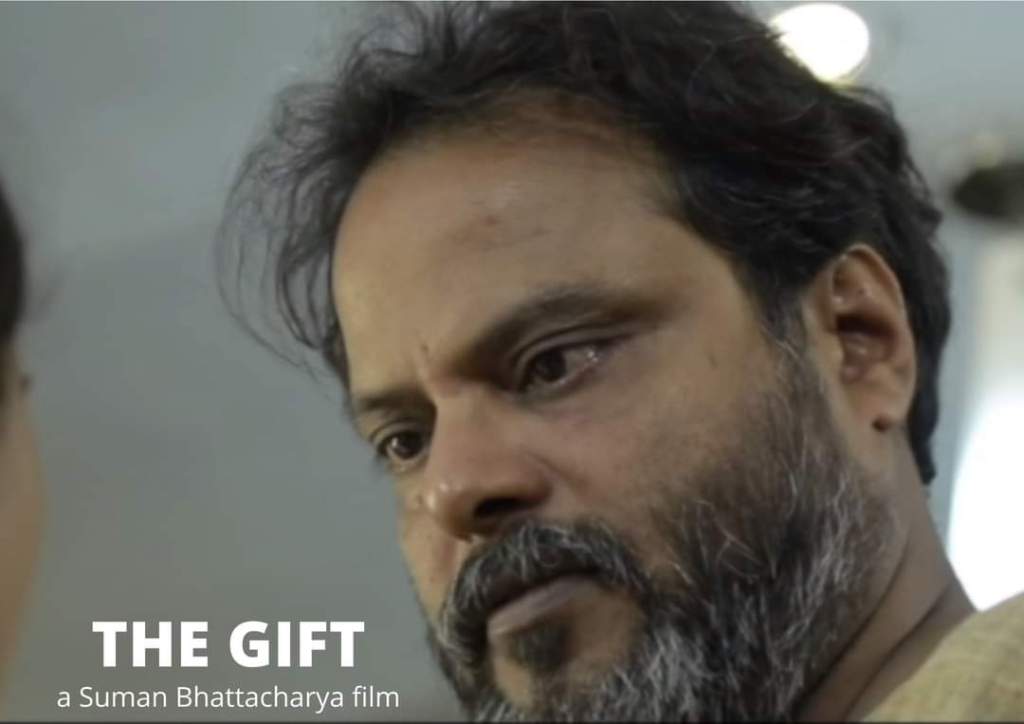
Producer-director Suman Bhattacharya’s debut movie, The Gift,is a short, simple and beautiful present. It has the quintessential O Henryesque flavour in its tone and tenor. Unlike a toffee or chocolate, The Giftdoes not come clothed in a fancy wrapper. Unlike other presents that give temporary contentment, this one is an emotion and provides deep satisfaction. The power of unconditional love. The power of selfless giving. The audience needs to peel off the various layers to see the real Gift here, and that’s a clever task by the debutant director.
The endearing film opens with the morning hustle-bustle of a busy metropolis, Kolkata. The city and its milieu, its daily grind, the mad rush to make a living, and in the process, forgetting how to live and choosing just to exist. That’s the bane of our being. The dull and insignificant events that happen in a day flow with clockwork precision but hardly matter to us in the larger scheme of things. They only make us more indifferent and disconnected from ourselves and each other. Nothing really tugs at one’s heartstrings. Nothing seems to matter anymore.
LOVE IS GIVING: The Gift
The camera takes us through the mundane life of urban residents until the day draws to an end, and a dog sleeping on the pavement conveys the subtlety of this profound statement. The subtle notes of the sitar playing in the background make the story’s plot music to one’s ears.
The narrator leads the audience into another day, but it comes covered in myriad human emotions that unfold, scene by scene, and by the end, the audience finally gets to unwrap the gift they had waited for all along. The ten something girl comes with her father to an upmarket bakery to buy a birthday cake but realises that these things are way beyond their means. Her father makes up for it, but without compromising on his self-respect. Just when we had lost everything that we thought there was to lose, and everything seemed dark and gloomy, the father-daughter duo came along and gave us something for free. It is the greatest gift one can ever give another person (here, the uber-rich woman who comes to the cafe and orders chicken quiche and hazelnut cappuccino, and also the audience), and that is one’s happiness. Remember the smiley chocolate? The girl gives it away, quite literally and also metaphorically.
LOVE IS GIVING: The Gift
The little girl’s generous heart is open. It is always ready to give even things that it can’t afford. She doesn’t belong but offers the most precious gift — the experience of knowing that we always belong, somewhere, somehow, and to people who are special.
The narrator’s takeaway is also ours — never mind those failures till yesterday because each new day is a sequel of a beautiful life; gifted with hopes to succeed. The movie starring Adrija Chakraborty, Jayati Chakraborty and Ashok Majumder is all about unconditional love and selfless giving. There is also a not-so-obvious reference to The Gift of the Magi’s magical sentence, “Of all who give and receive gifts, such as they are wisest. Everywhere they are wisest.”
LOVE IS GIVING: The Gift
Like O Henry’s heartwarming story, The Gift of the Magi, Suman’s short film The Gift brings joy all along, much more than the material value of the onscreen exchange, and that’s what is a priceless gift for the audience too. It is currently doing festival rounds and has had 18 screenings, seven awards and counting. The Gift’s next stop is the online International Kolkata Short Film Festival from January 22-29, 2022.
Gifts of the heart can’t be claimed by anyone except the giver.
Love is a mystery. Love is unitive. Love is how we connect as human beings with one another and with the whole universe together. Love is how we learn, become better, and make the world a better place to live for us and others. Love needs freedom to breathe, equality to thrive, and openness to flow and grow. Love is personal, political, philosophical, sexual, social, historical, metaphysical, transcendental, et al. Sadly, we have only one word to describe such a complex emotion. The ancient Greeks had six different words, but even that’s not enough. 2021 taught me new ways to describe the complexity of love and its various hues. Love lost on many counts, but it miraculously sprang on a few occasions like a phoenix. My LOVE vocabulary was defined and redefined by people who touched my life one way or another this year.
shillpi a singh
LOVE IS STORY: Jameel Gulrays
The human species thinks in metaphors and learns through stories, said American writer Mary Catherine Bateson, and Mumbai-based septuagenarian adman Jameel Gulrays couldn’t agree more with her. After spending more than five decades in the advertising world, working on popular brands, and teaching the nuances of this profession as a faculty member at leading institutions, Gulrays turned a new leaf and dedicated himself to work on his passion project – Katha Kathan. It was kindled by his earnest desire to preserve Urdu, and other Indian languages, promote and popularise them so that these aren’t reduced to mere dialects but live on to tell tales and regale the younger generations. He, along with his band of storytellers, has been pursuing the idea zealously since then.
Early years
He was born with a silver spoon to Abid Gulrays in Bombay (as Mumbai was known then) on November 5, 1949. His father was multitalented – satirist, poet, and columnist par excellence – who also wrote songs for Hindi films in the 40s and 50s. Reminiscing his lyricist father, he says, “Surajmukhi released in 1950 had two memorable songs – suniye huzoor husn ka charcha na kijiye and husn ka guroor hai ye buri baat hai. The latter sung by Lata Mangeshkar was a blazing hit.” His father has 20 songs and ghazals to his credit as a lyricist.
(from left to right) Abid Gulrays with Durga Khote, Ayaz Peerbhoy, and O.N. Verma, while recording a radio programme “Sanforized Ke Mehmaan”.
At one point time, Abid Sahab was also associated with the newspaper, Inquilab. His satirical poems titled Baatein were a popular feature of the newspaper. He wrote these poems daily under the pseudonym, Cigarette Baaz. He also wrote a column, Tazyane, and it was so popular among the readers that many of them bought the newspaper just to read his piece. He used the pseudonym Phool Phenk, which came from Gulraiz. He wrote many columns under different names. He moved on from Inqilab to edit Mosavvir following a tiff with the management at the newspaper. Babu Rao Patel owned the publication Mosavvir, a popular film magazine, and at one point in time, it was edited by none other than Saadat Hasan Manto.
A poster of film Surajmukhi.
“I still fondly remember what he told me in my growing-up years, though I lost him quite early on at eight, these lessons have become the guiding principles of my life. He used to tell me that ‘should anyone move one step towards you, you should take ten steps forward and meet him/ her. If someone takes one step away, you move 10 miles away’. He always urged me to do my job without expecting anything in return, as expectations always hurt. Another invaluable lesson was around money. It is inconsequential, so don’t give importance to it; it can’t buy happiness.”
But destiny had other plans. Gulrays’ father was fond of horse racing, and in one such race, he lost his entire fortune. He couldn’t cope with the humungous loss, and unable to bear it, he passed away soon after. It was the beginning of a long period of misery for the family. They were forced to move out of their plush bungalow in Mahim and settle in the predominantly Muslim locality, Bhendi Bazaar. The little boy was just eight then. Due to financial constraints, he was enrolled in an Urdu medium school – Bandra Urdu High School (now Bandra Urdu High School & Junior College Of Science, Commerce and MCVC). “In hindsight, I think, it was all a part of God’s plan. I loved reading Urdu and Persian literature during my early years in school and college, and these stories stayed on with me forever. Perhaps, I was destined to take on the arduous job of saving the language and its literature one day,” he says, with a deep sense of satisfaction.
The badge of his Bandra Urdu High School carried three words – Azm (determination), Koshish (efforts) and Imaandari (honesty) and these values have stood him in good stead all through.
Ad-ding on to life
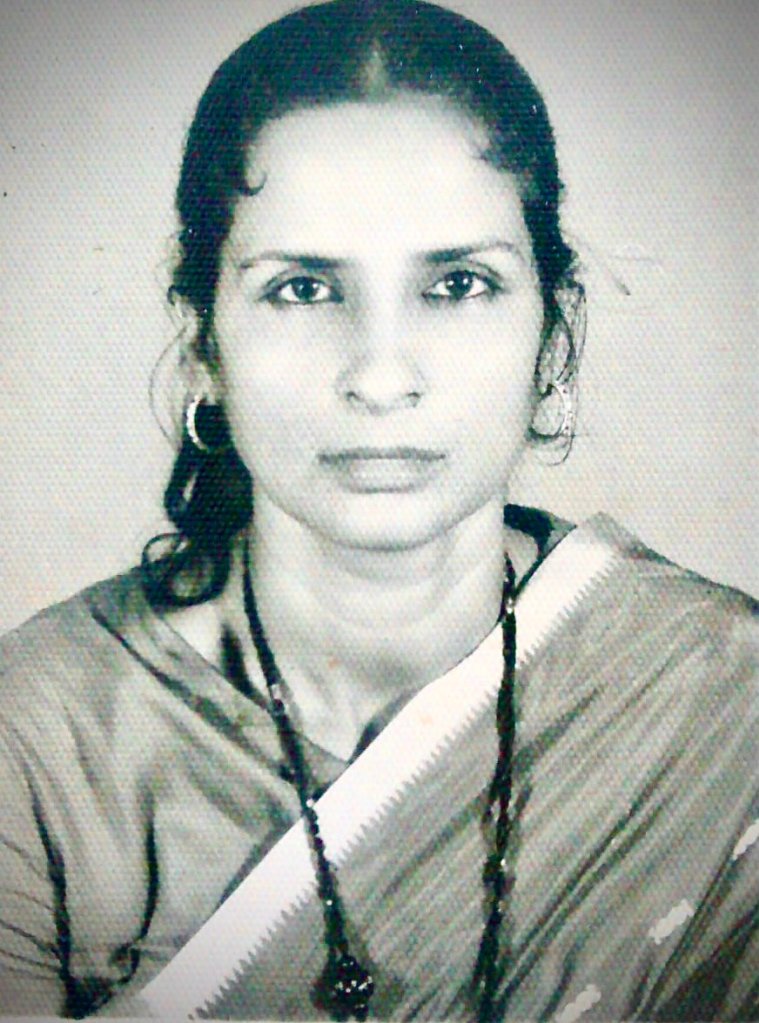
The loss of the breadwinner took a toll on his mother. She couldn’t live for long in penury, fell ill, and eventually passed away. “Her death shattered me completely as she was my biggest pillar of strength,” he says with moist eyes. His voice chokes on the mere mention of his parents, both of whom he lost early on in life.
Gulrays shared his mother’s photo on her birth anniversary on June 6. She passed away when he was 18.
He was eighteen and barely in the first year of college then, but he had to fend for himself and also look after his family that included two younger brothers. He desperately started looking for a job to make ends meet. Circumstances forced him to leave his place in Bhendi Bazaar and relocate to a far-off suburb Malvani. “The nearest station was Naigaon, and I had to walk for an hour to take a local train. It was an underdeveloped area then, and hardly any buses used to ply there. Come rain or hail, I had no choice but to keep marching on, both literally and metaphorically,” he says.
Advertising legend Ayaz Peerbhoy, who was his father’s friend, came forward to help and hired him for his agency. The remuneration was meagre, but it was something he badly needed, and he gladly took up this offer. In those days, the advertising world was dominated by English-speaking people, and anyone who didn’t know the language had little or no chance of survival. His ability not to give up came in handy and has stood him in good stead throughout. He not only learned English but mastered it. Later in his life, he set up an advertising agency and had the top-notch brand as his clients, and gave some memorable advertising campaigns in his five-decade-long career.
A new chapter
He is an avid reader, and loves to spend hours immersed in the world of words. The library at his house in Khar, Mumbai, has an enviable collection of Urdu literature. One day, while sitting in his room, immersed in one of Manto’s stories, it dawned upon him that after his demise, his treasure trove will be in a shambles. “A raddi wala (ragpicker) will come and collect these books and sell it to a kabadi wala (junk dealer), who will sell it to vendors. Manto will be served on a plate of bhelpuri, Chugtai will be wrapped in paan, and Krishan Chander will be wrapped on vada pavs,” he rued. The thought shook him no end, and he decided to tell those tales, some well-known, others not so known, and many of them unheard, unread, and unknown, for the benefit of the younger generation. His passion for preserving Urdu and other Indian languages and the earnest desire to promote and popularise them for the younger generation led him to pursue the idea zealously.
His undying love for stories that gave birth to Katha Kathan, a virtual repository of gems from Indian languages, relayed through his online social media channels on YouTube and Soundcloud – and relived through his offline storytelling sessions, a regular feature before the lockdown.
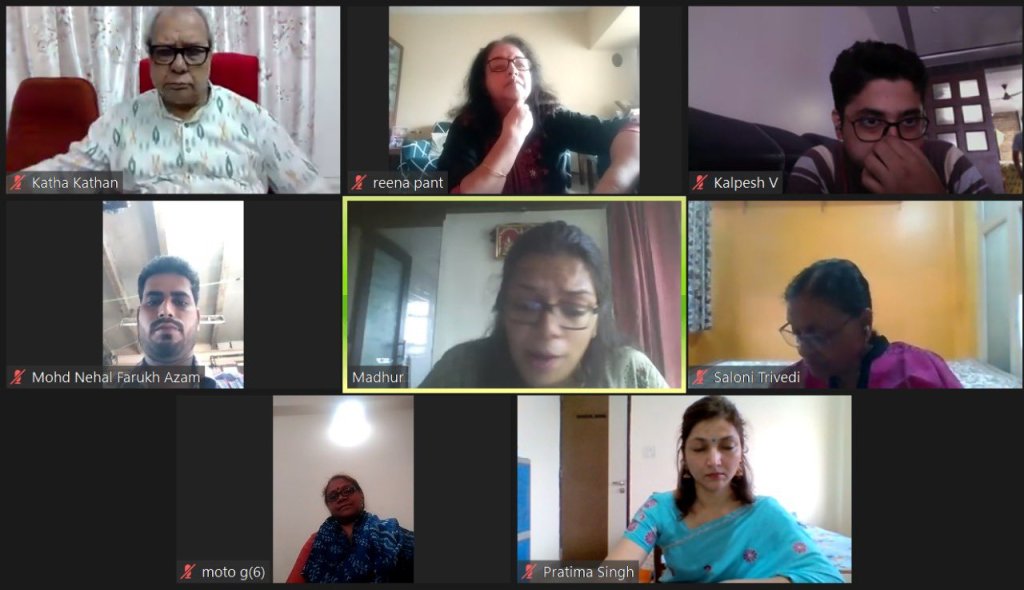
A virtual Baithak with Team Katha Kathan in progress.
To start with, he started recording masterpieces from Urdu literature and releasing them on his YouTube channel. “One day, people might not be able to read these tales as they would no longer know the script. If these pieces are recorded and preserved, they would still be able to listen to them, whenever and wherever, and this, in a way, will preserve the treasure trove of stories for posterity,” he recounts. Initially, Gulrays thought of focussing only on Urdu literature, but once he exchanged the idea with others, he realised that the fate of other Indian languages is no different, so he widened his scope and included other “gems” of Indian literature, and featured stories in vernacular languages too.
Katha Kathan was started in 2015, and to date, he has recorded more than two thousand stories for his online platforms. It is a passion project funded by his selfless desire, and in all these six years, he has made humungous investments in terms of his money, time and energy, without taking a penny from any outsider. The growth and reach of the Katha Kathan project are purely organic, be it the views or the subscribers. The numbers only show the depth of his involvement and the widespread reach of his movement to keep Urdu and other Indian languages alive.
Praiseworthy efforts
His honest endeavours have been suitably rewarded, and the former adman is now known as a connoisseur of the Urdu language, and his quintessential storytelling has won him many ardent fans and followers, and they range from celebrities to ordinary people. His popularity cuts across geographical, social, and linguistic barriers. People across the globe closely follow his work. Renowned actor Naseeruddin Shah has joined hands with him and is a regular in all Katha Kathan events. It is their shared love for Urdu that has kindled their camaraderie and friendship.
Jameel Gulrays and actor Naseeruddin Shah pose against the Wall of Fame featuring literary giants from Urdu and other Indian languages. “Our relationship is based on mutual respect for each other’s work,” he says.
Sharing an anecdote, he says, “It so happened that I was recording Ismat Apa’s stories and releasing them on my YouTube channel, one after the other. I noticed that someone called Naseeruddin Shah would invariably comment and praise my work on these uploads. At first, I thought this must be some imposter. Why would someone of Naseeruddin Shah’s stature stop by at my YouTube channel, appreciate my work and care to comment? I wondered.” After the fifth story, he received a message that he (Naseeruddin) is coming to Delhi and would like to meet Gulrays. The actor thought that Gulrays is Delhi-based. Gulrays informed him that he lives in Mumbai, and they met, discussed the stories; Shah staged those as “Aurat, Aurat, Aurat,” and it was well-received by the audience. The actor, in his magnanimity, mentioned Gulrays’ name and his contribution in every interview that he gave after his play’s astounding success. “I sometimes wonder how come a genuine soul like him still exists in this world. He never declined his invite to any Katha Kathan show,” he says. Today, the actor is relearning Urdu, and calls Gulrays whenever he comes across a difficult word or sentence. Their relationship is based on mutual respect for each other’s work. “I have also benefited immensely from this partnership, and Naseeruddin Shah has always obliged my request for the interviews. Karwan-e-Mohabbat, with which I am associated, has gained a lot from these interviews,” he says.
Minding the language
These days, filmmaker Vishal Bharadwaj and his singer wife Rekha Bharadwaj are taking lessons in Ghalib from the connoisseur of the Urdu language. “There are two interesting anecdotes about Ghalib. One is that “if it wasn’t for many of Ghalib’s “shrah” (explanation of Ghalib by many scholars), he would have been very easy to understand. And the second one is that Ghalib is perhaps the only poet in the world whose work, if you can’t decipher, gives you double the pleasure,” says Gulrays. He thinks that if one has to understand Ghalib, one has to view his poetry through the prism of mysticism. “Ghalib himself declares in one of his couplets that he would have been considered a “Sufi” if it wasn’t for his drinking habits. Jameel insists that any effort to understand Ghalib must be made in this direction if we truly want to decipher his work,” he adds. One of his explanations has impressed Gulzar so much that he has expressed his desire to meet him.
Katha Kathan celebrates the works of Rabindranath Tagore, Premchand, Sahir Ludhianvi, Krishen Chander, Ismat Chugtai, and many others, but the celebrated and controversial writer Manto remains Gulrays’ all-time favorite. “Manto continues to be misunderstood despite finding new admirers decades after his death because most people haven’t really read his work in totality. They read six or eight of his stories and dub him an obscene or a dark writer. He is neither, and there is a lot of it that needs to be explored to understand Manto’s body of work better,” he adds.
Jameel Gulrays is not just an individual but an institution.
Taking a walk down the memory lane, he recounts how his childhood home – his lavish bungalow in Mahim – had a portion of it rented out to Shyam, a popular actor in those days, by his father to tide over the financial crunch. Shyam and Manto were best of friends, and Manto often dropped in to see Shyam. It seems like a connection established by the umbilical cord, and Gulrays holds the prolific writer in high regard. “Why Manto decided to migrate to Pakistan is a question still debated by many. He was miserable there, as some of his letters reveal. Perhaps, he took that decision because of an incident involving his friend Shyam. Riots had hit both sides of the border. Shyam had some relatives in Lahore, and he was anxious about their safety and wellbeing in such troubled times. One day, news came that one of them had been killed, and in an inebriated state, he told Manto that he could kill him one of these days. Regaining his sobriety, he apologised, but Manto was so shaken up that he decided to leave India. The interesting bit is Shyam went to see him off at the dock, where they drank together for the last time,” recounts Gulrays.
Lifelong mission
Now, in his twilight days, Gulrays could ill afford to bask in the glory days and live off comfortably. Not someone to sit on his laurels, he has been working for the Indian languages and literature because, as he says, “Languages are our homes, and we must protect them.”
He rues how the millennials are losing touch with their mother tongue. “If they don’t prefer to communicate in their mother tongue, eventually they would lose touch and forget to read and write in that language. Once that happens, it would spell the death knell for these languages,” says Gulrays, explaining the real reason behind his passion project – the need to preserve these languages so that they don’t up remain a dialect for future generations.
To listen to stories, follow Jameel Gulrays on YouTube and Soundcloud.
Gulrays is not just an individual but an institution. So many people claim to love Urdu, but there is no one like him. He remains one among the few sincere and selfless soldiers of the language who has been single-handedly working on this mission, regardless of the bouquet or brickbats that could come his way.
A Baithak of Katha Kathan is a must on the first Saturday of every month. During the pandemic, it has moved to a virtual platform. Earlier, it was held at his home, where stories flowed along with a generous helping of snacks and beverages. These days, he has started using Clubhouse to his advantage and hosts a dramatised storytelling session with Katha Kathan Team at 10.30 pm every Sunday. These virtual sessions see story lovers from across the world in attendance.
Katha Kathan’s Jashn-e-Manto featuring actor Naseeruddin Shah.
Bushra Rahman, an eminent Urdu novelist across the border, once sent a message praising his style. Shah, when asked, ‘why we don’t a Zia Mohyeddin here?’ had once famously quipped, “You haven’t heard of Jameel Gulrays.” Shah’s statement sums up the sentiments of his ardent admirers, who come from across the world, belong to different age groups, and speak different languages. The common thread binding them all is their love for stories in Urdu and other Indian languages. And the tribe is growing every day.
Team Katha Kathan with Jameel Gulrays.
A devoted Urdu lover, he has a team of young volunteers growing under his tutelage at Katha Kathan to keep the love for languages and stories alight. He quotes a couplet of Majrooh Sultanpuri in the parting, and that succinctly sums up his illustrious journey.
The power of a glance has been so much abused in love stories, that it has come to be disbelieved in. Few people dare now to say that two beings have fallen in love because they have looked at each other. Yet it is in this way that love begins, and in this way only.
Love is a mystery. Love is unitive. Love is how we connect as human beings with one another and with the whole universe together. Love is how we learn, become better, and make the world a better place to live for us and others. Love needs freedom to breathe, equality to thrive, and openness to flow and grow. Love is personal, political, philosophical, sexual, social, historical, metaphysical, transcendental, et al. Sadly, we have only one word to describe such a complex emotion. The ancient Greeks had six different words, but even that’s not enough. 2021 taught me new ways to describe the complexity of love and its various hues. Love lost on many counts, but it miraculously sprang on a few occasions like a phoenix. My LOVE vocabulary was defined and redefined by people who touched my life one way or another this year.
SHILLPI A SINGH
LOVE IS FAITH: Khrienuo Angami & Akshat Sharma
Kohima girl Khrienuo Angami met Dehradun boy Akshat Sharma at the Naga Students Union Sports Meet at Delhi University’s Hindu College in 2003. “It was a chance meeting for a fleeting moment that was destined to bring two people hailing from different faiths and different states together for a lifetime. There were hiccups, a lot of them, but Que Sera Sera,” recounts Angami with a chuckle.
LOVE IS FAITH: Khrienuo Angami & Akshat Sharma
While Sharma moved to XLRI, Jamshedpur, to pursue MBA, Angami went to Jawaharlal Nehru University for her M.Phil. Angami and Sharma identified each other more with the friend tag, but Cupid had struck them no matter how hard they tried, and they had been swept off their feet. “We started dating each other only in 2007 and informed our respective parents about our plans to get hitched. Well, but it was easier said than done. The opposition was vehement,” says Angami, a Protestant Christian from the Scheduled Tribes in Nagaland, while Sharma is a Brahmin from Uttarakhand.
The family dynamics also played a significant role in paving the way for acceptance. Angami’s three younger brothers rallied around her. They championed the cause of intercaste, interfaith union with all their might, even as her parents and younger sisters chose to oppose the alliance, tooth and nail; they stopped all communication for a year. Being the only child worked in Sharma’s favour, and his parents gave in easily because “his happiness mattered the most to them.” Sharma visited Angami’s folks in Nagaland and tried to win them over to break the ice. He succeeded, and two rounds of talks between their parents over the wedding rituals to be followed happened in Delhi in 2011. “I have four younger siblings, and my parents were worried that I would be ex-communicated from the church if I marry a Hindu. The news would be a big disgrace to the family back in Nagaland. He somehow agreed, but it wasn’t easy to win him over,” recalls Angami.
LOVE IS FAITH: Khrienuo Angami & Akshat Sharma
The couple got married twice – one according to elaborate Hindu rituals and the other under the Special Marriage Act in 2012. Today, their two children follow both religions, and festivals for the Angami-Sharma household are all about fun and food. It’s their faith in love and humanity that keeps them afloat.
Faith makes all things possible… love makes all things easy.
Love is a mystery. Love is unitive. Love is how we connect as human beings with one another and with the whole universe together. Love is how we learn, become better, and make the world a better place to live for us and others. Love needs freedom to breathe, equality to thrive, and openness to flow and grow. Love is personal, political, philosophical, sexual, social, historical, metaphysical, transcendental, et al. Sadly, we have only one word to describe such a complex emotion. The ancient Greeks had six different words, but even that’s not enough. 2021 taught me new ways to describe the complexity of love and its various hues. Love lost on many counts, but it miraculously sprang on a few occasions like a phoenix. My LOVE vocabulary was defined and redefined by people who touched my life one way or another this year.
shillpi a singh
LOVE IS FOOD FOR THE SOUL: Farmers and Agripreneurs
“Why do farmers farm, given their economic adversities on top of the many frustrations and difficulties normal to farming? And always the answer is: Love. They must do it for love. Farmers farm for the love of farming. They love to watch and nurture the growth of plants. They love to live in the presence of animals. They love to work outdoors. They love the weather, maybe even when it is making them miserable. They love to live where they work and to work where they live. If the scale of their farming is small enough, they like to work in the company of their children and with the help of their children. They love the measure of independence that farm life can still provide,” said Wendell Berry.
Retracing actor extraordinaire Manoj Bajpayee’s brand endorsements in 2021 makes one marvel at the ingenuity of his choices. He endorsed products and services that matter to an ordinary person, be it home, finance, farm, food, and rightly so. “I was born and brought up in a village, and I have always flaunted being a farmer’s son with immense pride. It is the core of my being, my work and how I choose to do what I do,” he says. A proud farmer’s son, he endorsed Krish-e App by Mahindra because the product reflects his identity, and he could relate to it. “Moreso, because I find technology a great enabler, and Krish-e has leveraged it to its advantage to help farmers reduce costs, increase productivity, and ultimately farmers’ income,” says the actor, who won the National Award for his searing performance in Devashish Makhija’s Bhonsle this year. With his endorsement, Bajpayee set the tone for the changing narrative in the agriculture sector that’s gravitating towards tech and seeing the active participation of young agripreneurs.
IT professional Muhaimin Sheik decoded the perfect work-from-home balance during the lockdown, much to his delight. A native of Ramanathapuram, Pottagavayal village in Tamil Nadu, Sheik returned home to be with his family during the pandemic last year and has stayed in the village ever since then. Hailing from a family of farmers, he wasn’t as deeply involved in the process as he is now, and the WFH, in a way, helped him reconnect with his roots. “I spend five days coding and two days farming. I start my weekdays with a stroll down the farm before logging in for work. One day someone asked me, ‘You are educated and working with a software firm, so why do you want to do this? The company pays you well, right?’ I replied, ‘Yes, it does, but I can’t eat the money. I can eat rice only’,” says Sheik.
A native of Ramanathapuram, Pottagavayal village in Tamil Nadu, IT professional Muhaimin Sheik at his farm.
CEO of Athvas Horti Fed Producer Company Ltd Asiya Nazir from Kupwara in Kashmir runs a farmer producer organisation and sells to wholesale and retail buyers on a tech-enabled Harvesting Farmers Network (HFN) platform. “I sell walnut, almonds, apple jam, honey and saffron on HFN mobile app directly to buyers across India. The tech-enabled market linkage is a massive relief for farmers like me,” says Nazir.
FPO from Kupwara Kashmir leveraging #HFN to sell their produce like walnut, almonds, honey, etc directly to buyers across India pic.twitter.com/16ilTx3ihT
CEO of Athvas Horti Fed Producer Company Ltd Asiya Nazir from Kupwara in Kashmir
On the other hand, Raghu Dharanipathi of Kapila Agrofarms in Siddipet, Telangana, has benefitted tremendously by feeding corn silage (Cornvita by SAGO) to his cattle for the last three years. “Sago has been one of the best both in terms of quality of the product and customer service. Milk production of our dairy cattle consistently improved by 10-15% in the last three years,” says Dharanipathi.
The story of Ajit Sorate,a large farmland owner from Baramati, Maharashtra, who faced challenges due to a lack of knowledge about the advanced implements available in the market, is no different. Thanks to Krish-e advisory, his plantation costs have been drastically reduced. Earlier, Sorate used to utilise 16 acres for sugarcane and 12 acres for maize cultivation. This year, after registering on the Krish-e app, he has planted sugarcane, from which he expects over 35% more output. “Krish-e app comes with Mahindra’s promise and has a smooth functioning where I can avail proper advice on soil testing, primary tillage and intercropping to help in scientific mapping of the crop,” he says.
Back story
Krish-e is a new business vertical from Mahindra Group that provides technology-driven services that are progressive, affordable, and accessible to farmers. “We launched Krish-e and Nidaan apps in October 2021, keeping in mind the ever-evolving needs of the modern farmers. These apps leverage a combination of agronomy, data and farming expertise to improve farmer’s income per acre,” says Hemant Sikka, President, Farm Equipment Sector, Mahindra & Mahindra Ltd.
HFN founder Ruchit Garg, who launched a mobile app in November 2021, had been actively helping smallholders’ farmers from across the country market and sell their harvest through a dedicated Twitter page during the first wave of COVID19. Farmers used to message crop details to him, and he used to broadcast those details on Twitter, and the farmers’ produce used to find buyers in no time. Buoyed by the consumer response, he decided to have a dedicated mobile app for farmers. “HFN Kisan mobile app is world’s only mobile app which provides full-stack services to not only farmers in horticulture, but also to farmers involved in fishery, poultry and livestock,” says Garg.
Hyderabad-based agri-tech startup SAGO Speciality Feeds was started by three passionate agripreneurs — former NABARD employee Chandrasekhar Singh, his nephew Saikiran and son Anurag — in 2019. At SAGO, they have deployed fermentation biology to develop and manufacture silage from corn crops and use microbial inoculants for making silage. The technology helps produce high-quality feed for cattle and enables efficient year-long storage of green fodder. “Silage is a highly nutritious and balanced feed for cattle, sheep and other ruminants, and it can also be used as a biofuel feedstock for anaerobic digesters. It doesn’t contain any synthetic additives or chemicals. Silage also helps reduce the volume of feed as it is highly compressed, thereby decreasing the overall cost and meeting the nutritional requirement,” says Singh.
Agri-tech startup SAGO Speciality Feeds was started by three passionate agripreneurs — former NABARD employee Chandrasekhar Singh, his nephew Saikiran and son Anurag — in 2019.
Growth in numbers
The numbers are promising, and best elucidate the success story. Garg recounts how the app helped a Bangalore farmer sell 20,000 kg of grapes in just three days and how a farmer from Bihar got a weekly brinjal subscription from a nearby hotel by using the app. “We have at least one farmer from each Indian state/UT on our platform,” he adds with pride.
Ruchit Garg, founder of HFN Mandi and HFN mobile app.
The high-quality corn silage is produced at SAGO’s plant in Banswara, Rajasthan. “More than 1,200 farmers produce corn crop for us annually. Over 230 dairy farms, involving over 12,000 dairy cattle, are fed with our corn silage annually. Sago has created an efficient and sustainable agricultural production ecosystem covering Gujarat, Rajasthan, and Telangana and significantly improved the livelihood of the farming community involved,” elucidates Singh.
The Krish-e and Nidaan apps have received more than six lakh downloads. With an omnichannel approach, Krish-e is has been able to make a considerable difference to farming outcomes. “Through Krish-e, Mahindra is creating a nation of ‘Champion Farmers’. To date, Krish-e has increased the yield of farmers by up to Rs 15,000, brought down the cost of farming by about 8-12% and increased profit by up to Rs 6000 per acre. It reflects the passion of those progressive farmers who have adopted new practices to improve their outcomes,” adds Sikka.
Plans in the offing
SAGO plans to expand into other speciality feeds for animals such as Aflatoxin free corn for pet feed and Quality Protein Maize for poultry feed. “These are a couple of products in the pipeline to be launched in the next two years. We are preparing to foray into the value-added food sector, focused on Functional Foods,” says Singh.
Mahindra Group’s biannual event – Krish-e Champion Awards – is aligned with the Kharif and Rabi seasons. These Awards recognise and felicitate farmers and institutions, who have risen above the ordinary, by thinking innovatively and driving a positive change in agriculture. “Through the Krish-e Champion Awards, we aim to inspire millions of farmers and agripreneurs to build a promising future for the country. These Awards celebrate the progress of these farmers who took this first and very important step with us,” emphasises Sikka.
Like most other fields, technology in agriculture is a must, believes Garg, adding that it impacts every aspect of agriculture, from seed to market. “Agriculture requires a mix of digital and physical approaches for building a scalable and sustainable business model,” says Garg, who is planning to launch a network of brick-and-mortar HFN Kisan Centers. “These will be farmer-owned and operated. We plan to open 17,000 such centres across India,” he adds.
Young farmer Sheik sums up the tenacious spirit of others of his ilk and states, “There are many ways to earn money, but there is only one way to earn food, and that’s through agriculture.” True that! We owe a lot to the farmers. It is about time we realise it too.
Love is a mystery. Love is unitive. Love is how we connect as human beings with one another and with the whole universe together. Love is how we learn, become better, and make the world a better place to live for us and others. Love needs freedom to breathe, equality to thrive, and openness to flow and grow. Love is personal, political, philosophical, sexual, social, historical, metaphysical, transcendental, et al. Sadly, we have only one word to describe such a complex emotion. The ancient Greeks had six different words, but even that’s not enough. 2021 taught me new ways to describe the complexity of love and its various hues. Love lost on many counts, but it miraculously sprang on a few occasions like a phoenix. My LOVE vocabulary was defined and redefined by people who touched my life one way or another this year.
shillpi a singh
LOVE IS PROMISE: Jaspreet Chandhok
Jaspreet Chandhok is an architect by education who runs one of India’s leading lighting design firms, Ethereal Designs in Delhi & Mumbai, and is a happy mother-in-waiting. “Motherhood was always on my mind, but adoption has been my only choice,” says Chandhok.
LOVE IS PROMISE: Jaspreet Chandhok, a mother-in-waiting.
She got married at 35 and conceived at 36. The first trimester was tough for her. “I had frequent nausea, severe acidity, lethargy, throwing up at any strong smell or taste to the extent I couldn’t even brush my teeth daily for fear of vomiting. As the first trimester completed, I suffered a miscarriage. It was traumatic. The idea repulsed us, and we were afraid of going through the same rigmarole again. To add to it, my husband was facing a challenging medical situation too,” reminisces Chandhok.
At 40, she wanted to be a mother badly but chose to miss the biological route. “Adoption seemed to be the most promising and empowering means of bringing a child into our lives. We registered in the Central Adoption Resource Authority (CARA) in August 2020. Our seniority on the waiting list of prospective adoptive parents in Delhi was 1421 in September 2020; Currently, we are 1014th, which could mean another 18 to 20 months of waiting time,” adds Chandhok.
Once she and her husband registered for CARA, they have been pretty firm on their decision throughout. “We not only preferred to go for closed adoption only though CARA because we feel it fulfils the mutual need of the child and the couple,” says the mother, who is happily waiting to bring her bundle of joy home, one day soon. It is a long and arduous wait.
Less than 30% of prospective parents registered at CARA before the Chandhoks have brought their child home in the last 16 months. The maths is simple: 16 months for 400. At this rate, the total wait for the Chandhok couple seems longer than three years. The number on the waiting list seems more gruelling and taxing than even the toughest All-India competition’s list of rank holders. They stand 1014 on Delhi’s waiting list, 1408 on Maharashtra and 892 in Punjab as on December 18, 2021.
Meanwhile, a group of 350 (the number is growing every day) prospective adoptive parents (registered with CARA) like her formed ‘Adoption Action Group’ four months ago and have been trying various means to bring about awareness and request the Ministry of Women and Child to streamline, improve and make the adoption process faster.
“I also coordinate some activities of the group including the Twitter campaign, and I ardently keep tweeting on some days. It worries my close ones. They get the impression that I’m suffering while waiting, so I’m doing it. But I don’t do it out of frustration or desperation. I do it as a process of motherhood. I might not be carrying that unknown child in my womb and watching it grow inside me, but I have been feeling similar excitement as any other biological mother. My motherhood journey is different but yet similar to any other mother,” says Chandhok.
As a mother-in-waiting, she signs off saying the most profound words in favour of her decision to adopt and not give birth: “Yes, the child we will bring home won’t have our bloodline, our looks or genes, but we are not running a kingdom anyway; there is no royal blood legacy that we are aware of and something that we must take forward through our progeny. Our love is our legacy. We are eagerly looking forward to our child, who shall belong to our own ‘Loveline’ not ‘bloodline’.” That’s an unsaid PROMISE she’s made to her unknown CHILD, and with LOVE.
Love is a mystery. Love is unitive. Love is how we connect as human beings with one another and with the whole universe together. Love is how we learn, become better, and make the world a better place to live for us and others. Love needs freedom to breathe, equality to thrive, and openness to flow and grow. Love is personal, political, philosophical, sexual, social, historical, metaphysical, transcendental, et al. Sadly, we have only one word to describe such a complex emotion. The ancient Greeks had six different words, but even that’s not enough. 2021 taught me new ways to describe the complexity of love and its various hues. Love lost on many counts, but it miraculously sprang on a few occasions like a phoenix. My LOVE vocabulary was defined and redefined by people who touched my life one way or another this year.
SHILLPI A SINGH
LOVE IS EQUALITY: Tribe of Penguin Dads
Penguin dads are redefining the rules of parenthood by ‘mothering’ their children. Meet the waddle, who are busting the pre-defined and gender-dictated notions and social norms and taking up daddy duties, and for good.
Bengaluru-based IT professionals Abhinav Sitesh and his wife Natasha welcomed twin girls – Abhisha and Naysha – into their lives in December 2016. The couple’s joys were doubled, and so were the duties and responsibilities that came along in their new role. “Natasha’s post-delivery complications had left her bedridden. We had no family support around, so I was on double duty. I had to take care of the little ones’ feeding, bathing, massaging, cleaning poop, pee, and puke, plus putting them to sleep. With two of them, it was around the clock job, from then to now, and to add to my woes was my work-from-home arrangement for an important office assignment,” recalls Sitesh, who had to give paternity leave a miss to do the due as a ‘working father’. He has since then chosen to WFH and is one of the many young fathers, who are happy to be on daddy duty 24×7 and find the newfound role to be far more enjoyable and satisfying. “When one of my children was diagnosed with autism, I knew that here on, I will have far more responsibilities to shoulder. A lot more interventions are required at my end to ease it out for them,” he says. The couple relocated to Lucknow from Bengaluru in March this year so that his children could be around their grandparents, relatives and other extended family members.
LOVE IS EQUALITY: Abhinav Sitesh with his twins.
Parenting as a joint venture
In a traditional setup, the onus often falls on a mother to raise the child, and she eventually becomes the sole nurturer, while the father’s role is to earn, and he is considered more of a provider. Delhi-based sports journalist Nishant Singh, who is married to news anchor and correspondent Rajani Sen, belongs to the new creed of fathers and is happy to ‘mother’ his two boys, Adamya and Sahishnu. “The societal norms are changing, and our generation is making necessary contributions by shattering the stereotyped, gender-defined roles at home and outside. What a mother does, a father can do too, and a couple is in this parenting business together, isn’t it?” asks Singh. As a father, he is quite hands-on in raising his children and loves to do it all, be it helping with their studies, taking them out to play games or participating in extracurricular activities. As his wife recounts, “Adamya had to wear a rainbow-themed shirt to school, and she was in office in the evening shift, and by the time she came home, Nishant had used his creativity to colour a white shirt and keep it ready for his school.”
LOVE IS EQUALITY: Rajani and Nishant with their children.
Parenting coach and author of a parenting book ParenTeen Prakriti Prasad agrees with Singh on the shared responsibilities while raising a child. “Conceiving a child is a joint endeavour of both parents. I don’t see why and how nurturing that infant, toddler, adolescent or even a young adult became the sole responsibility of the mother with the father acting as a mere spectator, supervisor or sometimes a visiting faculty, with minimal involvement in parenting,” she says.
Starting point
A father playing an active role in raising his children becomes a talking point because it has been an exception and not a rule. As a father of seven-year-old Sadgi, author and columnist Pankaj Ramendu, who chose to stay at home to take care of her since her birth, while his wife Kalpana pursued her career ambitions, rues, “Why do people find it unusual? It is because our previous generations have been raising children with a set mindset. We have never questioned the existing gender roles in our society because we have been conditioned to accept it as a norm.”
LOVE IS EQUALITY: Pankaj Ramendu with his daughter Sadgi.
Contextualising the parenting dynamics, Prasad adds, “Indian dads have traditionally just been onlookers of their newborns or enforcers of discipline in their growing up years. It’s both heartening and relieving to see this burgeoning trend of hands-on dads, what you call ‘penguin dads’ now in India too. Millennial fathers are taking paternity leave not just to revel in the birth of their child but chipping in with staying up the nights, changing diapers or bathing and feeding their infants.”
Ramendu believes that a man has never been taught to shoulder this responsibility and participate in a child’s upbringing because this idea has been perpetuated to suit the patriarchal setup. “It is all about gender equality, something which has been an oft-neglected issue. Motherhood is an emotion and not a gender-specific category to bracket a parent. A father can have the same emotions and fit in the role of a mother well if given a chance,” he says.
Changing the rules
Bengaluru-based Prithvi Ramachandran has dabbled in many trades, most notably being the Bengaluru casting director for the Oscar-winning Ang Lee film, Life of Pi, but one role that he is content with the most is the role of a do-it-all dad for his two boys – Mir and Arya. “I have been a stay-at-home dad since my elder son was born, although the terminology might be disputed since the pandemic began and everyone else also began to stay at home! My wife Ruhi works full time and has had a demanding career for over 25 years,” says Ramachandran, who decided to take an active role in children’s upbringing. He takes care of school drops/pickups, organizing playdates, and cooking/ensuring healthy meals and snacks, and the couple takes turns reading stories to kids at bedtime.
A father doing it all for his children, more than the mother, makes his role conspicuous to others, and there is a fair share of challenges all through. “However, much I’ve had to swallow my ego and deal with disapproving looks, snide comments from friends and relatives, and a general giving up of power, I feel blessed that I have been able to spend so much time with my children and dogs. Having children, watching them grow and experiencing with them the joys of the simple things in life helped me realize what life is truly about,” says Ramachandran.
It is a win-win situation for all three parties – the mother, the father and the kid. While the overworked mom gets a breather, dad his share of unique bonding and the kid thrives in an atmosphere of love and attention. “These children are bound to share a much deeper bond with their fathers. Besides, I think this will also reverse the archaic gender perceptions about fathers being the breadwinners while mothers being the nurturers, something we’ve unwittingly been passing on to our children,” advises Prasad.
Two-gether is the way
The tribe of penguin dads is growing because these men want to reverse the outdated concept of bracketing a mother as a nurturer and a father as a provider because these gender-defined roles have blurred. Sitesh fondly remembers how his equation with Abhisha and Naysha is in complete contrast to what he shared with his dad. “I like it this way – open, warm and affable,” he says. Like Ramendu, Ramachandran too believes in gender agnostic parenting and says, “Men being involved in the raising their children is the way it ought to be. It is challenging enough to leave it to just one person. As the saying goes, it takes a village, and all that.. the more hands, the better.”
But Prasad is amazed and also amused to see only mothers flocking parenting workshops and sessions. She encourages both parents to attend such sessions or their children’s PTMs or school events to keep parenting even-keeled. “It goes a long way in boosting the child’s confidence and self-worth besides strengthening their bond. When both parents work as a team to bring up their children, the child grows upon the firm foundations of love, understanding and belief in each other. Such children grow up to display positive traits,” she reasons.
Love is a mystery. Love is unitive. Love is how we connect as human beings with one another and with the whole universe together. Love is how we learn, become better, and make the world a better place to live for us and others. Love needs freedom to breathe, equality to thrive, and openness to flow and grow. Love is personal, political, philosophical, sexual, social, historical, metaphysical, transcendental, et al. Sadly, we have only one word to describe such a complex emotion. The ancient Greeks had six different words, but even that’s not enough. 2021 taught me new ways to describe the complexity of love and its various hues. Love lost on many counts, but it miraculously sprang on a few occasions like a phoenix. My LOVE vocabulary was defined and redefined by people who touched my life one way or another this year.
shillpi a singh
LOVE IS DIVERSITY: Kalki Subramaniam
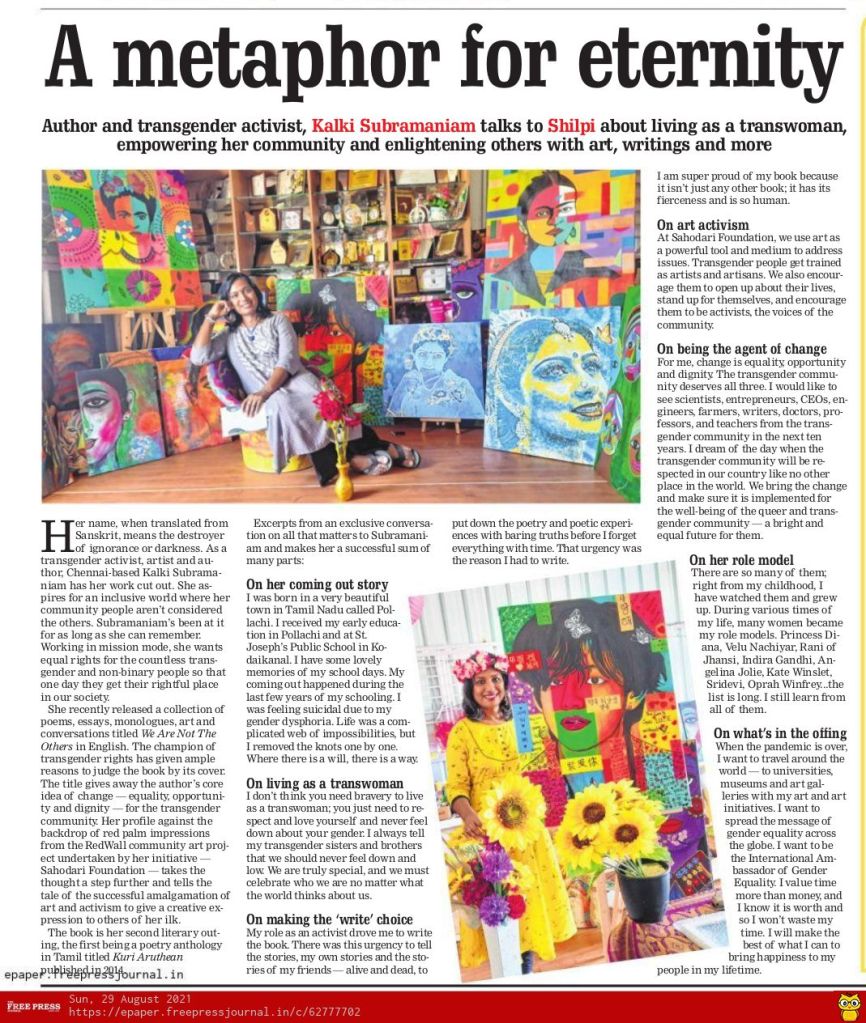
Her name, when translated from Sanskrit, means the destroyer of ignorance or darkness. As a transgender activist, artist and author, Chennai-based Kalki Subramaniam has her work cut out. She aspires for an inclusive world where her community people aren’t considered the others. Subramaniam’s been at it for as long as she can remember. Working in mission mode, she wants equal rights for the countless transgender and non-binary people so that one day they get their rightful place in our society.
LOVE IS DIVERSITY: Kalki Subramaniam
She recently released a collection of poems, essays, monologues, art and conversations titled We Are Not The Others in English. The champion of transgender rights has given ample reasons to judge the book by its cover. The title gives away the author’s core idea of change — equality, opportunity and dignity — for the transgender community. Her profile against the backdrop of red palm impressions from the RedWall community art project undertaken by her initiative – Sahodari Foundation – takes the thought a step further and tells the tale of the successful amalgamation of art and activism to give a creative expression to others of her ilk. The book is her second literary outing, the first being a poetry anthologyin Tamil titled Kuri Aruthean published in 2014.
Excerpts of an exclusive conversation on all that matters to Subramaniam and makes her a successful sum of many parts:
On her coming out story
I was born in a very beautiful town in Tamil Nadu called Pollachi. I received my early education in Pollachi and at St. Joseph’s Public School in Kodaikanal. I have some lovely memories of my school days. My coming out happened during the last few years of my schooling. I was feeling suicidal due to my gender dysphoria. Life was a complicated web of impossibilities, but I removed the knots one by one. Where there is a will, there is a way.
On living as a transwoman
I don’t think you need bravery to live as a transwoman; you just need to respect and love yourself and never feel down about your gender. I always tell my transgender sisters and brothers that we should never feel down and low. We are truly special, and we must celebrate who we are no matter what the world thinks about us.
On making the write choice
My role as an activist drove me to write the book. There was this urgency to tell the stories, my own stories and the stories of my friends – alive and dead, to put down the poetry and poetic experiences with baring truths before I forget everything with time. That urgency was the reason I had to write. I am super proud of my book because it isn’t just any other book; it has its fierceness and is so human.
On art activism
At Sahodari Foundation, we use art as a powerful tool and medium to address issues. Transgender people get trained as artists and artisans. We also encourage them to open up about their lives, stand up for themselves, and encourage them to be activists, the voices of the community.
On being the agent of change
For me, change is equality, opportunity and dignity. The transgender community deserves all three. I would like to see scientists, entrepreneurs, CEOs, engineers, farmers, writers, doctors, professors, and teachers from the transgender community in the next ten years. I dream of the day when the transgender community will be respected in our country like no other place in the world. We bring the change and make sure it is implemented for the well being of the queer and transgender community — a bright and equal future for them.
On her role model
There are so many of them; right from my childhood, I have watched them and grew up. During various times of my life, many women became my role models. Princess Diana, Velu Nachiyar, Rani of Jhansi, Indira Gandhi, Angelina Jolie, Kate Winslet, Sridevi, Oprah Winfrey… the list is long. I still learn from all of them.
On what’s in the offing
When the pandemic is over, I want to travel around the world — to universities, museums and art galleries with my art and art initiatives. I want to spread the message of gender equality across the globe. I want to be the International Ambassador of Gender Equality. I value time more than money, and I know it is worth and so I won’t waste my time. I will make the best of what I can to bring happiness to my people in my lifetime.
Love is a mystery. Love is unitive. Love is how we connect as human beings with one another and with the whole universe together. Love is how we learn, become better, and make the world a better place to live for us and others. Love needs freedom to breathe, equality to thrive, and openness to flow and grow. Love is personal, political, philosophical, sexual, social, historical, metaphysical, transcendental, et al. Sadly, we have only one word to describe such a complex emotion. The ancient Greeks had six different words, but even that’s not enough. 2021 taught me new ways to describe the complexity of love and its various hues. Love lost on many counts, but it miraculously sprang on a few occasions like a phoenix. My LOVE vocabulary was defined and redefined by people who touched my life one way or another this year.
shillpi a singh
LOVE IS ART: Cheriyal scroll painters
The handful of artists belonging to the Nakash caste and hailing from Cheriyal village in Telangana are the keepers of the visual form of storytelling popularly named after them as Nakashi art or Cheriyal paintings. Over the years, these artists have painstakingly preserved the rich cultural tradition of using pictures to tell stories from Indian mythology and local folklore. The proponents of this art form are heavily dependent on their art for survival, but the 15-month lockdown left them in the throws of woes.
LOVE IS ART: The award-winning Nakashi artistsD Vaikuntam and his wife Vanaja.
“The Cheriyal art is on the brink of extinction. Today, only seven families are engaged in this art form. Five of these belong to the Nakashi community, and the others are outsiders who learned it from my father, D Vaikuntam,” says D. Rakesh, a young Nakashi artist. With no other source of income, his family of five – father Vaikuntam, mother Vanaja, brother Vinay Kumar, and wife Monisha – took to online workshops to fend for themselves during this period. The workshops conducted by SkillXn, Paramparik Karigar, Crafts Council of Telangana, Spic Macay, Dastkaar Haat Samiti, and Rajasthani Studios were creatively satisfying monetarily rewarding for his family. “The response was heartening, and the students showed keen interest in learning the art form. We want to keep it alive, and efforts like these will help us reach out to a wider audience,” says Vaikuntam.
The dying art form received a Geographical Indication status in 2007. Reminiscing the rich cultural tradition, Vaikuntam says, “Cheriyal scroll painting is one of the earliest forms of audio-visual entertainment. Hundreds of years ago, the storytelling communities travelled through villages, singing and narrating stories using the scroll as a visual tool. Each scroll measured about three feet in width and could extend to over 60 feet. A scroll contained about 40 to 50 panels, and each panel depicted a part of the story. These were displayed in a sequence to tell the tale.”
With newer forms of storytelling ruling the public imagination, the Nakashi artists have adopted unique ways to reinvent the art form and keep it relevant. “The pictorial tale from the epics doesn’t excite people anymore. The scrolls have been reduced to an aesthetic item adorning the walls, collected by art lovers,” rues Vaikuntam. To make the art form saleable, Nakash artists have designed utility items. “We made masks during the lockdown and sold them through our Facebook and Insta pages. We also use the traditional art form to make key chains, pen holders, and wall decor items,” says Rakesh.
Each Cheriyal scroll starts with a panel of Ganapati, followed by Goddess Saraswati. “It is customary for the artist to seek the blessing of the deities to ensure that the art flourishes without any obstacle,” says Vaikuntam. The Cheriyal scroll painting is drawn on handmade khadi cloth or canvas processed by applying a paste of tamarind seed, tree gum and white clay. Three coats of the paste are applied, allowing a day in between for the paste to dry. Once the scroll is ready, the artist outlines characters using a squirrel-haired brush. In Cheriyal scrolls, only natural colours are used like white comes from grounded sea shells, black from lamp soot, yellow from Pevidi stone, blue from Indigo leafs, red from Inglikam stone and the other colours from various vegetable dyes and ground stones. Every colour is mixed with thirumani tree gum, before being applied on the scroll. “The red colour fills the background. The face and skin colours are decided by the nature of the character, like blue and yellow are for gods and goddesses, respectively; brown or darker shades for demons, while pink and skin tones are for humans,” explains Vaikuntam.
LOVE IS ART: National Award winner Cheriyal artist D Vaikuntam.
Love is a mystery. Love is unitive. Love is how we connect as human beings with one another and with the whole universe together. Love is how we learn, become better, and make the world a better place to live for us and others. Love needs freedom to breathe, equality to thrive, and openness to flow and grow. Love is personal, political, philosophical, sexual, social, historical, metaphysical, transcendental, et al. Sadly, we have only one word to describe such a complex emotion. The ancient Greeks had six different words, but even that’s not enough. 2021 taught me new ways to describe the complexity of love and its various hues. Love lost on many counts, but it miraculously sprang on a few occasions like a phoenix. My LOVE vocabulary was defined and redefined by people who touched my life one way or another this year.
SHILLPI A SINGH
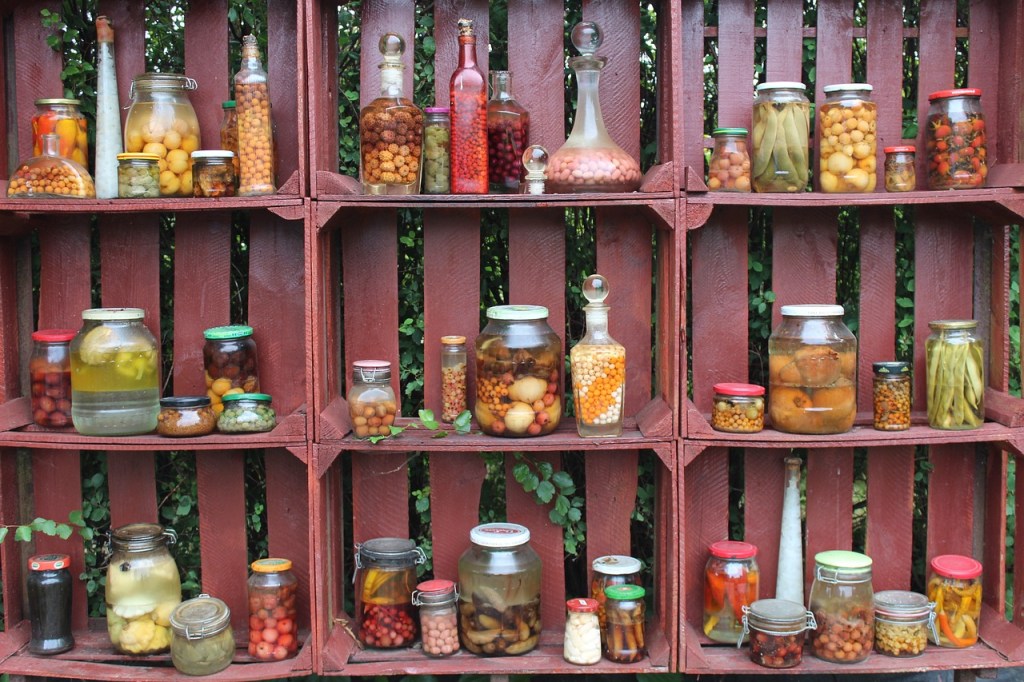
LOVE IS A JAR OF PICKLES: Upasna Prasad
Like a jar of pickles, love is sweet, sour, tangy, and spicy. Love brings colour to your life, just like a jar of pickles makes your everyday meal delectable by adding flavour. Love and a jar of pickles take their own sweet time to ferment. If not preserved well, both a jar of pickles and love can get spoiled in no time.
Homemaker Upasna Prasad has been pickling for as long as she remembers, especially during cold winter months. “It takes a lot of patience and time for the pickles to come out just right,” she says. We couldn’t agree more. It is ditto for love.
LOVE IS A JAR OF PICKLES: Upasna Prasad
Why pickles?
“I have developed my system of learning good Bihari recipes for the past few years. And I have realised that unless I learn fast, the recipes of my grandmother, mother and mother-in-law will be lost forever. Who would send me these delectable achars? So I started pickling with fervour a couple of years, picking up the tips and tricks from them, and mastering the art in some measure.”
Pickling: My favourite winter past-time
“Karonda ka khatta-meetha achar is a sweet Bihari pickle that is a welcome change from regular pickles. When it is freshly made, this seasonal achar tastes best.
One can never match up to the flavour and aroma of homemade Barabarachar. As the name suggests, yam or jimikand (oal) achar is popularly known as Barabar achar since all the major ingredients used in this pickle are equal in quantities or proportions.
Bharwan lal mirchachar (stuffed red chilli pickle) is an integral recipe of any Bihari household. The market is flooded with this bright red delight during the winter months. What makes this pickle extraordinary is the tanginess of dry amchoor powder and the mild bitterness of mustard powder topping it with loads of mustard oil added as a pickling agent.
A mixed achar is one of the best Bihari pickles passed on from generation to generation with everlasting memories. Mostly fresh winter vegetables such as potato, brinjal, ginger, chilli, radish, carrot, cauliflower, and flat beans are blended perfectly with spices and mustard oil giving a tangy, zingy flavour. It needs to be soaked in the winter sun before it can be pronounced ready for consumption.
Lahsun ke patta ka achaar is another popular homemade Bihari pickle, enhancing the taste of the simplest food with its strong aroma and flavours. That’s the magic of green garlic!
How can one forget Amla (Indian gooseberry) achaar, which is nutrient-rich, loaded with iron and vitamin C in abundance, and easiest to prepare. The ingredients are simple too – amla, carrom seeds, turmeric, salt and oil to prepare. It is a must-have in winter to keep the cold at bay.”
Homegrown art
“In Bihari pickles, we use a fine blend of roasted spices and oodles of mustard oil to ensure the pickle’s longevity. This delicate balance of spices and oil will make a fantastic pickle that will last for the whole year and not spoil.
LOVE IS A JAR OF PICKLES: Upasna Prasad
Bihari pickles have a consistency close to a large rough chunk of the featured spices/ vegetables smothered in tangy (mostly mustard) oil and stained yellow colour from the inclusion of ground turmeric (haldi).
Among many Bihari families, pickles are a complete substitute to various recipes, as it requires no refrigeration and is ideal for long-distance journeys.
I love Bihari pickles as a side to most dal dishes and rice. Winter is the time to conjure up some sweet, spicy, sour and tangy pickles to accentuate any meal. These homemade pickles are good to eat and so easy to prepare that you will wonder why we ever buy them from grocery stores. There is something good about how pickles are prepared in Bihar and Jharkhand. The tartness combined with the spiciness is just perfect.”
A bite can tickle, be it a jar of pickles for your taste buds or love for your life.
Love is a mystery. Love is unitive. Love is how we connect as human beings with one another and with the whole universe together. Love is how we learn, become better, and make the world a better place to live for us and others. Love needs freedom to breathe, equality to thrive, and openness to flow and grow. Love is personal, political, philosophical, sexual, social, historical, metaphysical, transcendental, et al. Sadly, we have only one word to describe such a complex emotion. The ancient Greeks had six different words, but even that’s not enough. 2021 taught me new ways to describe the complexity of love and its various hues. Love lost on many counts, but it miraculously sprang on a few occasions like a phoenix. My LOVE vocabulary was defined and redefined by people who touched my life one way or another this year.
shillpi a singh
LOVE IS FREE-SPIRITED: Phoolsunghi
New Delhi-based academician, columnist and translator Gautam Choubey has scripted history with his literary outing — Phoolsunghi — that happens to be the first-ever translation of a Bhojpuri novel into English. Apart from being the most representative work in Bhojpuri, Phoolsunghi also happens to be one of the most loved literary works by Pandey Kapil, who is hailed as the protagonist of the Bhojpuri literary movement in post-Independence India. It was published in Hamish Hamilton by Penguin Random House.
The first ever translation of a Bhojpuri novel into English, Phoolsunghi will transport you to a forgotten world filled with mujras and mehfils, court cases and the crashing waves of the River Saryu. 🐝 pic.twitter.com/v5oeMVyJ2d
The story from the soil of Bihar pans out in Chhapra where the magical, mystical, and mundane intertwine much like the lives of three characters — courtesan Gulzaribai who was popular in the region as Dhelabai; ageing zamindar Babu Haliwant Sahay, who worked as an official in the law court and had a stake in the flourishing opium trade; and Bhojpuri folk poet and singer Mahendra Misir. The timeless tale about these celebrated legends of Bihar has traversed centuries and fascinated litterateurs across ages. These dalliances resulted in three other literary jaunts of repute — Ramnath Pandey’s Mahendar Misir, Jauhar Safiyabad’s Poorvi Ke Dhah and Anamika’s DusDwareka Pinjara.
The historical novel spanning ninety years touches upon the early years of colonial rule in India without making any direct references to the fight for independence or any social conflict or instances of religious disharmony. The plot, story, and setting spread over 16 chapters together draw a reader into the enchanting world of the lifelike characters. Music serves as the perfect backdrop in Phoolsunghi, and there is a lot of drama, action, tragedy that unfolds in the lives of these people, to keep one hooked, from start to finish. The enthralling mehfils and mujras, high-pitched abduction drama, episodes of court cases and counterfeiting notes reveal the author’s attempt to make it a wholesome entertainer.
The author explores various shades of romantic love, making it an emotional roller coaster ride for a reader. It delves deep into the characters through the maze of the relationships that they share with each other, crossing paths at times, and flowing like the two banks of a river in a few instances.
The novel documents the lives and times, rise and fall, love and longing, trials and tribulations of these characters, who live in and around the banks of river Saryu in Chhapra and its adjoining villages of Mishrawaliya, Sheetalpur, Revelgunj and Muzaffarpur. Like a river that flows through these cities, the plot intermittently drifts to Banaras and Calcutta, and makes pit stops in Punjab and Delhi, before returning to Chhapra. The story also traces the advent of the railway line and how dhuwankas or trains play an important part in the narrative. Phoolsunghi offers a bird’s-eye view of how the characters co-existed in harmony without being bothered by religious, class or caste considerations, and in some measures, it is also a social commentary on the lives of migrant workers. It reveals how some of them seamlessly merged in the mainstream in their adopted land while a few others, bit by melancholia trace their way back to their roots, sooner than later. The migrant’s life in a metropolis is bound to resonate with the readers, and tug at their heartstrings, especially those who have either been a migrant themselves or have witnessed something more heart-wrenching pan out in the country not so long ago.
LOVE IS FREE-SPIRITED: PHOOLSUNGHI
The Bhojpuri story is quite evocative and engrossing, and Choubey has done full justice to it. The translated work has a cinematic language to it with lively characterisation, and vivid imagery making it an endearing read. It will be no surprise to see the real characters, who inhabited Chhapra once upon a time, taking a reel avatar sometime soon and glossing the big screen, regaling the larger audience who live far, far away from this mofussil. The verses in Bhojpuri have been passionately and painstakingly translated into English by Choubey, but a reader would have benefitted from the richness of the language and appreciated it more had only a list of the originals been provided along with the glossary.
By foraying into the unexplored domain of translating a popular piece of Bhojpuri literature for a discerning, elitist, city-bred reader, Choubey has managed to do the unthinkable, and in one go. It is a stellar act for its sheer thought and effort. He has not only highlighted the long and diverse literary culture of the language but also debunked the common perception of it being only a folk language, giving Bhojpuri its due. His disruptive effort, hopefully, might lead to many more such works being produced by the speakers and readers of the language, and in that context, Choubey’s present translation will fondly be remembered for being the first of its kind that helped to pave the path for many more.
Phoolsunghi has something for all; it serves as a timely reminder about the richness of Bhojpuri literature for the younger generation and has a multitude of joy and nostalgia to offer for the older ones. The story will transport you back to your roots so soak in the subtleties of a bygone era from a faraway land, and shore it up for yourself and your coming generations.
“I have fallen in love with the imagination. And if you fall in love with the imagination, you understand that it is a free spirit. It will go anywhere, and it can do anything.”