
https://www.freepressjournal.in/weekend/republic-day-2022-from-right-to-zero-fir-to-right-to-use-the-restroom-at-any-hotel-interesting-laws-that-you-probably-didnt-know

Hindi is the common thread that connects, binds and gives a sense of belonging to storytellers who are using the different mediums to take the language to greater heights with their humble endeavours. Be it an award-winning French subtitler who is using his knowledge of Hindi and Urdu, and understanding of Indian culture to take Indian cinema to a larger market across the shores or an award-winning filmmaker who turned into an author while documenting the 2020 migrant crisis in the wake of countrywide pandemic-induced lockdown. On the other hand, a bilingual author turned filmmaker who is currently busy adapting his first novel for the big screen loves to transcreate stories in Hindi and English and simultaneously. A poet-journalist loves translating human emotions into verses and rues the neglect of the language over the years. A walking-talking library of Indian literature started a read-aloud storytelling project for the Millennials who prefer to read with their ears while a young literature buff is busy building a feature on his platform that will pay readers to read because “reading makes a person”.
Shillpi a singh
On January 10, the first World Hindi Conference was held in 1975 in Nagpur, Maharashtra. In 2006, Prime Minister Manmohan Singh declared this day World Hindi Day. Here’s what a few raconteurs in India and abroad had to say to celebrate the day.
French national and award-winning subtitler François-Xavier Durandy has been associated with many great films shown at major festivals in France. He is a trained translator who speaks English, Hindi, German and Urdu, besides his mother tongue French. Incredibly, most of the movies he has subtitled have gained recognition at international fora. The most recent being CNC Aide aux Cinémas du Monde grant for Girls Will be Girls produced by Richa Chadha and Ali Fazal’s banner Pushing Buttons Studios, and backed by Sanjay Gulati and Pooja Chauhan of Crawling Angel Films and Claire Chassagne of Paris-based Dolce Vita Films.
Having spent considerable time in India, he has picked up the nuances of the language and its cultural cues. “It is indeed paramount to slip into the shoes of both storytellers and their different characters. In French, the word interprète has three distinct meanings: interpreter, of course, and spokesperson and performer. As translators, we have to interpret the meaning of a text to the best of our abilities, act as the author’s spokesperson in a different cultural context and embody the characters, become their voice and somehow perform their part in the target language,” says Durandy.
Perfect command of the original language and a thorough knowledge of Indian culture comes in handy in his job as a subtitler. “My familiarity with Hindi and Indian culture does help me know the nuances and character dynamics of a script, even when it’s not in Hindi. I translated the script from English into French for Girls Will Be Girls for submission to the CNC Aide aux Cinémas du Monde grant. The whole script is in English, including the dialogue, at this stage. But when I was translating the lines of the characters, I was always thinking about what they would say in Hindi to see whether it would make a difference in my translation. A simple example is the second person pronoun. To choose between tu and vous in French, I would try to imagine what would be likelier between tum and aap,” he adds.
Subtitling is a major enabler per se, as it allows a film to find its audience beyond its linguistic boundaries. “All the more so with indie cinema, which is more content-driven.
The audience may enjoy big-budget films without subtitles or poor subtitles because of their immense production value. But when it comes to smaller films, shot on location and with lesser visual impact, quality subtitling becomes a must,” he says, explaining how cinema in India’s so-called regional languages has travelled and been embraced by the rest of the country and world, thanks to subtitles.
Film scripts that Durandy has translated for CNC were usually all-English because many writers have their dialogue translated into Hindi (or another regional language) later, with all pre-production work happening in English. “I worked recently for a debut filmmaker, and while the dialogue was in Hindi, the rest was in English, but you could tell that he would have been much more comfortable in his mother tongue. I felt that resorting to English was not allowing him to fully and eloquently express himself. People should always be free to write and talk in the language they’re the most comfortable with. That’s what we translators are here for!”
In a televised address to the nation at 8 pm on March 24, 2020, Prime Minister Narendra Modi announced that the entire country would be in ‘lockdown’ (from midnight of March 25) to mitigate the spread of the coronavirus. The sudden measure wreaked havoc on the lives and livelihoods of daily-wage migrant workers across the country and had far-reaching repercussions. Award-winning filmmaker and author Vinod Kapri, who had been actively engaged in COVID relief work in and around Delhi NCR during those days, was rattled at the misery unfolding before his eyes. One day, he knew that seven of them were planning to set off on bicycles to their hometowns, from Ghaziabad in Uttar Pradesh to Saharsa in Bihar. “My seven heroes – Sandeep, Mukesh, Ritesh, Aashish, Rambabu, Sonu and Krishna – had no employment, no food, and no place to call home after the sudden lockdown. Their seven-day-long journey speaks of their indomitable spirit. They defied all imaginable odds to cycle for 1232 km,” says Kapri, who accompanied them on this journey, shadowing them until they reached their hometown. The heartwrenching account of the construction labourers pedalling their way home was first released as a documentary early in 2021. It had two songs of despair – “Marenge To Wahin Jaakar” and “O Re Bidesiya” – penned by Gulzar and composed by Vishal Bharadwaj.
One thing led to another. “I only wanted to document their journey, but there were many things that I couldn’t capture on camera but jotted in my diary. The book was never on my mind. But a close friend suggested that I put it down on paper because he felt that 1232 Km spotlighted the COVID-19-led migrant crisis in India. It found a home, and quite on its merit, be it the OTT platform or publishers because this extraordinary story really pulls on the heartstrings,” recounts Kapri. His debut book has been released in Hindi, English, and four other regional languages. The response to his documentary and books has been overwhelming. “It is a documentation of the plight of migrant workers. I want it to reach more and more people so that people know the nameless faces around us, who sweat it out day in and day out only to make our lives easier but bore the worst during the lockdown. The royalty of these books will go to these men because it is their book,” he emphasises.
It is quite commonplace for the Millennials to be quite well-versed with Franz Kafka, Khalil Gibran, Haruki Murakami, Gabriel Garcia Marquez, and many other literary giants of their ilk from across the world. But seldom do they even care to flip through the enormous body of work of litterateurs from the Indian subcontinent. Mumbai-based septuagenarian former adman, Urdu connoisseur and avid storyteller Jameel Gulrays started a read-aloud storytelling project called Katha Kathan in 2015 to help the Millennials “read these literary gems through their ears.”
“My storytelling project aims to explore the rich tapestry of literature in Hindi, Urdu, and other Indian languages to preserve, promote, and popularise them so that they aren’t lost into oblivion but live on for many generations. My band of storytellers at Katha Kathan are the backbone of this. Our zealous efforts are aimed at the larger cause of preserving the vast repertoire of Indian literature,” says Gulrays.
After wowing the audience through live sessions held in Mumbai and many other cities during the pre-pandemic days, a successful run on his YouTube channel, and podcasts on Soundcloud, Team Katha Kathan forayed into the voice-based social network app Clubhouse in 2021. The literary evening enlivens the statement made by Premchand in his memorable short story, Eidgaah, “Club ghar mein jadoo hota hai” through weekly dramatised readings of classics. “We endeavour to reintroduce and rejuvenate languages and motivate the younger generations by narrating the literature and ensuring it reaches them through the medium (read social media platforms) they consume,” states Gulrays.
The session sees the audience from India’s nook and corners and across the world tuning in every weekend to brush up on these classics. It is a mix of both literature lovers and newbies to the world of Urdu and Indian classics. It often has celebrities like Rekha Bharadwaj, Vishal Bharadwaj, Naseeruddin Shah, and many others joining in to be regaled by stories.
Journalist and poet Pratap Somvanshi made a failed literary debut when he was still in school. “I was in class 8 then and had written a short story. I sent a two, and a half-page story accompanied by a three-page covering letter addressed to the editor of Nandan. The story was rejected, but the thoughtful editor sent a heartwarming note,” reminisces Somvanshi. The rejection letter laid the foundation of his career path. He is the editorial head of a leading Hindi national paper and writes poetry. “It is ‘bhavanuvad’ – a translation of human emotions and relationships,” he adds. In 2016, his first anthology of poems – Itwar Chhota Pad Gaya – a culmination of his friends’ tireless efforts and wife’s insistence was published. “I love poetry and live it too. My poems and life are interdependent. They can’t exist in isolation,” he says.
Commenting on the long-standing neglect of Hindi, he gives an overview of the publishing industry. According to him, today, it is like a business where the publishers look for saleability and numbers. It could also be a co-operative where the author pays to publish his book or is Atmanirbhar venture where the author opts for self-publishing option. “There were a few Hindi publishers till a few years ago, and they too had their priorities. Books in Hindi were never published to sell copies but to be stocked in libraries. There are 150 crore Hindi speakers worldwide, of which 100 crore can read and write Hindi. But when it comes to Hindi, only 1000 copies are published, be it novel, poetry or short stories.”
Somvanshi whose couplet – Ram tumhare yug ka Ravan accha tha – is the most forwarded message on social media platforms on Dussehra. “Social media has made crowd sharing of emotions so easy, and it bodes well for Hindi writers. People are discovering literary gems on social media, and then they go hunting for books by these poets, be it of Jaun Elia or Fahim Badayuni,” he states. A few poets find publishers on their merit – be it known face or saleability – but a lot depends on the readers. “They create the market and not the other way around,” he says.
Ankur Mishra wears many hats and aplomb. He is the founder of Kavishala and Foreantech and the author of seven books, but he remains a literature buff in one’s heart of hearts. He started a website called Kavishala for poets to have an online mehfil of sorts. “Kavishala is a one-stop platform for literary minds. Ease of getting good and genuine content at one place. Kavishala has many verticals – Kavishala Talks and Kavishala Campus Ambassadors, and Kavishala Sootradhar, where one can access the works of eminent litterateurs of yore. We must make the younger generation aware of the treasure trove of Indian literature and languages,” says Mishra.
Another interesting vertical on the platform, Kavishala Labs, helps readers access exciting articles about Indian literature and writers. “The Kavishala team works hard for these articles, and they come up with not known and lesser facts for an engaging read. Kavishala Sootradhar is a vertical where we have 6000+ poets and writers from Indian and world literature, and the content is free. We aim to be a virtual library for our readers in easy clicks. Kavishala has three million-plus monthly page views on this content only,” he adds.
80% plus writers and poets are from the Hindi language to date. “The number of readers in Sootradhar is encouraging. We’ve 13% plus page views from the USA and 10% plus from UAE, which means Hindi literature has a good reach in non-Hindi speaking countries. If we get help from investors, we can make it even bigger and better,” he says. On World Hindi Day, Kavishala is conducting Kavishala International Meetup, where the platform will bring together Hindi and Hindi literature lovers in one place. “The event will be virtual and private. Our target is to have at least 150-200 people from different countries,” he adds.
Another plan in the offing includes making Kavishala the word first kind of platform, which will give readers money for reading. “We attempt to make reading a habit. There are a handful few readers left among the younger generations. We want to pay them for reading in an attempt to revive that reading culture,” he emphasises.
Filmmaker-author Pankaj Dubey has an uncanny knack for transcreation. With nine bestselling titles to his credit, five in English and the rest four transcreated in Hindi, almost simultaneously, Dubey is currently busy adapting his first novel What a Loser (English) and Loser Kahin Ka (Hindi) for the big screen. What sets him apart from others of his ilk is the two-language deal for all his books from the publishing house, Penguin Random House. “I owe it to my editor, late Renu Agal, who spotted it first and encouraged me to write in both. Being bilingual is a significant marker in South Asia. It helped me bag the nomination for a prestigious writer’s Residency in Seoul, South Korea, in 2016,” says Dubey, who was one amongst the three novelists from Asia to get this opportunity. “I am bilingual, so I write all my stories together in Hindi and English. I never try to translate. Since my first book, I’ve been selling quite well, and that’s been my purpose because if I’m not interested in being a much-loved author, I would rather write diaries and not get them published,” he says.
The spectacular success of his first novel made it a breeze for the rest. “I always had conviction in my story and my telling. I have been fortunate, but I know that many others don’t have it easy. But once you get a publisher, and if your book does well, the sky’s the limit,” adds Dubey, who pursued his filmmaking passion and his first film, Maratha Mandir Theatre, is streaming on Disney Hotstar+.
He owes his success to his storytelling and adaptability, both of which are up to date. The books are popular among the Millennials because the characters speak the readers’ language. One problem with Hindi literature is that the growth of writers in Hindi literature has been slower than the growth of readers. Moreso, because the readers and their tastes have evolved over a while.
Commenting on the challenges of contemporary Hindi writing, he says, “Most Hindi writers, if not all, are stuck to the language and vocabulary of the past, which makes it dull and uninteresting for the readers. The idea is to contemporise things and accepts the linguistic ingredients of the contemporary world and society. That helps a lot,” he adds.
Dubey attributes the democratisation of the reading and writing process to the advent of social media. “It has given access to everyone to all kinds of literature at the click of a mouse. So it is very challenging for the writers if they don’t try it well. The attention span of the readers is decreasing every day. Social media has made it challenging for good writers. At the same time, it has opened new ways to promote your work. So you can spread awareness around your writing, and once your writing is light, it will fly on its own,” he states.


In 2022, a visually impaired assistant professor #AkhileshKumar waits to hold his book in hand, while a mother-in-waiting #JaspreetChandhok is looking forward to bringing home her ‘adopted’ child.
A person with epilepsy #VinayJani will run to create awareness for the less spoken neurological condition, while a Bicycle Mayor #ArshelAkhter will pedal for green mobility.
#ShramanJha of #WWFIndia believes the emphasis shifts to a more proactive, participative stance with the theme “Shape our Future”, be it for the #EarthHour or as #AkashDeep of #GRIHACouncil says on #greenbuildings that can be #sustainable and #affordable.
An entrepreneur #SarvmeetOberoi hopes to pamper our pawsome family members at his pet facility – #PetfelixDogBoarding – a little more. At the same time, a chocolate brand #Kocoatrait led by L Nitin Chordia expects to become more sustainable and increase its contribution to the circular economy.
A martial arts expert #FaisalAliDar hopes to initiate more children into sports and sportspersons into coaching while a cafe’s founder in Jamshedpur #AvinashDugar is brewing a change for the deaf.
A busker Debojyoti Nath hopes to make more music and spread kindness, and a farmer #PradeepGawande is sowing hope to reap prosperity in 2022, for himself and others of his ilk.
What we left behind are memories. What we are taking forward are moments. Here’s what 12 wonderful people are looking forward to this year, their wishes, and everything in between worth celebrating!


Love is a mystery. Love is unitive. Love is how we connect as human beings with one another and with the whole universe together. Love is how we learn, become better, and make the world a better place to live for us and others. Love needs freedom to breathe, equality to thrive, and openness to flow and grow. Love is personal, political, philosophical, sexual, social, historical, metaphysical, transcendental, et al. Sadly, we have only one word to describe such a complex emotion. The ancient Greeks had six different words, but even that’s not enough. 2021 taught me new ways to describe the complexity of love and its various hues. Love lost on many counts, but it miraculously sprang on a few occasions like a phoenix. My LOVE vocabulary was defined and redefined by people who touched my life one way or another this year.
shillpi a singh
The rules of engagement in modern relationships have changed over the years, comments Pallavi Barnwal, certified sexuality coach, and founder of GetIntimacy.com, listing out the changes, one by one.
She observes how love is aided by technology; people find their partners or connect to them on a dating app, or through social media. The age of getting married has increased (which means the first relationship is not always the last one and people have more than one past relationship before they get married. Technology has spoilt people for choice and the days are engulfed around technology but at the same time of energy of technology (fast, quick, solution-oriented) does not match the energy of love which is (slow, gradual, mystical). People are socially distanced from extended family networks, and although they might have broad swathes of followers and social media friends, the reality is that is lonelier than ever. In this realm, their expectations and demands from their marriages and partners have drastically increased. New relationship models are emerging – single-parent families, live-in relationships, gay couples, divorce because of emotional/ sexual compatibility. People are looking towards sex not just as a form of making babies, or intimacy but also as a source of pleasure. They are looking towards sex not just as a form of making babies, or intimacy but also as a source of pleasure; they don’t mind are experimenting with sex toys, watching adult movies on Netflix, trying out kink partners in onlyfans, exploring cuckoldry, threesomes, etc.
New Delhi-based Barnwal states how the emerging era of modern love and sex is a completely different paradigm. “To be able to deal with it and get what we want needs totally different skills. One we have not learned in our parent families, since that relationship model was based on meeting needs, setting family, and raising kids. But we are spoilt for choice and because of a rising emphasis on “self” or the “individual” we feel entitled to our wants and also have a ‘more’ mindset when it comes to Love and Sex.”

Mr and Mrs Malhotra, a happily married couple on (role play), who deep down were broken, shattered and looking for ways to walk out on each other because their sex life was in a mess. In the nick of time, the couple went through a series of sessions. In their first session together as a couple, the intimacy coach got hold of the issue between the two. “She helped me communicate with my husband in a positive manner. Earlier I would whine and complain but wasn’t clear in my expectations. The next six sessions were with two of us individually where the coach helped us understand each other and our needs better. She empowered us to learn ways of positive and non-violent communication and helped us to understand what the other partner was going through and what are the challenges both of us are facing with one another,” recounts Mrs Malhotra.
The couple also received home works and assignments that they had to practice during the week before the next session. The last two sessions were together as a couple where they communicated with each other, planned on how to work together as a couple with respect and empathy. “We are now on a nurture program where we meet the counsellor once a month to go through any current challenges and find solutions to them,” says Mr Malhotra.
Role of an intimacy coach
The growing bitterness in modern relationships and the subsequent incapability to express one’s desires has led to a growing need for an intimacy coach. Malhotra couple’s intimacy coach, Niyatii N Shah worked on building their love languages, admiration, gratitude and forgiveness. Talking about her role, Mumbai-based Shah adds how she doubles up as a counsellor, psychologist or sex educator and intimacy coach to work with couples and help them build or revive intimacy in their relationship.



A trained sex educator and sex coach, Barnwal is currently practising as a sexual wellness coach where her work involves conducting assessments (verbal, written) to understand the client issue, history taking, assisting the client with the right information around sex, and recommending activities and exercises to have a healthy sexuality. “The actual work involves a lot of nitty-gritty. My work also involves a blend of mythology and sexuality, where I share mythological stories, and Kamasutra retelling because, in essence, it is a guidebook for a healthy marriage where Kama – sexual desire is one of the significant sections of the book,” says Barnwal.
On the other hand, Bengaluru-based relationship and intimacy coach Shivanya Yogmayaa’s clientele includes people who are suffering from issues with sexual intimacy, emotional disconnect with their partner, and need help in sexual behaviour and sexual orientation issues. She uses holistic psychological and practical approaches to resolve issues between couples. “I believe in when a person heals, relationship heals. I help couples to deepen the connections between themselves and everyone else around. I also guide people to achieve more confident and satisfying lives.”
As Mr and Mrs Das recount how they had worked with a few therapists and relationship counsellors across the world in the past before they stumbled upon Shivanya. “No one has been able to bring the breakthroughs in our relationship the way Shivanya has. We have had long-standing intimacy issues over our 15-year-old relationship and were getting close to calling the marriage off when we reached out to an intimacy coach. With every session, she intuitively and carefully helped us see each other’s perspectives and gave us practical tools and guidance to begin building our intimacy in a way that feels authentic to each of us,” says the Das couple, recounting their experience with intimacy coaching sessions that empowered them to understand and articulate their needs better.
Shah agrees that most couples experience love and attraction in their early relationship and after a few years their responsibility and social expectations rip off the bonds, and the first casualty is their intimate relationship. “Our aim is to provide support and enhance the internal resources so that the couple can make amends in their lives. We support and help the couple find new possibilities and alternative solutions while observing professional boundaries and absolute confidentiality,” she emphasises.
On the need for conversation
Barnwal adds how with the information age, and rising incomes, and a metro lifestyle, people become more familiar with sexual pleasure. “This awareness was steered by a handful of sex educators who started breaking the taboos by initiating conversations and spreading knowledge around sex. I talk about sexual communication, sex personality, kink, sexual problems, dating, and sexual pleasure. Because there had been an acute dearth of information around these subjects, the content came as a breath of fresh air,” says Barnwal, who has set up a community of over 50,000 people overall where they reach out with their problems, hopes, and queries.
Working as an intimacy coach is not an easy task. Explaining how she does what she does, Shah says, “It takes a series of sessions to work with the couple on understanding the challenges and obstacles that the couple is facing, exploring practical solutions for their relationship issues and then deepening their connection, emotionally, mentally and physically so that they can communicate their needs and preferences lovingly with each other.” Most coaches take independent sessions or have packages as per the client’s case.
It is a niche category of coaching, and people who have warmed up to the idea include a minuscule percentage in comparison to those who actually need intimacy coaching. “Unfortunately, sex coaching or sex counselling is a non-existent field in India. Here we have sexology which is more about a clinical treatment for physiological, biological disorders around sex. But as you see a lot of these stories are not about any biological problem, it is a lifestyle, relationship, and psychological issue. The taboo around sex is so huge that many mental health professionals are either not trained on this or are reluctant to even broach this subject,” says Barnwal recounting horrors of client stories where they were advised by other professionals to “just do it” or worse even “watch porn to get in the mood” which according to her is a typical response but lacks professional oversight.
Most couples-in-trouble over intimacy issues aren’t even aware that there’s someone like an intimacy coach who can help them sail through the crisis and save their relationship. “A little awareness shared on social media is helping people to know there are ways to solve their relationship issues. Seeking professional help for intimacy is still a taboo and there’s a lot of hesitancy still,” observes Shah.
Shivanya couldn’t agree more with Barnwal and Shah. “Intimacy coaching is yet to pick up in the Indian context. People prefer secrecy and lack the courage to open up in what they see as a private matter. But they fail to understand is that this private matter is the foundation of their marriage,” she says. Another issue that Barnwal highlights is how most people expect overnight results in coaching which is not possible. “Considering our heavy puritanical past and the sexual stigma deep-seated in our family structures, social fabric, and our psyche, creating awareness around sex education is a mammoth task,” she stresses.
It is not time or opportunity that is to determine intimacy;—it is disposition alone. Seven years would be insufficient to make some people acquainted with each other, and seven days are more than enough for others.
jane austen

Love is a mystery. Love is unitive. Love is how we connect as human beings with one another and with the whole universe together. Love is how we learn, become better, and make the world a better place to live for us and others. Love needs freedom to breathe, equality to thrive, and openness to flow and grow. Love is personal, political, philosophical, sexual, social, historical, metaphysical, transcendental, et al. Sadly, we have only one word to describe such a complex emotion. The ancient Greeks had six different words, but even that’s not enough. 2021 taught me new ways to describe the complexity of love and its various hues. Love lost on many counts, but it miraculously sprang on a few occasions like a phoenix. My LOVE vocabulary was defined and redefined by people who touched my life one way or another this year.
shillpi a singh
Retracing actor extraordinaire Manoj Bajpayee’s brand endorsements in 2021 makes one marvel at the ingenuity of his choices. He endorsed products and services that matter to an ordinary person, be it home, finance, farm, food, and rightly so. “I was born and brought up in a village, and I have always flaunted being a farmer’s son with immense pride. It is the core of my being, my work and how I choose to do what I do,” he says. A proud farmer’s son, he endorsed Krish-e App by Mahindra because the product reflects his identity, and he could relate to it. “Moreso, because I find technology a great enabler, and Krish-e has leveraged it to its advantage to help farmers reduce costs, increase productivity, and ultimately farmers’ income,” says the actor, who won the National Award for his searing performance in Devashish Makhija’s Bhonsle this year. With his endorsement, Bajpayee set the tone for the changing narrative in the agriculture sector that’s gravitating towards tech and seeing the active participation of young agripreneurs.

IT professional Muhaimin Sheik decoded the perfect work-from-home balance during the lockdown, much to his delight. A native of Ramanathapuram, Pottagavayal village in Tamil Nadu, Sheik returned home to be with his family during the pandemic last year and has stayed in the village ever since then. Hailing from a family of farmers, he wasn’t as deeply involved in the process as he is now, and the WFH, in a way, helped him reconnect with his roots. “I spend five days coding and two days farming. I start my weekdays with a stroll down the farm before logging in for work. One day someone asked me, ‘You are educated and working with a software firm, so why do you want to do this? The company pays you well, right?’ I replied, ‘Yes, it does, but I can’t eat the money. I can eat rice only’,” says Sheik.

CEO of Athvas Horti Fed Producer Company Ltd Asiya Nazir from Kupwara in Kashmir runs a farmer producer organisation and sells to wholesale and retail buyers on a tech-enabled Harvesting Farmers Network (HFN) platform. “I sell walnut, almonds, apple jam, honey and saffron on HFN mobile app directly to buyers across India. The tech-enabled market linkage is a massive relief for farmers like me,” says Nazir.
On the other hand, Raghu Dharanipathi of Kapila Agrofarms in Siddipet, Telangana, has benefitted tremendously by feeding corn silage (Cornvita by SAGO) to his cattle for the last three years. “Sago has been one of the best both in terms of quality of the product and customer service. Milk production of our dairy cattle consistently improved by 10-15% in the last three years,” says Dharanipathi.
The story of Ajit Sorate,a large farmland owner from Baramati, Maharashtra, who faced challenges due to a lack of knowledge about the advanced implements available in the market, is no different. Thanks to Krish-e advisory, his plantation costs have been drastically reduced. Earlier, Sorate used to utilise 16 acres for sugarcane and 12 acres for maize cultivation. This year, after registering on the Krish-e app, he has planted sugarcane, from which he expects over 35% more output. “Krish-e app comes with Mahindra’s promise and has a smooth functioning where I can avail proper advice on soil testing, primary tillage and intercropping to help in scientific mapping of the crop,” he says.
Krish-e is a new business vertical from Mahindra Group that provides technology-driven services that are progressive, affordable, and accessible to farmers. “We launched Krish-e and Nidaan apps in October 2021, keeping in mind the ever-evolving needs of the modern farmers. These apps leverage a combination of agronomy, data and farming expertise to improve farmer’s income per acre,” says Hemant Sikka, President, Farm Equipment Sector, Mahindra & Mahindra Ltd.
HFN founder Ruchit Garg, who launched a mobile app in November 2021, had been actively helping smallholders’ farmers from across the country market and sell their harvest through a dedicated Twitter page during the first wave of COVID19. Farmers used to message crop details to him, and he used to broadcast those details on Twitter, and the farmers’ produce used to find buyers in no time. Buoyed by the consumer response, he decided to have a dedicated mobile app for farmers. “HFN Kisan mobile app is world’s only mobile app which provides full-stack services to not only farmers in horticulture, but also to farmers involved in fishery, poultry and livestock,” says Garg.
Hyderabad-based agri-tech startup SAGO Speciality Feeds was started by three passionate agripreneurs — former NABARD employee Chandrasekhar Singh, his nephew Saikiran and son Anurag — in 2019. At SAGO, they have deployed fermentation biology to develop and manufacture silage from corn crops and use microbial inoculants for making silage. The technology helps produce high-quality feed for cattle and enables efficient year-long storage of green fodder. “Silage is a highly nutritious and balanced feed for cattle, sheep and other ruminants, and it can also be used as a biofuel feedstock for anaerobic digesters. It doesn’t contain any synthetic additives or chemicals. Silage also helps reduce the volume of feed as it is highly compressed, thereby decreasing the overall cost and meeting the nutritional requirement,” says Singh.

The numbers are promising, and best elucidate the success story. Garg recounts how the app helped a Bangalore farmer sell 20,000 kg of grapes in just three days and how a farmer from Bihar got a weekly brinjal subscription from a nearby hotel by using the app. “We have at least one farmer from each Indian state/UT on our platform,” he adds with pride.
The high-quality corn silage is produced at SAGO’s plant in Banswara, Rajasthan. “More than 1,200 farmers produce corn crop for us annually. Over 230 dairy farms, involving over 12,000 dairy cattle, are fed with our corn silage annually. Sago has created an efficient and sustainable agricultural production ecosystem covering Gujarat, Rajasthan, and Telangana and significantly improved the livelihood of the farming community involved,” elucidates Singh.
The Krish-e and Nidaan apps have received more than six lakh downloads. With an omnichannel approach, Krish-e is has been able to make a considerable difference to farming outcomes. “Through Krish-e, Mahindra is creating a nation of ‘Champion Farmers’. To date, Krish-e has increased the yield of farmers by up to Rs 15,000, brought down the cost of farming by about 8-12% and increased profit by up to Rs 6000 per acre. It reflects the passion of those progressive farmers who have adopted new practices to improve their outcomes,” adds Sikka.
SAGO plans to expand into other speciality feeds for animals such as Aflatoxin free corn for pet feed and Quality Protein Maize for poultry feed. “These are a couple of products in the pipeline to be launched in the next two years. We are preparing to foray into the value-added food sector, focused on Functional Foods,” says Singh.
Mahindra Group’s biannual event – Krish-e Champion Awards – is aligned with the Kharif and Rabi seasons. These Awards recognise and felicitate farmers and institutions, who have risen above the ordinary, by thinking innovatively and driving a positive change in agriculture. “Through the Krish-e Champion Awards, we aim to inspire millions of farmers and agripreneurs to build a promising future for the country. These Awards celebrate the progress of these farmers who took this first and very important step with us,” emphasises Sikka.
Like most other fields, technology in agriculture is a must, believes Garg, adding that it impacts every aspect of agriculture, from seed to market. “Agriculture requires a mix of digital and physical approaches for building a scalable and sustainable business model,” says Garg, who is planning to launch a network of brick-and-mortar HFN Kisan Centers. “These will be farmer-owned and operated. We plan to open 17,000 such centres across India,” he adds.
Young farmer Sheik sums up the tenacious spirit of others of his ilk and states, “There are many ways to earn money, but there is only one way to earn food, and that’s through agriculture.” True that! We owe a lot to the farmers. It is about time we realise it too.


Love is a mystery. Love is unitive. Love is how we connect as human beings with one another and with the whole universe together. Love is how we learn, become better, and make the world a better place to live for us and others. Love needs freedom to breathe, equality to thrive, and openness to flow and grow. Love is personal, political, philosophical, sexual, social, historical, metaphysical, transcendental, et al. Sadly, we have only one word to describe such a complex emotion. The ancient Greeks had six different words, but even that’s not enough. 2021 taught me new ways to describe the complexity of love and its various hues. Love lost on many counts, but it miraculously sprang on a few occasions like a phoenix. My LOVE vocabulary was defined and redefined by people who touched my life one way or another this year.
SHILLPI A SINGH
It was not too long ago when lonely widow Usha Parmar (Ratna Pathak Shah) in Alankrita Srivastava’s Lipstick Under My Burkha scorched the screen with her burning desire for intimacy. Parmar sought refuge in Hindi pulp novels out of desperation, fantasised about escapades with a young man and, in return, was rebuked and ridiculed for her overt sexuality because her actions were unfitting her age. Subtly, Parmar’s character hints that sexuality, desire, activity and intimacy in the elderly don’t come with an expiry date. While age-related medical issues have a considerable role to play, the social and cultural aspects too have a bearing on them.
Senior psychotherapist and counsellor Padma Rewari recalls how she recently offered consultation to a 52-year-old woman, well past her menopause, who didn’t want to put a pause button on her sex life, much to her husband’s chagrin. “The woman went deep into depression after her husband body-shamed her and made fun of her overtures. She didn’t know how to deal with her need for intimacy, which was a social and cultural taboo for her husband. His behaviour made her feel so low about herself that she developed suicidal tendencies,” says Rewari.
Cause of concern
One partner’s overt and other partner’s inert reaction to the other’s needs was the cause of the problem in Rewari’s patient. Although sexuality is a fundamental driving force, human sexuality is frequently misunderstood and often neglected in the case of the elders. “Sexuality and senior citizens seems a weird proposition. There is a mental block. People often suppress those desires and feelings because it is not age-appropriate behaviour,” says Rewari.
It is assumed that older people lose their sexual desires or are physically unable to perform. It is common for older men to fear the loss of sexual prowess, while older women may also express sexual desire but may fear their interest is undignified and disgraceful. “You become a senior citizen as soon as you cross 50. Ageism has a tremendous impact on the subconscious mind. It makes one slowly withdraw and retire when it comes to sexual activity, and expressing the desire and need for intimacy is a strict no-no. It is taboo. If one partner still has such desires, and the other partner doesn’t show such feelings or desires, it leads the partner (who has it still) on a guilt trip,” adds Rewari.
Niyatii N Shah, sexuality educator, intimacy coach and counsellor, has come across many cases where one of the partners and, in some cases, the couple approached her for help. “I have had both types of clients. Many of them seek advice through social media. A few of the most common reasons I have come across are lack of respect, no sexual satisfaction, boredom and abuse,” says Niyatii.
Dealing with the issue
The sexuality, desire, activity and intimacy in the elderly seems to be waning partly because of medical complications and partly because of a general loss of interest due to social or cultural reasons. “It’s a mix of both but mainly because of loss of interest and emotional baggage. Most of the time, partners are very supportive if there’s a medical reason. Intimacy counselling looks into why the couples are not intimate anymore and helps them live a fuller life that they desire from each other,” informs Niyatii.
During a recent webinar organised by Boston Scientific, psychiatrist, clinical sexologist, and sex and intimacy coach Dr Anita Shyam, who regularly meets such couples, said, “I also follow a simple formula in patients — seek a detailed sexual and relationship history. So that pretty much gives me a more comprehensive view of the issue. Is it an organic cause? Or is it a psychological cause? Is it a social cause or whether it is a relationship problem?”
If there is an organic cause, she refers them to the physicians who specialise in that field, but if it is a psychological cause, she digs deeper to ascertain the reason. “Is this person suffering from anxiety or depression? Or is he or she into drugs and alcohol? Sometimes even the partner can have a problem. The partner must be suffering from medical issues, desire disorders or depression that could lead the man to have ED. If not, then the couple must be having a relationship problem. So, I look holistically at the three parts of the triangle — the individual, the partner and the relationship,” she says.

A problem area
A marked increase in life expectancy over the past century has meant that individuals over the age of 65 form an increasingly large proportion of the population. Yet, very little attention has been paid until recently to treating sexual dysfunction in older adults. Older individuals are generally erroneously viewed as asexual people who have lost their interest in sex and their capacity for sexual behaviour. Calling for the need for more attention in psychiatric training to deal with sexuality in the elderly, Rewari adds, “The chain of ignorance needs to break. We need to change the way we think about older people and how they treat each other once they reach a certain age. We say age gracefully but without suppressing the fantasy or the feeling of sexual desires. Leave the guilt out, which plays on every human mind. These are conditioned behaviours and patterns which we have seen all through, but it is normal to have the flame of desire and need for intimacy burning even if you are past a certain age.”
People often refuse to believe that they are depressed and stressed. And sometimes, they could even be on a list of psychiatric medications. “Stress is a major factor for any of the psychological and several medical problems. There are four phases in a sexual cycle. Stress affects the desire, if the desire is affected, it’s going to affect the arousal, it affects the orgasm and also the resolution. It plays a major role in even in an individual’s life and in the relationship, causing a lot of relationship and sexual problems in couples,” says Dr Shyam.
Health issues
While women could blame menopause, older men could have many physical problems because of diabetes, hypertension, high cholesterol and smoking that could affect their sexual capabilities. “There are many issues that men may have. A libido problem means he doesn’t feel the urge for sex. He may have an arousal problem and he’s not attracted to his partner, he may have an erection problem. Then sometimes, he has a problem with early orgasm or premature ejaculation. All of which are different and need different treatments,” says Dr Rupin Shah, consultant andrologist and microsurgeon.
India is the diabetes capital and 50-70% of men with diabetes will eventually develop erectile dysfunction due to the disease. “Lifestyle is vital because, as I tell patients, sex happens when you are at the peak of your health, then you have the greatest urge, the greatest energy, the greatest capability. As your general health diminishes, your sexual abilities decrease, even though that desire may be there. So the middle-aged executive who’s overweight, not exercising, overeating sugar, smoking 10 cigarettes a day is going to have a lifestyle-induced sexual problem,” adds Dr Shah.
Why it matters
There was an upsurge in teleconsultation in such cases during the pandemic-induced lockdown. It was because it is comfortable and convenient for the couple or individual to discuss the issue over a phone rather than in person. The key remains communication. “Always communicate how you feel with your partner. Seek professional help, talk to friends, understand what spouses think in general, and seek medical help if required,” emphasises Niyatii.
Communication and conversation become more important as one grows older. “The bond needs to be stronger, and as the empty nest syndrome hits, the couple needs to be there for each other. A relationship which is healthy and respectful needs to be maintained so that the couple live happily,” says Rewari, signing off.
Ask me to define my love for you and I’ll say it’s captured in every beautiful memory of our past, detailed out in vivid visions of our dreams and future plans, but most of all it’s right now, at the moment where everything I’ve ever wanted in my life is standing right in front of me.
Leo Christopher


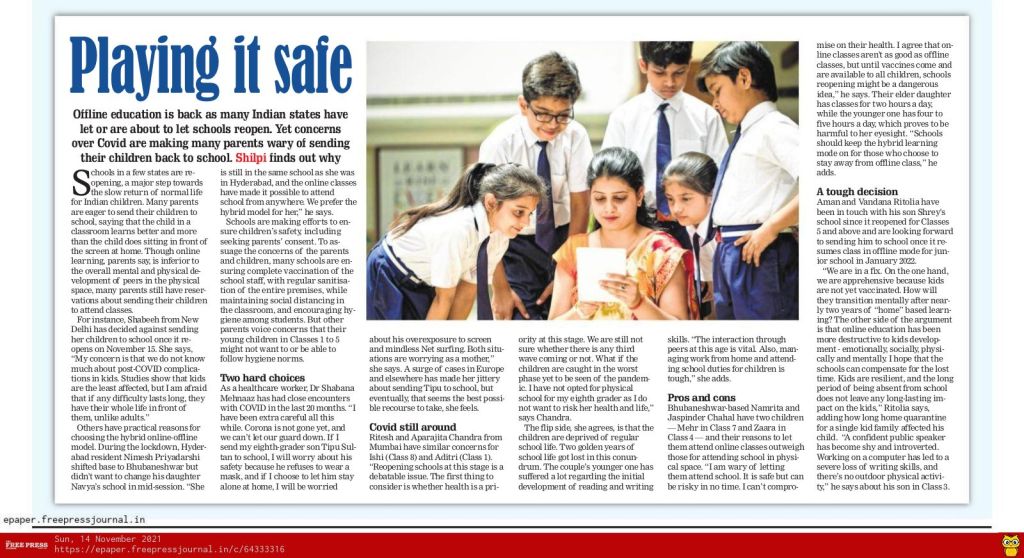
While some parents have no qualms about letting their children return to learning in the physical space, many others are wary. I spoke to a few of them to know the reasons behind their decision.
The drop in COVID-19 cases and rising vaccination figures bode well for wary parents and their children across the country. Gradually schools are reopening, with a few of them opting for a hybrid model — offline and online — for students who don’t wish to attend physical classes can log in and take virtual lessons.
The much-awaited move marks the slow return of normal life for children. While some parents still have reservations about reopening schools and sending their children to attend classes in the physical space, most of them agreed that what the child could do sitting in a classroom can never match what the child does sitting in front of the screen at home.
Apart from poor quality, a worried parent Shabeeh from New Delhi, who isn’t sending her children to school once it reopens on November 15, says, “My concern is that we do not know much about post-COVID complications in kids. Studies show that kids are the least affected, but I am afraid if any complication arises, and lasts long, it would be difficult to manage.”
For a few others, the hybrid model suits them best. During the lockdown, Hyderabad resident Nimesh Priyadarshi shifted base to Bhubaneshwar but didn’t want to change his daughter Navya’s school in mid-session. “She is still in the same school as she was in Hyderabad, and the online classes have made it possible to attend school from anywhere. We prefer the hybrid model for her, though the school has resumed offline classes for others as well,” he says.
Before opening their doors and resuming teaching within the four walls of the learning space, the schools had taken ample precautions, including seeking parents’ consent. To assuage the concerns of the parents and children, the schools had ensured complete vaccination of the school staff, with regular sanitization of the entire premises, while maintaining social distancing in the classroom, encouraging hygiene among students, etc. A quick roundup of those sending their children to school versus those who don’t want to, and why.
Noida based Amitesh, and Priyamvada Srivastava had sent their children Aadyant and Aarya to attend classes in the physical space when the school had reopened briefly in November last year. “We had no apprehensions this time around. No doubt, online learning was convenient. Kids could attend classes while being stationed here in Noida or Patna or Kolkata, and they did. But when it came to learning, there were no takeaways for children. My son told us that offline is real learning after returning home on the first day, November 8. We were relieved to see this return to normalcy,” he says. There were three children in Aadyant’s class 7 and four in Aarya class 5 on Day 1, but slowly the strength is increasing. Online and offline classes follow different timetables and timings, and there are different teachers assigned for each. “Children are responsible and particular about COVID protocols because any miss could have severe consequences,” she adds.
Patna residents Divesh and Deepa Sehara have been sending their son Milind Dev (Class 8) to school on alternate days from September 6, and every day after Dussehra break. Deepa says, “I was happy about school reopening. Children had forgotten about what life was all about before the pandemic. Their world shrank to a mere phone or a laptop. School is not just about studying; it is also about overall mental and physical growth. So it was a relief to see him back to where he rightfully belongs, the school.” Sehara duo has faith in the precaution being taken by the school, giving them peace that second home is as safe as their child’s first.
Dr Nisheeth Kumar, who has been working from home since the lockdown started in March 2020, was pleased with the move to reopen schools. His twin sons, Aditya and Arnav, 7, are in Class 2. They have been going to school for about a month in Patna. “Children have been exposed to testing times for a long duration, and with the situation showing improvement, I think it made sense to let kids resume schools and attend classes in the offline mode. Overexposure to screens has taken a visible toll on children. I am glad schools have reopened, and kids are back to where they belong. My children seemed quite eager to be back to school, and my wife, Rashmi and I heartily welcomed this move,” Dr Kumar states.
Priya and Rahul Singh from Bhopal had one nagging issue with the reopening of schools. “The only constraint for us was that children are not vaccinated yet. At the same time, we know that children have strong immunity to recover against infection compared to adults. When parents take their children to malls, markets, and other public places, why not to school?” Rahul asks. Duo’s daughter Rupal is in Class 8, and her school is running and about for all classes, from 1-12, both in online and offline modes. “People in public places can be careless with COVID norms, but not in school. Everyone has to follow them. I feel that little ones in Classes 1-5 are too young to follow norms, so the school should consider excusing them from the offline mode in this session,” Priya adds.
As a healthcare worker, Dr Shabana Mehnaaz in Ranchi has had close encounters with COVID in the last 20 months. “I have been extra careful all this while. Corona is not gone yet, and we can’t let our guards down. If I send my eight grader son Tipu Sultan to school, I will worry about his safety because he refuses to wear a mask, and if I choose to let him stay alone at home, I will be worried about his overexposure to screen and mindless Net surfing. Both situations are worrying as a mother,” she says. A surge of cases in Europe and elsewhere has made her jittery about sending Tipu to school, but eventually, that seems the best possible recourse to take, she feels.
Ritesh and Aparajita Chandra from Mumbai have similar concerns for Ishi (Class 8) and Aditri (Class 1). “Reopening schools at this stage is a very debatable issue. The first thing to consider is whether health is a priority at this stage. We are still not sure whether there is any third wave coming or not. What if the children are caught in the worst phase yet to be seen of the pandemic. I have not opted for physical school for my eighth grader as I do not want to risk her health and life,” says Aparajita. The flip side, she agrees, is that the children are deprived of regular school life. Two golden years of school life got lost in this conundrum. The couple’s younger one has suffered a lot regarding the initial development of reading and writing skills. “The interaction through peers at this age is vital. Also, managing work from home and attending school duties for children is tough,” Ritesh adds.
Bhubaneshwar based Namrita and Jaspinder Chahal have two children – Mehr in Class 7 and Zaara in Class 4 – and their reasons to let them attend online classes outweigh those for attending school in physical space. “I am wary of letting them attend school. It is safe but can be risky in no time. I can’t compromise on their health. I agree that online classes aren’t as good as offline classes, but until vaccines come and are available to all children, schools reopening might be a dangerous idea,” Namrita says. Their elder daughter has classes for two hours a day, while the younger one has four to five hours a day, which proves to be harmful to her eyesight. “Schools should keep the hybrid learning mode on for those who choose to stay away from offline class,” Jaspinder adds.
Aman and Vandana Ritolia from Bengaluru have been in touch with his son Shrey’s school since it reopened for Classes 5 and above earlier this year and are looking forward to sending him to school once it resumes class in offline mode for junior school in January 2022. “We are in a fix. On the one hand, we are apprehensive because kids are not yet vaccinated. How will they transition mentally after nearly two years of “home” based learning? The other side of the argument is that online education has been more destructive to kids development – emotionally, socially, physically and mentally. I hope that the schools can compensate for the lost time. Kids are resilient, and the long period of being absent from school does not leave any long-lasting impact on the kids,” Aman says, adding how long home quarantine for a single kid family affected his child. “A confident public speaker has become shy and introverted. Working on a computer has led to a severe loss of writing skills, and there’s no outdoor physical activity. All of it is bad,” adds Vandana about her son who is a Class 3 student at a private school in Bengaluru.
Durgapur based Rajiv and Indu Dalmia have two kids — Viha in Class 9 and Vedant in Class 3, while one goes to school, the other is attending online school still. “It has been over 500 days since the schools shut due to the pandemic. Having lost a year and a half of learning with adverse effects on kids physical and mental well-being, the benefits of opening schools with precautions far outweigh the risks,” says Indu. With everything else being open — theatres, malls, restaurants, airports, etc., the huge gatherings during festivals, it is high time to consider reopening schools for lower classes too with necessary precautions and restrictions, she argues. “Children are losing touch with the basic foundation of their lives, and that’s a huge cost to pay in the long term,” says Rajiv.


