
https://www.freepressjournal.in/weekend/national-safe-motherhood-day-maternal-mortality-rate-all-you-need-to-know-about-the-fall-the-cause-and-the-reason


The ethos of Padma Shri recipient Shyam Sunder Paliwal’s life revolves around water, daughter and trees. A resident of Rajsamund district in Rajasthan, Paliwal is the architect of the Piplantri Model that hinges on water conservation, environment protection and saving the girl child.
“It was not too long ago that the district was known as a hub of marble mining. When I took over as Sarpanch of Piplantari, I found that the water here was severely contaminated. The poor sex ratio was another worry. The winds of change began to blow when we started an initiative to plant 111 saplings to celebrate the birth of a girl child across the villages, nurture and help the tree thrive. Slowly, the rural communities had realised that the trees that would grow from these humble efforts would help the environment in more than one way. Simultaneously, we started water conservation efforts like building small check dams,” says Paliwal, founder of Kiran Nidhi Sansthan, a grassroots organisation committed to rural development.
His initiative brought about a visible social change and helped water and environmental conservation in Piplantari. More than three lakh trees have been planted here in the last ten years, and the water level has increased to 50 feet from 500 feet. “It is heartening to see my penance bear fruits. It has been a long and arduous journey spread over the last two decades. We never dithered but stayed put, instilled confidence in the people and won their trust to do this wonder here. It was possible because the community came forward and pitched its support to these initiatives for tree plantation, water conservation and saving the girl child,” he says.
But the work is far from over. The much-celebrated water warrior’s Piplantari Model is the perfect medium to convey the message to others, and many Panchayats and village heads are following in his footsteps.
He will continue his work on these three fronts all around the desert state and elsewhere in the country because it is an ongoing process. “There can never be enough of these measures to save the environment from climate change. We need to do more, all the more,” he emphasises.

Nagaur farmer Himmata Ram Bhambhu a.k.a. ‘Registan ke Ratna Ram’ was felicitated with Padma Shri for his enviable contribution to the environment. He adores and reveres trees and has so far planted five and a half lakh saplings in desert areas of Rajasthan, using ingenious ways to water and see them grow into green giants.
Bhambhu fondly recalls how his grandmother once made him plant a Peepal sapling and sowed a noble thought in his impressionable mind that eventually shaped his life. “She made me realise that humans could live at the most for 100, but trees live for hundreds of years. The thought stayed with me. Over the past five decades, I have been on a sapling planting spree in Rajasthan, and almost all of them have grown into green giants dotting Nagaur and other places in the desert state. They are my real wealth,” he says.
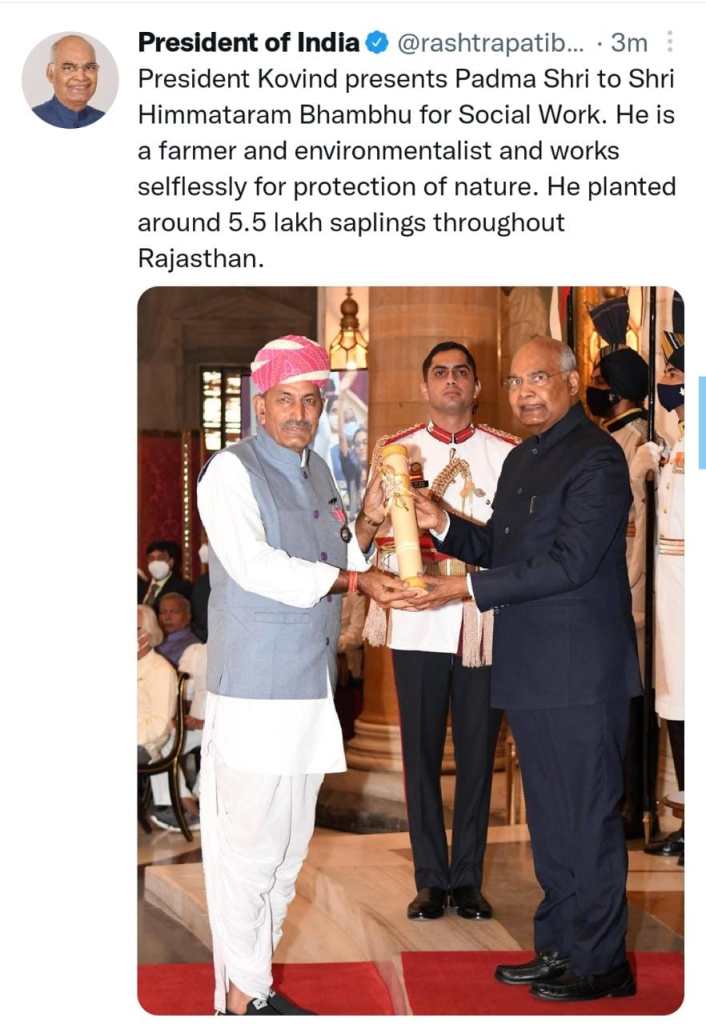
The district is home to India’s largest salt lake, Sambhar Lake and so Bhambhu had an onerous task at hand – overcome the problem of saltwater that could foil his green plan. He devised ways to counter it, and chose trees that could withstand water scarcity in the arid state.
He bought six acres of land in Harima village near Nagaur in 1999 and over the years, planted 11 thousand saplings, and today that patch of land has turned into a lush green forest and is the abode of hundreds of animals and birds. “Nagaur experiment proves that plants can grow in saltwater. We carried water from elsewhere, mixed it with saltwater to nurture this forest. Watering these saplings was a task in itself, but totally worth it. Our successful experiment here proves it. There are all kinds of trees in this forest, and what better than trees for rainwater harvesting. These are the biggest oxygen generators,” he adds.

Currently, the septuagenarian is in mission mode to plant five lakh more saplings by 2030 in the state. “I look at the 7 Js – jal (water), jungle (forest), jameen (land), jeev (animals), jaivik (organic farming), jalvayu (climate change), and jansankhya (population) – as the major standpoints of my green plan because each are inter-related,” he highlights.
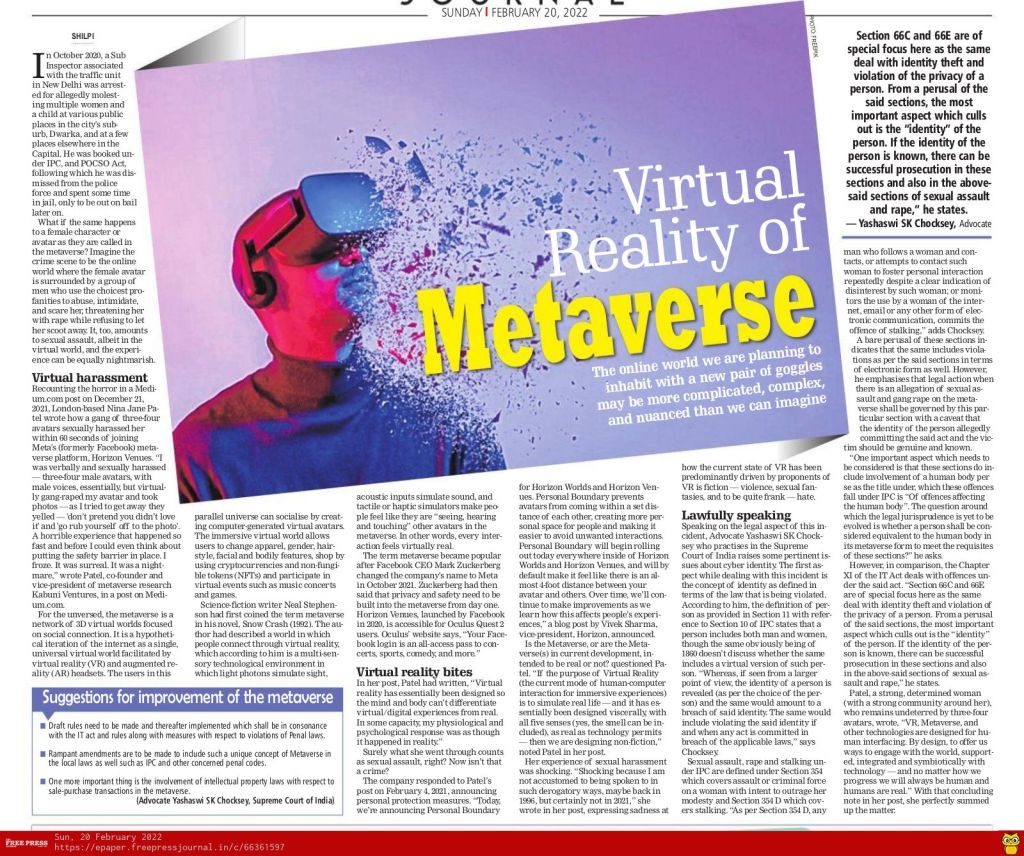

“If it is true that there are as many minds as there are heads, then there are as many kinds of love as there are hearts,” wrote Leo Tolstoy in Anna Karenina. Love is one complex emotion that has different definitions for different people. Ahead of Valentine’s Day, we delved deep into the love of all kinds, types and hues to explore what the four-letter word means to different people, and in the process, discovered an all-new vocabulary to define LOVE. Every great love starts with a great story, and that’s what connects Rekha and Jameel. If falling in love seemed next to impossible for Rachit, Sapna was determined, and that’s why their love is different. Gazala and Ahmed have evolved over the years, and love is both sweet, sour and spicy for them. For Nimisha and Rohini, love is an unsaid commitment to be with each other, while Manish Gaekwad is still waiting for love to come his way. It means selfless service for Vimla Kaul and giving for Tunisha. It is comforting for Anil and Kritika Rao and evergreen for widow Divya Juyal. But Love is Love for all.




Hindi is the common thread that connects, binds and gives a sense of belonging to storytellers who are using the different mediums to take the language to greater heights with their humble endeavours. Be it an award-winning French subtitler who is using his knowledge of Hindi and Urdu, and understanding of Indian culture to take Indian cinema to a larger market across the shores or an award-winning filmmaker who turned into an author while documenting the 2020 migrant crisis in the wake of countrywide pandemic-induced lockdown. On the other hand, a bilingual author turned filmmaker who is currently busy adapting his first novel for the big screen loves to transcreate stories in Hindi and English and simultaneously. A poet-journalist loves translating human emotions into verses and rues the neglect of the language over the years. A walking-talking library of Indian literature started a read-aloud storytelling project for the Millennials who prefer to read with their ears while a young literature buff is busy building a feature on his platform that will pay readers to read because “reading makes a person”.
Shillpi a singh
On January 10, the first World Hindi Conference was held in 1975 in Nagpur, Maharashtra. In 2006, Prime Minister Manmohan Singh declared this day World Hindi Day. Here’s what a few raconteurs in India and abroad had to say to celebrate the day.
French national and award-winning subtitler François-Xavier Durandy has been associated with many great films shown at major festivals in France. He is a trained translator who speaks English, Hindi, German and Urdu, besides his mother tongue French. Incredibly, most of the movies he has subtitled have gained recognition at international fora. The most recent being CNC Aide aux Cinémas du Monde grant for Girls Will be Girls produced by Richa Chadha and Ali Fazal’s banner Pushing Buttons Studios, and backed by Sanjay Gulati and Pooja Chauhan of Crawling Angel Films and Claire Chassagne of Paris-based Dolce Vita Films.
Having spent considerable time in India, he has picked up the nuances of the language and its cultural cues. “It is indeed paramount to slip into the shoes of both storytellers and their different characters. In French, the word interprète has three distinct meanings: interpreter, of course, and spokesperson and performer. As translators, we have to interpret the meaning of a text to the best of our abilities, act as the author’s spokesperson in a different cultural context and embody the characters, become their voice and somehow perform their part in the target language,” says Durandy.
Perfect command of the original language and a thorough knowledge of Indian culture comes in handy in his job as a subtitler. “My familiarity with Hindi and Indian culture does help me know the nuances and character dynamics of a script, even when it’s not in Hindi. I translated the script from English into French for Girls Will Be Girls for submission to the CNC Aide aux Cinémas du Monde grant. The whole script is in English, including the dialogue, at this stage. But when I was translating the lines of the characters, I was always thinking about what they would say in Hindi to see whether it would make a difference in my translation. A simple example is the second person pronoun. To choose between tu and vous in French, I would try to imagine what would be likelier between tum and aap,” he adds.
Subtitling is a major enabler per se, as it allows a film to find its audience beyond its linguistic boundaries. “All the more so with indie cinema, which is more content-driven.
The audience may enjoy big-budget films without subtitles or poor subtitles because of their immense production value. But when it comes to smaller films, shot on location and with lesser visual impact, quality subtitling becomes a must,” he says, explaining how cinema in India’s so-called regional languages has travelled and been embraced by the rest of the country and world, thanks to subtitles.
Film scripts that Durandy has translated for CNC were usually all-English because many writers have their dialogue translated into Hindi (or another regional language) later, with all pre-production work happening in English. “I worked recently for a debut filmmaker, and while the dialogue was in Hindi, the rest was in English, but you could tell that he would have been much more comfortable in his mother tongue. I felt that resorting to English was not allowing him to fully and eloquently express himself. People should always be free to write and talk in the language they’re the most comfortable with. That’s what we translators are here for!”
In a televised address to the nation at 8 pm on March 24, 2020, Prime Minister Narendra Modi announced that the entire country would be in ‘lockdown’ (from midnight of March 25) to mitigate the spread of the coronavirus. The sudden measure wreaked havoc on the lives and livelihoods of daily-wage migrant workers across the country and had far-reaching repercussions. Award-winning filmmaker and author Vinod Kapri, who had been actively engaged in COVID relief work in and around Delhi NCR during those days, was rattled at the misery unfolding before his eyes. One day, he knew that seven of them were planning to set off on bicycles to their hometowns, from Ghaziabad in Uttar Pradesh to Saharsa in Bihar. “My seven heroes – Sandeep, Mukesh, Ritesh, Aashish, Rambabu, Sonu and Krishna – had no employment, no food, and no place to call home after the sudden lockdown. Their seven-day-long journey speaks of their indomitable spirit. They defied all imaginable odds to cycle for 1232 km,” says Kapri, who accompanied them on this journey, shadowing them until they reached their hometown. The heartwrenching account of the construction labourers pedalling their way home was first released as a documentary early in 2021. It had two songs of despair – “Marenge To Wahin Jaakar” and “O Re Bidesiya” – penned by Gulzar and composed by Vishal Bharadwaj.
One thing led to another. “I only wanted to document their journey, but there were many things that I couldn’t capture on camera but jotted in my diary. The book was never on my mind. But a close friend suggested that I put it down on paper because he felt that 1232 Km spotlighted the COVID-19-led migrant crisis in India. It found a home, and quite on its merit, be it the OTT platform or publishers because this extraordinary story really pulls on the heartstrings,” recounts Kapri. His debut book has been released in Hindi, English, and four other regional languages. The response to his documentary and books has been overwhelming. “It is a documentation of the plight of migrant workers. I want it to reach more and more people so that people know the nameless faces around us, who sweat it out day in and day out only to make our lives easier but bore the worst during the lockdown. The royalty of these books will go to these men because it is their book,” he emphasises.
It is quite commonplace for the Millennials to be quite well-versed with Franz Kafka, Khalil Gibran, Haruki Murakami, Gabriel Garcia Marquez, and many other literary giants of their ilk from across the world. But seldom do they even care to flip through the enormous body of work of litterateurs from the Indian subcontinent. Mumbai-based septuagenarian former adman, Urdu connoisseur and avid storyteller Jameel Gulrays started a read-aloud storytelling project called Katha Kathan in 2015 to help the Millennials “read these literary gems through their ears.”
“My storytelling project aims to explore the rich tapestry of literature in Hindi, Urdu, and other Indian languages to preserve, promote, and popularise them so that they aren’t lost into oblivion but live on for many generations. My band of storytellers at Katha Kathan are the backbone of this. Our zealous efforts are aimed at the larger cause of preserving the vast repertoire of Indian literature,” says Gulrays.
After wowing the audience through live sessions held in Mumbai and many other cities during the pre-pandemic days, a successful run on his YouTube channel, and podcasts on Soundcloud, Team Katha Kathan forayed into the voice-based social network app Clubhouse in 2021. The literary evening enlivens the statement made by Premchand in his memorable short story, Eidgaah, “Club ghar mein jadoo hota hai” through weekly dramatised readings of classics. “We endeavour to reintroduce and rejuvenate languages and motivate the younger generations by narrating the literature and ensuring it reaches them through the medium (read social media platforms) they consume,” states Gulrays.
The session sees the audience from India’s nook and corners and across the world tuning in every weekend to brush up on these classics. It is a mix of both literature lovers and newbies to the world of Urdu and Indian classics. It often has celebrities like Rekha Bharadwaj, Vishal Bharadwaj, Naseeruddin Shah, and many others joining in to be regaled by stories.
Journalist and poet Pratap Somvanshi made a failed literary debut when he was still in school. “I was in class 8 then and had written a short story. I sent a two, and a half-page story accompanied by a three-page covering letter addressed to the editor of Nandan. The story was rejected, but the thoughtful editor sent a heartwarming note,” reminisces Somvanshi. The rejection letter laid the foundation of his career path. He is the editorial head of a leading Hindi national paper and writes poetry. “It is ‘bhavanuvad’ – a translation of human emotions and relationships,” he adds. In 2016, his first anthology of poems – Itwar Chhota Pad Gaya – a culmination of his friends’ tireless efforts and wife’s insistence was published. “I love poetry and live it too. My poems and life are interdependent. They can’t exist in isolation,” he says.
Commenting on the long-standing neglect of Hindi, he gives an overview of the publishing industry. According to him, today, it is like a business where the publishers look for saleability and numbers. It could also be a co-operative where the author pays to publish his book or is Atmanirbhar venture where the author opts for self-publishing option. “There were a few Hindi publishers till a few years ago, and they too had their priorities. Books in Hindi were never published to sell copies but to be stocked in libraries. There are 150 crore Hindi speakers worldwide, of which 100 crore can read and write Hindi. But when it comes to Hindi, only 1000 copies are published, be it novel, poetry or short stories.”
Somvanshi whose couplet – Ram tumhare yug ka Ravan accha tha – is the most forwarded message on social media platforms on Dussehra. “Social media has made crowd sharing of emotions so easy, and it bodes well for Hindi writers. People are discovering literary gems on social media, and then they go hunting for books by these poets, be it of Jaun Elia or Fahim Badayuni,” he states. A few poets find publishers on their merit – be it known face or saleability – but a lot depends on the readers. “They create the market and not the other way around,” he says.
Ankur Mishra wears many hats and aplomb. He is the founder of Kavishala and Foreantech and the author of seven books, but he remains a literature buff in one’s heart of hearts. He started a website called Kavishala for poets to have an online mehfil of sorts. “Kavishala is a one-stop platform for literary minds. Ease of getting good and genuine content at one place. Kavishala has many verticals – Kavishala Talks and Kavishala Campus Ambassadors, and Kavishala Sootradhar, where one can access the works of eminent litterateurs of yore. We must make the younger generation aware of the treasure trove of Indian literature and languages,” says Mishra.
Another interesting vertical on the platform, Kavishala Labs, helps readers access exciting articles about Indian literature and writers. “The Kavishala team works hard for these articles, and they come up with not known and lesser facts for an engaging read. Kavishala Sootradhar is a vertical where we have 6000+ poets and writers from Indian and world literature, and the content is free. We aim to be a virtual library for our readers in easy clicks. Kavishala has three million-plus monthly page views on this content only,” he adds.
80% plus writers and poets are from the Hindi language to date. “The number of readers in Sootradhar is encouraging. We’ve 13% plus page views from the USA and 10% plus from UAE, which means Hindi literature has a good reach in non-Hindi speaking countries. If we get help from investors, we can make it even bigger and better,” he says. On World Hindi Day, Kavishala is conducting Kavishala International Meetup, where the platform will bring together Hindi and Hindi literature lovers in one place. “The event will be virtual and private. Our target is to have at least 150-200 people from different countries,” he adds.
Another plan in the offing includes making Kavishala the word first kind of platform, which will give readers money for reading. “We attempt to make reading a habit. There are a handful few readers left among the younger generations. We want to pay them for reading in an attempt to revive that reading culture,” he emphasises.
Filmmaker-author Pankaj Dubey has an uncanny knack for transcreation. With nine bestselling titles to his credit, five in English and the rest four transcreated in Hindi, almost simultaneously, Dubey is currently busy adapting his first novel What a Loser (English) and Loser Kahin Ka (Hindi) for the big screen. What sets him apart from others of his ilk is the two-language deal for all his books from the publishing house, Penguin Random House. “I owe it to my editor, late Renu Agal, who spotted it first and encouraged me to write in both. Being bilingual is a significant marker in South Asia. It helped me bag the nomination for a prestigious writer’s Residency in Seoul, South Korea, in 2016,” says Dubey, who was one amongst the three novelists from Asia to get this opportunity. “I am bilingual, so I write all my stories together in Hindi and English. I never try to translate. Since my first book, I’ve been selling quite well, and that’s been my purpose because if I’m not interested in being a much-loved author, I would rather write diaries and not get them published,” he says.
The spectacular success of his first novel made it a breeze for the rest. “I always had conviction in my story and my telling. I have been fortunate, but I know that many others don’t have it easy. But once you get a publisher, and if your book does well, the sky’s the limit,” adds Dubey, who pursued his filmmaking passion and his first film, Maratha Mandir Theatre, is streaming on Disney Hotstar+.
He owes his success to his storytelling and adaptability, both of which are up to date. The books are popular among the Millennials because the characters speak the readers’ language. One problem with Hindi literature is that the growth of writers in Hindi literature has been slower than the growth of readers. Moreso, because the readers and their tastes have evolved over a while.
Commenting on the challenges of contemporary Hindi writing, he says, “Most Hindi writers, if not all, are stuck to the language and vocabulary of the past, which makes it dull and uninteresting for the readers. The idea is to contemporise things and accepts the linguistic ingredients of the contemporary world and society. That helps a lot,” he adds.
Dubey attributes the democratisation of the reading and writing process to the advent of social media. “It has given access to everyone to all kinds of literature at the click of a mouse. So it is very challenging for the writers if they don’t try it well. The attention span of the readers is decreasing every day. Social media has made it challenging for good writers. At the same time, it has opened new ways to promote your work. So you can spread awareness around your writing, and once your writing is light, it will fly on its own,” he states.


In 2022, a visually impaired assistant professor #AkhileshKumar waits to hold his book in hand, while a mother-in-waiting #JaspreetChandhok is looking forward to bringing home her ‘adopted’ child.
A person with epilepsy #VinayJani will run to create awareness for the less spoken neurological condition, while a Bicycle Mayor #ArshelAkhter will pedal for green mobility.
#ShramanJha of #WWFIndia believes the emphasis shifts to a more proactive, participative stance with the theme “Shape our Future”, be it for the #EarthHour or as #AkashDeep of #GRIHACouncil says on #greenbuildings that can be #sustainable and #affordable.
An entrepreneur #SarvmeetOberoi hopes to pamper our pawsome family members at his pet facility – #PetfelixDogBoarding – a little more. At the same time, a chocolate brand #Kocoatrait led by L Nitin Chordia expects to become more sustainable and increase its contribution to the circular economy.
A martial arts expert #FaisalAliDar hopes to initiate more children into sports and sportspersons into coaching while a cafe’s founder in Jamshedpur #AvinashDugar is brewing a change for the deaf.
A busker Debojyoti Nath hopes to make more music and spread kindness, and a farmer #PradeepGawande is sowing hope to reap prosperity in 2022, for himself and others of his ilk.
What we left behind are memories. What we are taking forward are moments. Here’s what 12 wonderful people are looking forward to this year, their wishes, and everything in between worth celebrating!

 mindthegapalways