
Writer-filmmaker was in conversation with senior journalist Kaveree Bamzai at the launch of his novel Oonga at the recently concluded 14th edition of the Jaipur Literature Festival.

Sanjoy Roy: Welcome back to the 14th Jaipur Literature Festival protected by Dettol. We are delighted to bring it to you from here at the Diggi Palace front lawn live. It’s a pleasure to present today, Oonga by Devashish Makhija. He’s in conversation with Kaveree Bamzai and introduced by Nandita Das. Director and writer Devashish Makhija’s latest book Oonga is a powerful novel based on his first feature film of the same name. Capturing the inherent paradox between dystopian development and utopian ideologies, the book narrates the journey of a little boy in the midst of a clash between the Adivasis, the Naxalites, the CRPF and the mining company. Makhija’s other books include When Ali Became Bajrang Bali, Why Paploo Was Perplexed, Forgetting and Occupying Silence. He’s also the director of the feature films – Ajji and Bhonsle – and the short film Taandav. Among others, in his conversation with Kaveree Bamzai, Makhija dives into this evocative tale of identity and the tragedy of victims of violence forced into battles, they don’t wish to fight. The book is being launched here at the Jaipur Literature Festival 2021. Nandita Das has acted in more than 40 feature films in 10 different languages. Manto, Nandita’s second directorial film, premiered in 2018 at the Cannes Film Festival. Her first book, Manto and I, chronicles her six-year-long journey of making the film. Nandita, we’re delighted to have you here to make an introductory comment on Oonga, a film that you acted in. Nandita Das, over to you.
Nandita Das: Oonga is a film that I did almost nine years ago. When Dev came to me, it was his first film but I could see he was very passionate about the story and it’s a story that you know is really exploring the difficulties that Adivasis feel, especially as this is set in Odisha, a state that I come from, because they are caught between the Maoists, Naxal movements and outfits that are really fighting for their rights but can also get violent and at the same time those were trying to mainstream them in the name of development and how the common Adivasis just get completely caught between fighting for their rights and really not knowing how they should be dealing with their lives. You know, it’s a very complex issue and seldom do we see such complexities being told simply and powerfully. In fact, increasingly such films that are really representing stories of the people at large are vanishing from our collective consciousness. So it was definitely a film that I felt, I wanted to be part of. Hemla’s character was also really nice. It was very interesting because she’s kind of a conduit. She’s neither part of the Naxalite movement nor is she part of obviously the government or the mining corporation and all those people who are trying to mainstream them. She is really wanting to educate the children. She feels that’s where the power is and ideologically she’s very strong and it was lovely to be in Odisha and to be playing a character there. So yes, I mean it was a film that was close to my heart and I was really disappointed that it didn’t get released properly. Many independent films, unfortunately, bear with that fate.
I’m so happy that Dev decided to give it another form because the story had to be told and it’s really wonderful that now it’s in a book and we can all read it. And I think, you know, a story has its own soul and it must continue whether it’s through a film or through a book and maybe they’ll feed into each other. Maybe once you read the book, you’d want to see the film and those who have seen the film would want to read the book.
Nandita Das
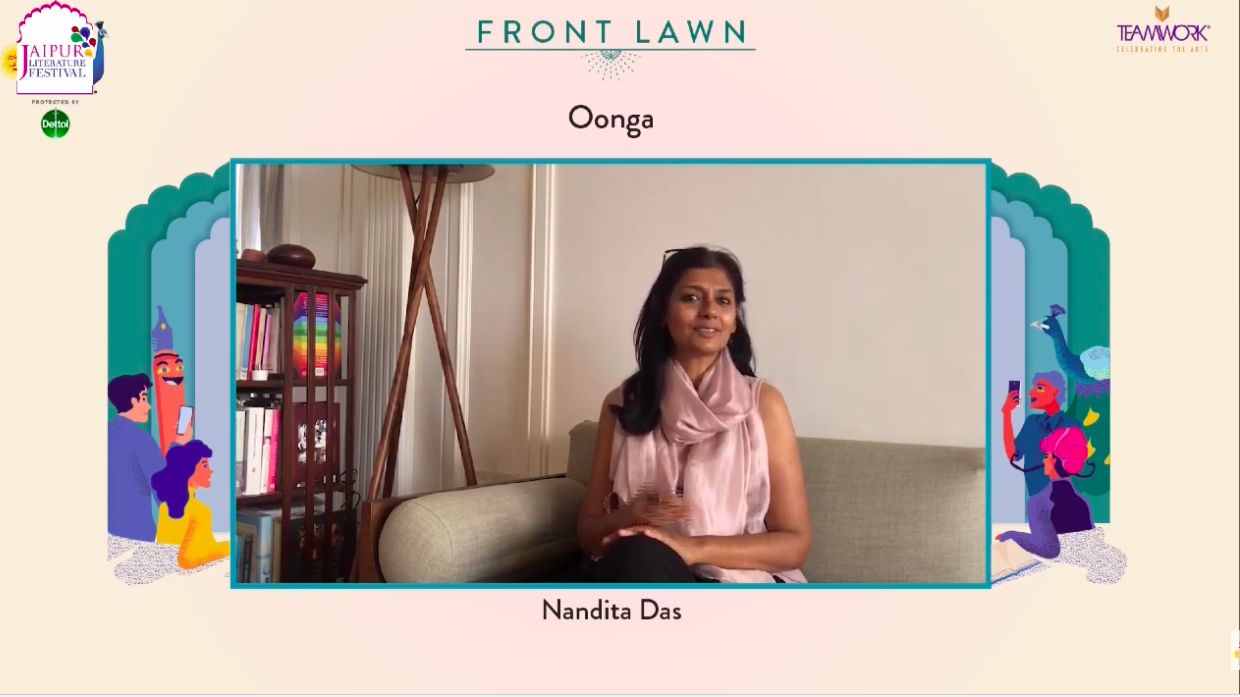
I just want to wish Dev and the publishers and everyone who’s been involved with the project good luck, and I’m sorry that I couldn’t be at Diggi Palace, quite a favorite place to come to JLF, but here is wishing the book and the people who have been with that journey for this long. Twelve years is not a short journey. So glad Dev, that you stuck with it and that you’re bringing this story to us. Thank you!
Sanjoy Roy: Thank you, Nandita Das for setting the context for Oonga, the film and Oonga, the book.

Devashish Makhija has researched and assisted on the movies Black Friday and Bunty Aur Babli. He has written numerous screenplays, notably Anurag Kashyap’s yet-to-be-made superhero saga Doga, has had a solo art show Occupying Silence, written a collection of short stories Forgetting, the forthcoming book of poems Disengaged, the bestselling children’s books When Ali Became Bajrangbali and Why Paploo Was Perplexed and been featured in numerous anthologies including Mumbai Noir, Penguin First Proof and the Sahitya Akademi’s Modern English Poetry.
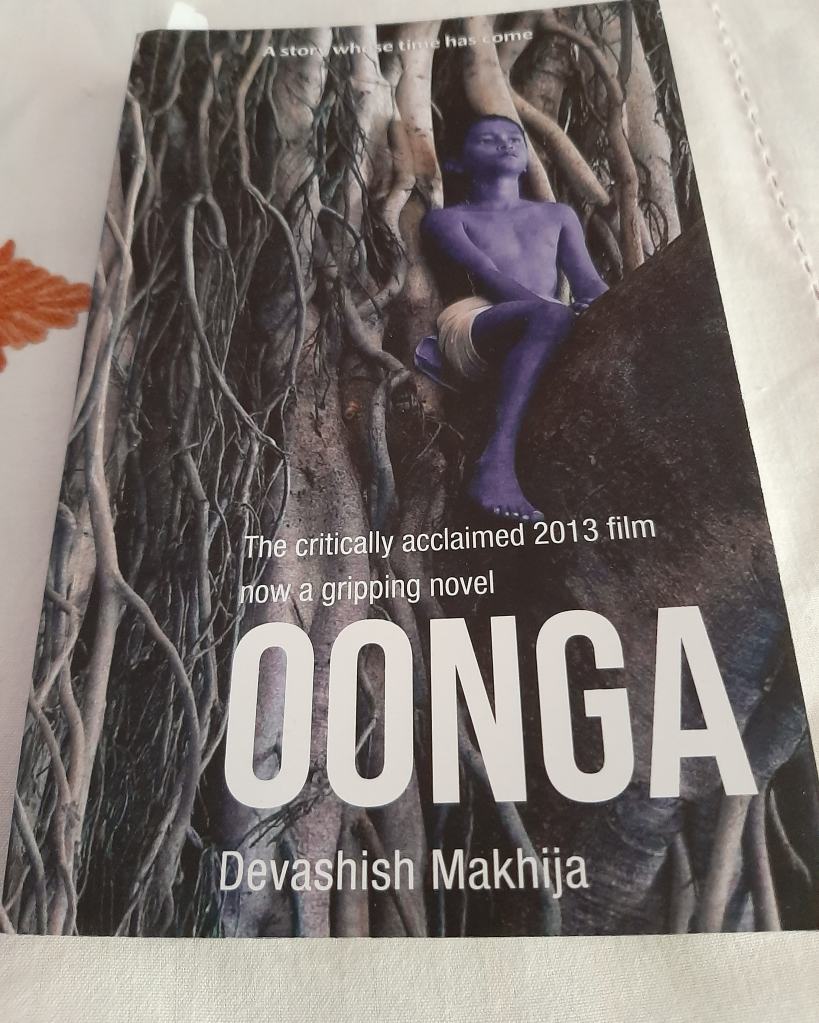
He has also written and directed the multiple award-winning short films Taandav, El’ayichi, Agli Baar, Rahim Murge Pe Mat Ro (Don’t Cry for Rahim LeCock), Absent, Happy, and the critically acclaimed full-length feature films Ajji (Granny) and Bhonsle. His films have competed and won awards at the international film festivals of Rotterdam, Gothenberg, Beaune, Black Nights, Busan, Glasgow, Tampere, MOMA, APSA, Barcelona, Singapore, amongst many others. Oonga, a feature film he wrote and directed in 2013 never released in Indian theatres despite a critically acclaimed film festival run so he reverse-adapted it into a gripping novel.
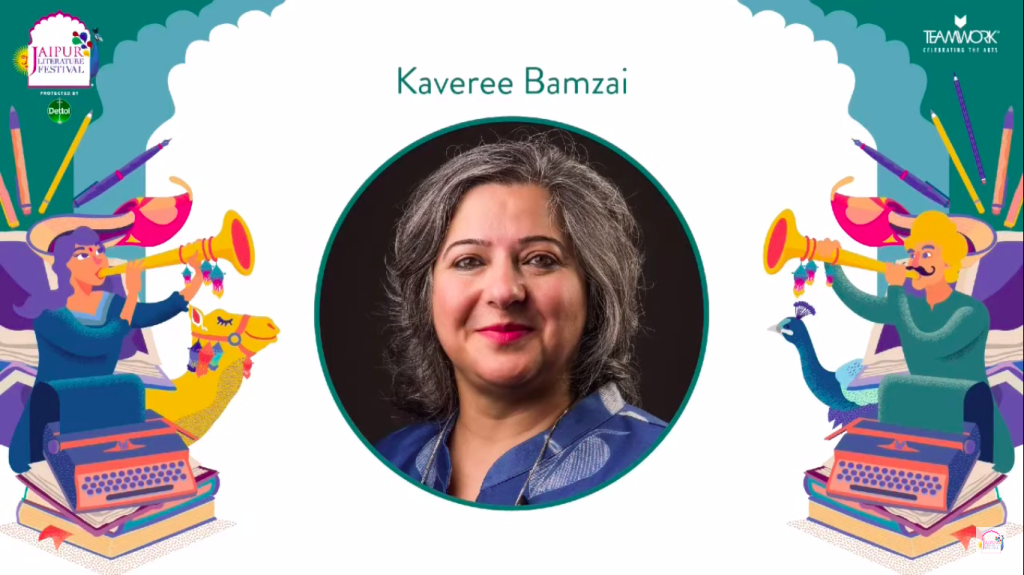
Kaveree Bamzai is an independent journalist. She was the first, and so far, only woman editor of India Today. A recipient of the Chevening Scholarship, she worked for the Times of India and Indian Express before this. She is the author of No Regrets: The Guilt-Free Woman’s Guide to a Good Life, Bollywood Today and two monographs in the series Women in Indian Film. She sits on several committees, including the Women Examplar Committee of CII and is recognised as a changemaker by Save The Children charity.
Kaveree: Devashish, it’s such a pleasure to see you and it’s been an absolute joy to read the book. I’ve spent the last two days doing that and it is truly gripping. It’s very powerful. I want to start with the line that you have there… “We, who take from the Earth and give back, will be replaced by those who take and never give back.” This really is who we are right now and I think the pandemic has taught us more than ever that this cannot go on. How amazing is it that the movie that you made, well, quite a few years ago, 2013, when it was released, is still so relevant? How amazing is that and how much more relevant is it? So, talk a little about that journey about making that movie, making this book and, at this moment in time.
Devashish: The sad thing is I don’t think it’s amazing as much as it’s hugely tragic. Yes, it’s hugely tragic that we can just never learn from our mistakes and I have travelled the areas, the Adivasi areas of Chhattisgarh and south Odisha about 11 years ago and for about five or six years before that, I was curious and dissatisfied with the narrative that I was reading in the mainstream media about what the Naxalites wanted; how they were being called to be the greatest internal security threat to this country by the Manmohan Singh Government and I felt that I wasn’t getting the complete picture. So when I travelled to those areas and the things that I saw, they sort of reeked of what the British had done to the Indians in all those years and now we were doing to our own countrymen. So, somewhere you know, that, that wheel was turning over and over again and we were not learning from our mistakes. What was relevant 200 years ago, was relevant 10 years ago. What was relevant 10 years ago, continues to be relevant today. I don’t know if it’s going to change. That’s the biggest heartbreaker.
So all the things that I wrote in Oonga in 2012 when I wrote the script and eight years hence when we were doing the final edits of the book, Tulika and I and I were re-reading material, re-reading my research (I had several exercise books where I had made notes as I was travelling through those areas), nothing had changed. Not one shred of research material or statistic or you know things that broke my heart in 2010. Nothing had changed. So somewhere, a book like this, sadly, would probably be relevant till we die.
Devashish Makhija
I don’t know what our next generation will see but the pandemic also hasn’t changed anything. We are back to being monsters. I thought we would, you know, re-evaluate our decisions, but no, we’re not.
Kaveree: Absolutely! And, in fact, Devashish, you also call it the company and company could be, you know, the company that you mentioned in the book. It could be the East India Company; really nothing changes; that’s really as you said is quite tragic.
The other point is the relationship between the Adivasis and their land and you know, we see it again and again and all the protests that we see — the farmers’ protests as well, their relationship with the land is so deep. And in fact, the land, and as you say in your book also reacts to their moods, you know, the trees cry, you know, the Earth cries; talk a little about that relationship. It’s so deep and so moving.
Devashish: Yeah. So in fact, it’s not just the Adivasis. If I say, any of us say that the Adivasis have this deep connection with nature and you know, we shouldn’t deprive them of that connection with nature. I think it will smack of an over-simplification. It will smack of talking about them as the other. I think we all have that connection; it’s just that with urban life, the kind of life that we live, we’re getting increasingly disconnected. So for me talking about these things using the Adivasi as a medium, was trying to tell urban youngsters, you know because it is young adult fiction; it’s for age group 16 and plus; I am hoping kids just out of school or in the last years of school will read this and wonder if they lost something by being born into these urbane, consumerist technologically, dependent lifestyles. So it’s all of us, who can, you know, pick cues from nature, live in harmony with nature and gain a lot, but we’ve just, we have lost that ability. So the Adivasis are a reminder that we have that ability and if we don’t live that codependent lives we are going to self-destruct faster and faster.
Kaveree: Yeah, another remarkable thing about the book is the women and I think that is the key here. The women are the ones who’re holding this community. They’re holding really a whole world aloft on their shoulders, you know, whether it’s Hemla or Oonga’s mother, they really are the spine, the backbone of the community.
Devashish: Women as characters and again I might smack of over-simplification here, but being a man when I made this film, Ajji, about five years ago, it was me trying to understand, what is the female energy and what is my relationship as a man being born into a world that is increasingly patriarchal. Even the MeToo movement really didn’t find success because we are so deep-rootedly patriarchal people; we need something stronger than that. So, from Ajji onwards, I’ve been questioning my role in the scheme of things that how can I raise questions that can hopefully someday 10 years or 100 years later lead to an answer.
The women that you speak of in Oonga, were there in the film as well. But I think I was not equipped to explore them to a certain depth like I could in the novel. For me Lakshmi, the Naxalite leader, Hemla and Oongamma are the beating heart of the story; Oonga is literally just the face. He’s not the beating heart of the story.
Devashish Makhija
So for me, it was important to explore those themes that I have now, you know been exploring the last four to five years. They were not in the film when we did that all those years back.
Kaveree: Devashish, the other thing is that it’s in Odisha, but it could be anywhere; it could be Kashmir, it could be the Northeast, that is the tragedy of India. It could be in any part of the country and it would be the same issue and I really admire the way you’ve been able to capture the CRPF sort of mindset, you know, it’s a very peculiar mindset, but we often don’t see them as victims and here you’ve been very non-judgmental and you have shown, they’ve suffered too. You have Pradip’s character, who realizes that the only way to have powers is to be in uniform; his father ended up in uniform guarding the very land that he sold them and it’s all such a terribly vicious cycle, but they are as well as victims.
Devashish: You know, as you were saying, it was a faceless company. It could be the East India Company. It could be a private company. It could be a public sector company. It was irrelevant to me what the company was. What was relevant to me was the thought process behind something as hegemonious and huge as a company that will only see its profit and when something that huge, you collectively are up against something, everybody ends up being a victim.
Sometimes even you don’t realize you’re a victim like Manoranjan, the CRPF commander. He doesn’t realize he’s a victim of a larger thought process, of a larger machine that is only using him for a certain end goal; and when you’re collectively up against that what can you be but a victim because you can’t use your mind and your consciousness to take decisions against that larger vicious thing; so for me, it was important to see that the CRPF are not in control. The Naxalites are reacting; they might have sometimes very very valid agenda, but they are not in control either.
Everybody is merely reactive and somewhere, the atmosphere that we live in today in this country, anyone who wants to question anything that the establishment does, we are all just reacting and that’s exhausting. I wish people act upon something sometimes because we spend all our lives we have reacting and we have no energy left to really act upon you know, our true impulses; somewhere that helplessness that I was feeling, I wanted to explore through this idea of everyone being a victim; a helpless victim.
Devashish Makhija
Kaveree: Absolutely. I think, the other point that every form of protest that we see, every form of dissent that we see, you see echoes of it in your book. The idea of asking for papers. The idea of asking for identity. I mean the whole agitation against CAA was all about that. The whole question is being explored here. It is quite contemporary in that sense. Talk a little about that sense of identity as well. The Adivasi sense of identity versus the Company, which could be anything. How does it play out?
Devashish: You have to look at the farmers’ protest today. When I speak to my peers, my contemporaries in the city, everyone looks at the farmers of India as one big mass. A faceless mass. And when they talk about what they’re up against, the government policies which are pro-corporate, you have an Adani or Ambani which has a face. They are not faceless.
Somewhere those who don’t understand what the farmers are protesting for and if they don’t try to understand how that’s important to the rest of us. We will always see that protesters faceless and they will always see what they’re protesting against as having a face and that’s what makes it easier for them to relate to you know the system because the system always comes with some sort of a face, be it the government or a corporate. So here also in my story, I was trying to flip it. I was trying to make the company faceless. I was trying to give a sense of identity to those who are paying that price, whether it was the CRPF or the Adivasi. It could be the farmers today in India or it could be the Dalit.
Devashish Makhija
It could be you know for lack of a better metaphor here, I myself feel rather displaced because I’m a Sindhi. My parents both of them came from Pakistan, which is now Pakistan during the partition. I was born and I grew up in Calcutta where I wasn’t a Bengali, but I was around Bengali culture a lot. I’ve been working in Bombay for 18 years, but I’m not Marathi, but I’m around Marathi culture a lot. My two films are Ajji and Bhonsle and, if you don’t know better, sound like Marathi films so I have been struggling with identity. I don’t know where my roots are. Yeah, so when I am trying to question the system as to my place in the scheme of things, I don’t know where to begin because I have nothing to prove that I have an identity that allows me to question this system.
If I multiply my helplessness by 5,000, I get the helplessness of an Adivasi or a Dalit or a farmer and for me, that breaks my heart, so I needed to give them faces and explore their identity.
Kaveree: The other interesting thing in the story is the importance of the eye. You see it everywhere in the novel. Everyone has to keep an eye out, ahead, behind. There is a symbol of the eye that represents the company. I found that again a very very powerful metaphor. Talk about that.
Devashish: Again you have beautifully caught it because somewhere I was trying to simplify and allegorise the idea of surveillance and today with modern technology, the system can observe you, surveil you a lot more but it’s always been the case. Even when we had landline phones, if the government wanted, they could tap your line. This goes back to my research for Black Friday. I spent six months researching material that S. Hussain Zaidi had already put in the book, but when you try to give faces for cinema, you need to research the people a little more deeply. So around that time, I spoke to people whom I can’t name. I spoke to the CBI. I spoke to people in the IB. I spoke to the police, the crime branch and there were thousands of hours of phone recordings that they had of people that I can’t name, but they’re like all the phones were tapped and they were just surveilling, surveilling, surveilling, all the time. I asked them that you know, you’ve got all this material, what is that you want to do with it. They said, if we release or leak it, we will not be able to hold on to the government for more than five minutes. So they sit on all this material.
I knew that back to the 1960s, when we could tap anything anywhere at will; today it has just become easier. So how do you then live a life of Liberty, Equality, Fraternity and all the things that the Constitution enshrines? How do you live that life? If you are being watched all the time? If you are supposed to toe the line. Do you walk the talk that the system wants you to? How do you manifest those ideas in the Constitution? So that idea of the eye for me was to create that sense of dread that you know, you’re being watched and you don’t have freedom even though you think that you do. It is a delusion.
Devashish Makhija
Kaveree: Yeah, absolutely, but I found in Hemla’s character so much purity, so much courage and so much fearlessness and I think that is the fearlessness that we have lost as a society. We’re also afraid. Aren’t we? I think that’s the biggest threat to us. It’s not what the state is doing to us. It’s not what the environment is doing to us and it’s our own fear and I think Hemla is such a hero to me because she has so much courage.
Devashish: One of my biggest inspirations for Hemla was Soni Sori and when I sort of knew more about her or watched her at work. There’s a line that I use often that a woman without hope is a woman without fear. So when you take away hope and I saw it in Soni Sori’s eye. If you look into her eyes, I see an absence of Hope, but that doesn’t mean that it manifests as utter Hopelessness. The absence of Hope is not Hopelessness but that absence of hope because she seemed so much taken away brings her certain courage. She has nothing left to lose. What do you take away from her anymore? So somewhere for Hemla, I wanted to manifest that she might have seen so much that we are not privy to that she cannot fear anymore. What is the worst that can happen that she will be physically assaulted, that someone will chop her hands off? She has seen that too. She has seen that happen. And something a friend of mine said to me during those journeys through the Adivasi area. He said that you know, we have to lose our fear of being thrown in jail.
Most of the time people don’t act upon a certain thing that they want to question the government about because they are afraid that they will get thrown in jail. He said you have to obliterate that fear. Forget that you will die in jail. You will get food. You will be able to take a piss when you want. You will get to dump once a day. You will get to sleep. Maybe the mosquitoes would bother you, but you will not die in jail. So if you take away that fear, it takes away your fear to question the system because the system has only one way to bring you down. By disciplining you. By throwing you in jail. By threatening you with a warrant. So I want to take talk about those things through Hemla.
Devashish Makhija
Kaveree: And you have done that really well. The other point I think comes through so powerfully is that question that we saw of the huge exodus during the pandemic when people went home and they were walking the streets with all their belongings on them. It’s not just about poverty. I think at the end of the day, it is about dignity. They want respect and if you don’t give it to them then, you know, at some point they will break.
Devashish: Dignity is everything and that’s one of the saddest things when you go to an Adivasi village where maybe five or six men have been missing for years because they were thrown in jail for merely asking for their rights. The first thing you see is that crushed soul because amongst themselves there’s a lot of dignity, but when they have to face the system like we went on to help one of the Praja lawyers there with a particular bunch of cases. So because we could read and write in English, so it was easier to read documents for them. These documents come by the fucking kilogram, so they always need help to read documents and respond to them. So we went to jail and we tried talking to the Jailor. We tried talking to their lawyer the first thing that the Jailor or the lawyer did was to get up and look through us and walk away. We felt insulted. Now imagine, we were there for a month and a half. Now imagine having to put up with that every day where you’re not acknowledged. When nobody looks you in the eye. Nobody talks to you. They just get up and walk away. That can make you think of doing very extreme things.
Kaveree: And yet you have Hemla trying her best to initiate dialogue, trying the best to teach Hindi to children so that they can grow up and speak to the company or the CRPF or whoever in their own language. So there is some amount of hope but it gets crushed so easily. Yet that plea for peaceful dialogue is still a very powerful hope that you end with even in your book, although it is dystopian. It is still there. The plea for hope. The plea for dialogue. To understand each other and to listen to each other. Let’s talk a little about how that is so much an absence, not just in that community, but everywhere, currently.
Devashish: You know that the dystopia that you speak of I think manifests in that one line wherein the end Hemla has run back to the Village. She still trying to talk to Manoranjan, but suddenly she has this gun pointed in her face and she suddenly realizes that I’ve been talking to the barrel of this gun all the time. I’ve not been talking to the people behind it because this is what they thrust in my face when I’m actually pleading. Somewhere that absence of communication that everyone is talking different languages.
When I say different languages, I don’t mean literally someone speaking Kovi or someone speaking Hindi but someone speaking the language of the gun when someone’s trying to speak the language of the heart. There cannot be a dialogue in such a situation. The gun has to be put down if there has to be a dialogue. When you see the farmers’ protests, there are water cannons or tear gas, metal rods. When you walk in with that you can’t have a dialogue with farmers who actually didn’t want to attack you in the first place and they still haven’t. But the face of the system is always, almost always, that of, you know of a violent weapon and you cannot talk to that beyond a point. The weapon has to be shed. Faces have to emerge for that dialogue to happen and somewhere the book is trying to entreaties. It is trying to make a case for that. But how possible is it until that effort is taken from both sides, not just one side?
Devashish Makhija
Kaveree: What does it do to you personally? You see all these beautiful, proud people, as you said earlier, you see their souls being crushed and you see so much oppression. I mean we see it too, but you’ve undertaken this journey and you have chronicled it. What does it do to you as a person?
Devashish: I had behavioural issues around the time I was working on this material. I’ve had physiological issues. Around the time I was making Ajji, I contracted prostate cancer and I didn’t realize then why these things were happening. But when you’re experiencing this and I’m not as strong as Medha Patkar. I don’t have those qualities to shield myself, to keep myself disaffected to carry on the fight because I’m always trying to take that emotion and create something of it. When I’m channelling that emotion through me, it is leaving something in me. So I had to grapple with my own demons that sort of got created when I see what I see or when I interact with the people I do and hopefully I try and manifest all of that into my story so that they don’t stay within me entirely, but of course, they don’t entirely go away either. So I have a life of stories inside me that have to do with all of this material. So a lot of my peers ask me, “Don’t you want to make a happy story? Don’t you want to tell a love story? The biggest tragedy is that I have love stories inside me. I have mainstream ideas. I have happy stories. I don’t have the opportunity to say them because there’s so much else. I finish with the Adivasi struggle and there’s the Dalit who needs representation. You finish with that and then there is patriarchy. You finish with that and then there is something else. The country is tearing at its seams with how horrific we are in the way we treat our own countrymen.
Kaveree: I mean I come from a state which has become a complete mental asylum. It’s an open mental asylum. Kashmir, I think is the most paranoid state in this country because it’s been like this now for over 25 years. They’ve lived with this surveillance thing. But the whole idea of nature feeling us. When you talk about the trees and the grass, they feel for us. They soak it all in, you know, when the Adivasis talk about the strange view that has come and they talk about nature feeling their pain. How much of that do you think is happening around us. You know, when we look at the raging environmental crisis. Is that nature’s way of feeding off some toxicity in a way?
Devashish: How can nature escape that if we are such an intrinsic part of nature. Say about a thousand years or 2,000 years back, we were not the most proliferating species on this planet. So there were other species maybe. Maybe they were more rats than human beings 2,000 years ago. So nature still has some chance of staying balanced, but now there are so many of us and we also emerged from nature. So when we are going to go around destroying what we ourselves a part of, will there not be a backlash? And I think, it is getting exponentially exacerbated. I think what we are thinking global warming might destroy us by 2055. It might happen by 2028 because it’s just exponentially getting worse. We are and we have been proliferating like a virus. Maybe COVID is one way of nature trying to find the little balance. I’m surprised that we had COVID so light. Like I thought we’d have it much worse.
Kaveree: Yeah, and I don’t think it’s changed us too much fundamentally. The other opposition I see so starkly in the novel is between Lakshmi and Hemla. It’s not just the ideology of the gun versus education, but it’s also the idea of giving in to your anger and I think that again is one of the greatest tragedies of our time. We have given in to our anger; we’ve given in it to our rage. Hemla is still someone who tries not to do that, but Lakshmi is too far gone on that path again. This is such a fundamental contrast.
Devashish: Oh, yes. So unfortunately when I started writing Oonga many years ago, I wanted to give Hemla some sort of a culmination in hope because I believe in her stance but as the story progressed, more and more, it felt too me that Laksmi is right and Hemla is being foolish and somewhere by the end, I couldn’t control it. It just went out of control and Laxmi survives and Hemla pays the price for believing.
Kaveree: That’s really tragic. But unfortunately, it’s the truth.
Devashish: Yes, I don’t know. Given the current climate.
Kaveree: More than ever.
Devashish: Punning on the word climate, I think across the world. I don’t know how we can escape this tragedy unless we all start thinking, you know, positively all at once, and believe in the right things, all at once. It can’t happen piecemeal anymore.
Kaveree: Another interesting thing that I found in your book is reclaiming of Ram by Oonga. I found that lovely because here you have Ram who’s been appropriated as a symbol by a very toxic movement and here you have this little boy, sort of appropriating Ram in the purest way possible, and in the sweetest way possible. This is something quite remarkable. And I think this is something again that you must talk a bit about this little boy believing in Ram and believing that he can vanquish Ravan.
Devashish: So now at the expense of probably calling a fatwa on my head by the very frightening right-wing. So on 6 December 1992. I’ll just take a minute to trace this back to an experience, a very personal experience. On 6 December 1992, in a little mohalla in Calcutta, I was 12-13 and we were one of three Hindu families in a predominantly Bangladeshi Muslim slum. The news of the masjid being demolished reaches this mohalla and we were attacked that night. My mother was almost raped. And that never left me. I didn’t feel anger for whoever was attacking us as more as much as I felt confusion. I didn’t know why that happened. The next morning. We were almost back to normal because I had to go buy eggs from a shop in the slum. I had to you know, navigate those same gullies that I was navigating every day growing up in that Mohalla so that stayed with me and somewhere every time someone says that there is a bhoomi where Ram was born, I have a physical response to that because you can’t literalise a metaphor. Ram is a metaphor for you know, certain values. All the characters of the Ramayana or the Mahabharata stand for certain values. Storytelling back then and even today is literally about dispensing values to the people you are telling those stories to through the characters that you populate those stories with.
So Oonga is my Ramayana, my Mahabharata, my modern mythology through which I’m trying to impart certain values. So for me to put forth that idea that Ram was, stood or represented certain ideas and was not real, was the most important thing for me in this story because it sort of achieves many things at many levels. It achieves that the idea that he goes beyond religion. So Ram is not just a Hindu metaphor anymore. Ram could be an Adivasi. He could be that Adivasi who stood up for his jungle and didn’t want his jungle destroyed by the industry and when little Oonga, a 10-11-year-old boy will actually arrive at the heart of that metaphor much quicker than an adult because he doesn’t have those trappings and those conditionings that adults do. So he finds the heart of Rama being an Adivasi and much quicker.
Devashish Makhija
He arrives at the metaphor and therefore when he understands at a very subconscious level that this is a metaphor so if Ram is a metaphor then what’s stopping me from being Ram and I can replicate those values and those ideas where I come from. So I want to send out this messaging because the right-wing has appropriated from me the things that I took away from the Ramayana, so this is me trying to take it back.
Kaveree: You do it really well, Devashish. I wanted to know what makes you? What keeps you going?
Devashish: One thing that also breaks me is the one thing that keeps me going. There is an unending abyss of rage. I try not showing it half the time when I’m constantly grappling with it, trying to subdue it, trying to therapeutise it, but when I sit down and tell a story, I dip into that rage. Without that rage, I don’t know how to tell stories. So it’s rage all the way. I would rather it come into my stories then manifest in me picking up the gun.
Kaveree: I really want to ask what’s next for you?
Devashish: Like I was telling Sanjoy earlier, all my stories are really hard to find backing for so I am trying. I’ve got like 15-16 stories that I’m trying to turn into films, but I’m hoping that this novel does well. The films I make get watched by a very niche audience. They almost never make their money back. So it takes me three-four years to set up a film so somewhere, you know, a storyteller like me is not getting the energy back that I’m putting into the world. So I’m hoping this book finds readers so that I feel like I’ve been energized enough. I would actually drop everything and write my next novel which is ready. And it has all the same motifs that Oonga did, only that they are a lot more personal. It’s about that night on the 6th of December 1992 in that mohalla in Kolkata.
(The above text – transcription and editing – is a handiwork of Suman Bhattacharya and Shillpi A Singh)













 mindthegapalways