February 14th is observed as National Ferris Wheel Day in honour of the birth of George Washington Gale Ferris, Jr., the man who invented the Ferris Wheel.
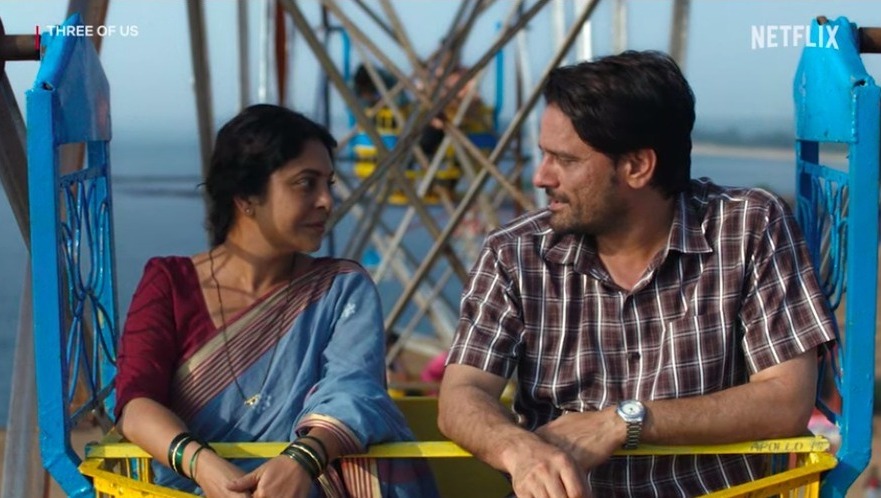
So here is celebrating the day, a bit belated, with the most telling image of the #FerrisWheel or the #GiantWheel from Avinash Arun Dhaware’s #ThreeofUs.
In the novel, “The Catcher in the Rye”, by J.D. Salinger, the protagonist, Holden Caulfield, reflects on his childhood memories while riding a Ferris Wheel with Phoebe at a carnival. He wishes it could be this way for him and her forever.
In this film, while taking a spin on the Ferris Wheel, childhood buddies Pradeep Kamath and Shailaja Desai relive their good old days, rewinding to that moment with a tinge of nostalgia when they were here together for the last time as children and giving that unfinished story the much-needed closure as adults.
Three of Us
A Ferris Wheel has a distinctive and universally recognizable nature, and it is no surprise that this scene is one of the most memorable in the film and finds a place on the poster, too.
The circular motion of a Ferris Wheel symbolizes cycles, continuity, and the never-ending nature of certain processes or experiences for both Pradeep and Shailaja and even Dipankar Desai.
The motion of a Ferris Wheel, with its ascending and descending movements, can be seen as a metaphor for their lives ups and downs after their last ride together on the Ferris Wheel many moons ago.
When Pradeep says, “If the wheel ever stopped mid-air, I didn’t want it to start again,” it highlights how the Ferris Wheel evoked nostalgia and a sense of the past, connecting people to memories of fun times and simpler pleasures. It also creates a sense of adventure and excitement because we see Dipankar choosing to stay away from the ride, letting Shailaja and Pradeep go for a ride one last time before they bid goodbye to each other forever.
Three of Us is streaming on Netflix.
When the wheel stops for a while (a brilliant way to pause and let the characters converse), Shailaja takes a moment to express how she still wouldn’t wish the wheel to restart. She reminisces how she was in a great hurry to get to Vengurla, and now, when she’s here, she’s missing Mumbai. But at that particular moment when the wheel has halted, she doesn’t feel the need to hurry anymore. “This is where I want to be, and I’m here,” she says, to which Pradeep couldn’t help but ask her, “Why didn’t you come back sooner, Shailaja?” She has no answer to his question but makes up for all that was and is now lost by saying, “After I left, I didn’t find the time to return. Our whole life is spent in a dilemma. Do we choose a busy or a peaceful life? Only recently, life said to me, “Slow Down.” And I did.”
Riding the Ferris Wheel together provides a different perspective of the surroundings with each revolution. It also symbolizes the importance of gaining new perspectives, reflecting, and seeing the bigger picture in various aspects of life for Pradeep and Shailaja.
However, the filmmaker has steered away from giving any romantic connotation to the Ferris Wheel ride by filming this scene in the glowing light of the evening and not an illuminated Ferris Wheel at night.
The scene is subtle, subdued, and sublime, much like their performances and the film, #ThreeofUs.
In the sweltering heat of 2016, superstar Shah Rukh Khan’s Fan got a “Jabardast” Bhojpuri twist in Manoj Tiwari’s voice. The lyrics penned by Dr Ranju Sinha scorched the musical charts and cooled the heart and soul of Bhojpuri music lovers. The song was released in nine Indian languages, two foreign languages and a mashup version that was a remix version of all the 11 tracks. Here’s SRK Fan Dr Ranju Sinha’s personal relationship with her Superstar.
Shillpi a singh
If you are a die-hard Shah Rukh Khan Fan from the eastern part of India, where Bhojpuri is the native language, chances are that you would have made a secret wish to see the superstar groove to a Bhojpuri song. Lo and behold, the wish had come true sooner when the Jabardast Fan song from Shah Rukh Khan-starrer was recorded in Bhojpuri, among many other languages. The peppy version was sung by singer, actor and parliamentarian Manoj Tiwari. The Hindi lyricist was Varun Grover, while the Bhojpuri version was penned by Dr Ranju Sinha, a producer, director, and lyricist in Bhojpuri cinema. And like Gaurav in Fan, she states, “Connection Bhi Na Kamaal Ki Cheez Hal, Bas Ho Gaya To Ho Gaya, Mat Pucho Kaise.” A conversation with Sinha and her special musical relationship with the Superstar… as a Jabardast Fan.
It was Sinha’s first outing in the Hindi cinema, and she still can’t believe that she had managed to fulfil a part of her dream – write the lyrics for Badshah SRK.
Retaining the essence of the original Jabardast Fan song in Hindi, she peppered the song with her nuanced choices of frequently spoken Bhojpuri words that helped the song strike a chord with Bhojpuri speaking youngsters. The Bhojpuri version of the song was a rage in Western Bihar, eastern Uttar Pradesh and Jharkhand.
Reminiscing her Fan moment, Sinha says, “It was a dream come true for someone like me to write a song for the superstar. SRK’s movie was about how a fan makes a star. In my case, too, I would say, Fan made me a star, in some measure.”
Dr Ranju Sinha.
A renowned name in the Bhojpuri cine circuit, life is a beautiful coincidence for Sinha. Born in a middle-class family in Bihar’s Muzaffarpur district on March 15th, 1962, she was married off at the age of 16 to Neelmani Kumar Sinha, a Bihar government official. “I was married off soon after Class 10 exams. I thought marriage meant the end of my academic and creative pursuits. But my parents-in-law and husband proved me wrong. They ensured that I continued my studies and finished my Class 12th, bachelors, masters and even got a doctorate,” she says, with a lot of pride.
Armed with a doctorate, she joined Raj Narain Singh Inter College, Muzaffarpur, as a lecturer in the home science department in 2002. By then, her two children — daughter Pooja Priyanka and son Pancham Priyam — had been packed off to New Delhi for schooling.
In 2005, her daughter moved to pursue an undergraduate program in audiology and speech therapy at Ali Yavar Jung National Institute for the Hearing Handicapped, Mumbai. “My daughter was all alone in Mumbai. She was homesick, so I thought it would be a good idea to move to Mumbai; Pooja would get to stay at home with me and would be able to focus on her studies.”
A homemaker, who mostly spent her days and nights taking care of her home and family in Muzaffarpur, Sinha shifted base to Mumbai only to give company to her daughter. She had planned to return home after Pooja completed her studies. As they say, man proposes, God disposes. “Initially, I did not know what to do with a lot of free time in this city. But it made me discover the creative side of my personality, which has been the biggest takeaway of being in Mumbai.” She was fond of writing, and for the first few months, all that she did was contribute articles for magazines and newspapers in Mumbai. Her penchant for writing made her explore options as a lyricist in the film industry. A movie buff, Sinha enjoyed watching the latest releases, but she had zilch knowledge about the craft of film-making as she admits today. But she was destined to be part of the film industry.
She says her elder brother, Mumbai-based businessman late Raman Kumar Bachchan, helped her get a toehold. It was on his insistence that she started looking for a meaningful creative engagement in the Bhojpuri film industry. “I started my career by penning devotional songs in Bhojpuri for ‘Chhatt Maharani’ for T-Series.” Dhananjay Mishra had composed the songs while Manoj Tiwari, and Anuradha Paudwal sang the songs. “It was a good start for a newcomer. Renowned singers such as Manoj Tiwari and Anuradha Paudwal lent their voices to my words. I was overjoyed.”
There was no looking back for Sinha after her debut as a songwriter for this devotional album. Buoyed by the success of this venture, she went on to pen devotional songs for two more albums — Chalo Re Sai Dham and Sai Base Hain Kan Kan Mein. Today she is a sought-after lyricist and story writer in the Bhojpuri film industry, having penned songs for hit movies such as Sautan, Ajab Devra ke Gazab Bhaujai, Niruha Banal Don, Rangbaaz and Jai Ho Jagdamba Mai. But that’s not all. She successfully forayed into film production and direction under her home banner, Gauri Shankar Arts Private Limited. She has produced half a dozen movies, including Jai Ho Jagdamba Mai, Chandrika, Preet Bada Anmol, Paro Patna Wali and among many others.
“In a way, I am in the best phase of my life. My children are doing well. Pooja is married to Dr Shashank Kumar, a dentist here in Mumbai, and the couple has a son Dhwanit. My son Pancham is currently working as Project Manager in NIIT Technologies in London, and he lives there with his wife and son.” So does she intend to leave Mumbai and return to her roots? “As of now, my hands are full. There is so much to do that I can’t even think of doing so by any means. I can’t even afford to take a break from work.”
Recalling her long association with Tiwari, Sinha says, “We go back a long way. His voice has the Midas touch. It did wonders to my just launched career way back in 2006. I was glad to have him lend his voice for the Bhojpuri version of Jabardast Fan.”
However, the call from Yash Raj Films was quite surprising for Sinha, as she fondly recalls. “I had initially dismissed it as a prank call. I couldn’t believe in my wildest dreams that I got a call from YRF to sing a song for their movie. When I checked with the production house, I realized it was indeed true. I was over the moon,” she says.
Sinha is a self-proclaimed Fan of SRK. The Bhojpuri Fan song is still popular among the masses. But unfortunately, not many people know that ‘E dilwa tohre jabardast ab toh fan ho gayil‘ was my work. The crowd goes berserk still to hear it in Bhojpuri, and that gladdens my heart.”



 mindthegapalways