
The article was published in The Free Press Journal, Mumbai, on February 18, 2024. https://www.freepressjournal.in/weekend/international-mother-language-day-how-bilingual-parenting-is-changing-the-way-kids-learn-languages

The article was published in The Free Press Journal, Mumbai, on February 18, 2024. https://www.freepressjournal.in/weekend/international-mother-language-day-how-bilingual-parenting-is-changing-the-way-kids-learn-languages

Children suffer, parents struggle while school and teachers juggle to remain relevant in the new normal brought about by COVID lockdown.
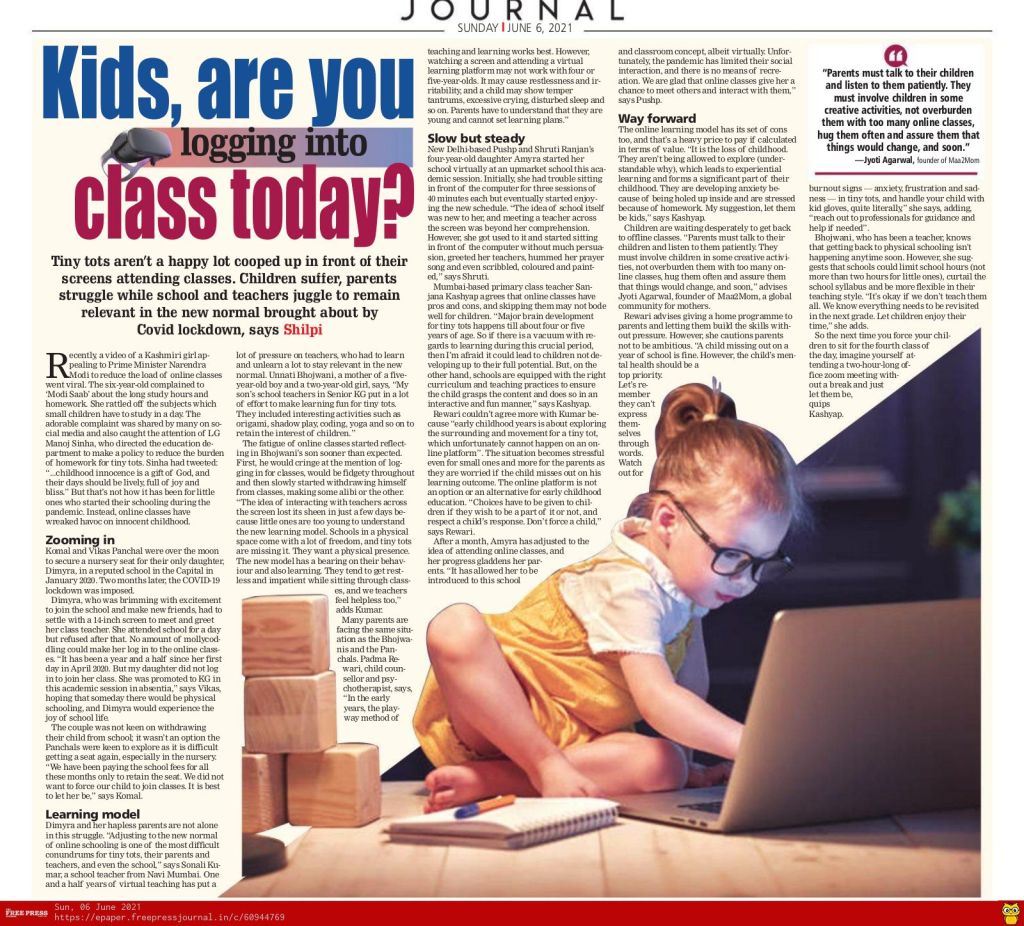
The article was carried in The Free Press Journal on June 6, 2021. https://www.freepressjournal.in/weekend/virtual-reality-tiny-tots-face-the-brunt-of-the-covid-lockdown

Dr Jesal Sheth tells how parents can chip in and help their children bust it.
New Delhi, April 1, 2021: The COVID19 pandemic and subsequent lockdown generated a lot of fear and stress across all age groups. Children usually thrive under predictable conditions, but the pandemic’s disruption greatly impacted them physically and emotionally. Online schooling, social isolation, lack of interactions with their friends, lack of physical sports and parental angst have aggravated their mental and emotional wellbeing. Children and adolscents have developed fear, anxiety, depression, and boredom. While most parents were involved in dealing with the pandemic’s uncertainty and putting all efforts to keep their family safe and sustainable, the emotional needss and mental health of children were somehow ignored.
THE IMPACT OF THE PANDEMIC ON CHILDREN: The pandemic has changed the way children typically grow, learn, play, behave, interact, and manage emotions. Children have been observed to have conduct problems, peer problems, externalizing problems, and general psychological distress. When compared with children who did not exercise, children with psychical activity had lower hyperactivity-inattention and less prosocial behavior problems.
Moreover, from a more emotional perspective, they have a lot going around in their head, and the biggest worry for them is whether or not they will see their friends in school or get sick. The combined effect between lifestyle changes and psychosocial stress caused by home confinement perhaps aggravates children’s behavioural problems.
In the long run, this can lead to an emotional breakdown among children, and the same may lead to these children resisting to return to school post-lockdown. This can happen primarily because children have lost their pre-lockdown routines and the loss of touch with their peers and mentors. In addition to this, the lockdown-related constraints can have a long-term negative effect on their overall psychological wellbeing.
SO, HOW DO WE TACKLE THIS? Here’s how you can help children cope with COVID-related stress;
(Dr Jesal Sheth is Senior Consultant-Paediatrician, Fortis Hospital, Mulund; Cover image by Tumisu from Pixabay)
 mindthegapalways