
Director and Writer:
Celine Song
Cast:
- Greta Lee as Nora
- Teo Yoo as Hae Sung
- John Maharo as Arthur
- Moon Seung-ah as Young Nora
- Leem Seung-min as Young Hae Sung
Celine Song’s “Past Lives” tugs at one’s heartstrings. The film by the Korean-Canadian filmmaker explores the complexities of human existence and the Korean concept of In-yun, the belief that souls can be inextricably linked through thousands of reincarnations but that the nature of their connection can shift from life to life.
The film opens with an unseen character (voice) asking, “Who do you think they are to each other?” while observing the three protagonists, Nora, Hae Sung, and Arthur, sitting across a bar late at night, engrossed in a deeply animated conversation with the East Asian lady flanked by an East Asian and White (American) men. This question is an access point into the complex tale and takes the audience straight into the past and present worlds of Na Young or Nora and Hae Sung, two deeply connected childhood friends from Seoul, who meet in New York twenty-four years later, and Nora’s Jewish American husband, Arthur. The Korean-American Nora navigates the two worlds when the twain meet and doubles up as a translator for Hae, whose English is poor, and Arthur, whose Korean is basic, to help them converse easily.
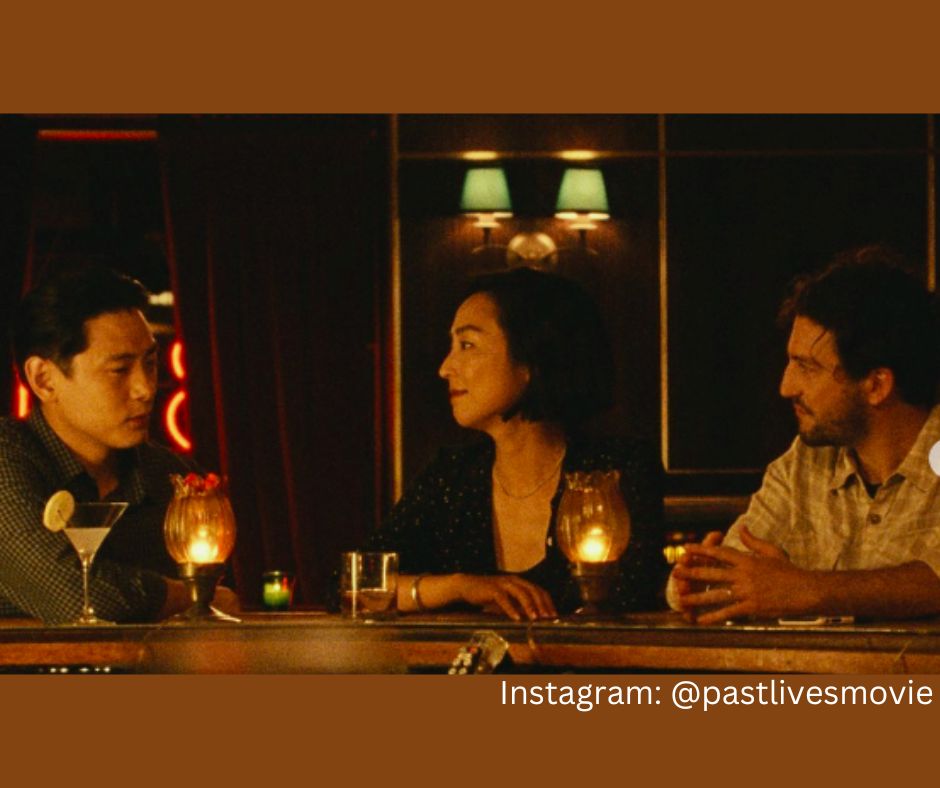
More here: https://www.instagram.com/pastlivesmovie/?hl=en
There are two love stories, running parallelly through the entire runtime of 146 minutes, with both feeding into each other, yet showing us how truly distinct, in magnitude and scale, spread and width, geographically and emotionally close and distant, these two love tracks are from each other.

In no time, the story shifts to Seoul in South Korea, with 12-year-old children (a boy and a girl) walking home after school. The girl is grumpy while the boy is playful, dribbling his basketball all along because he, for once, could beat the girl at the grades and stood first in the class. He calls her a psycho and moves on. At home, the girl’s family is busy prepping to emigrate to Canada, and the girl and her sibling get engrossed in finalising their English names. The girl’s mother asks her if she likes anyone in her class, to which the 12-year-old sheepishly confesses that she does like a boy with whom she will get married when she grows up. The mother proposes to take them together on a date, which she heartily accepts with a shy grin.

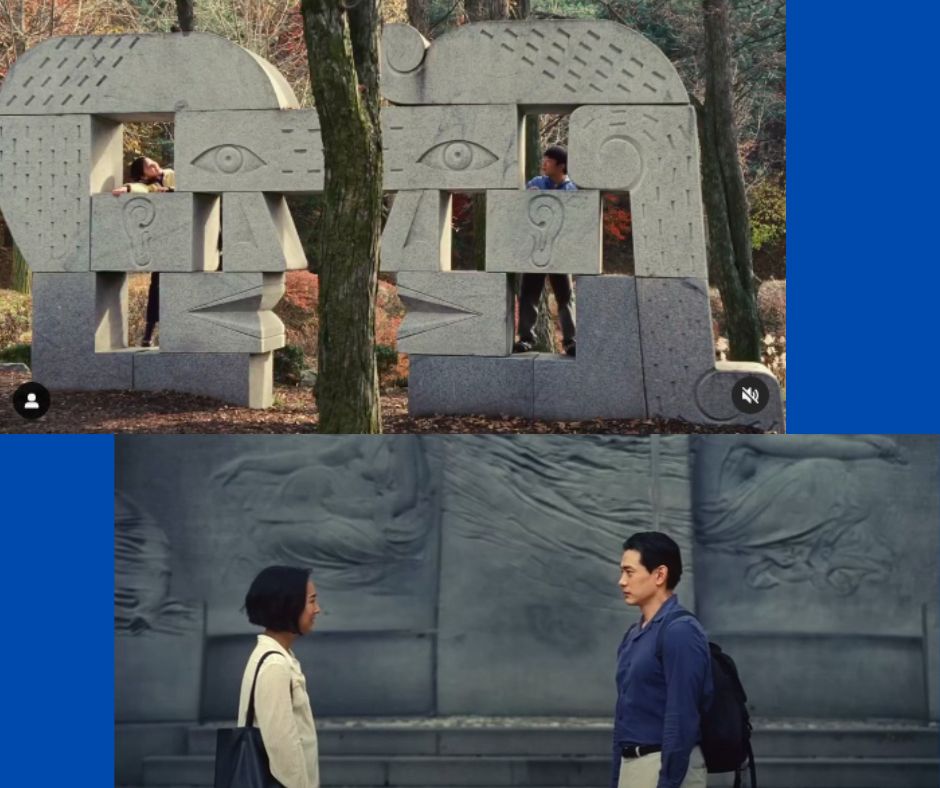
The kids and their mothers meet, and the scene with the girl holding the boy’s hand and sleeping in the backseat while resting her head on his shoulder is symbolic in multiple ways. Nora’s mother’s profound statement to Hae’s mom — “If you leave something behind, you gain something, too” — becomes the guiding light of the young girl’s life, from Seoul to Ontario, from Ontario to New York. Life zips past their childhood, separating them across space and time at a great pace. The symmetry in a young boy staring into the nothingness out of the car window is matched in the finale scene where he looks out as the Uber taxi speeds away to drop him at the airport after his one-week-long reunion with Nora in New York, 24 years later. Then their last meeting in a garden on a rainy day as children in Seoul playing hide and seek against a huge stone art installation, and then meeting against the backdrop of a stone structure in New York is another level of symmetry in their lives and beings, one’s longing and another’s belonging matches frame by frame, without missing a beat.
The story pans in and out of Nora’s life as an adult, where she reads Hae Sung’s message on her filmmaker father’s Facebook page and connects online with him after 12 long years of separation. She asks him, why did he look up for her? His response wins (my heart, at least) hands down, “I wanted to see you one more time.” They rekindle that spark of friendship spread across geographies and time zones, but their togetherness across Skype calls gets spaced out and freezes in the frame. A pragmatic Nora realises that she had moved to New York to make a writing career and wouldn’t trade off that ambition at any cost. She decides to focus on her life’s larger goal — the upcoming Artists’ Residency — at the expense of the duo’s what-if relationship status and keeps it on hold till further notice. Hae is devastated and considerably lonely but accepts her childhood buddy’s decision. Their banters and bickerings across the screen make them so adorable as friends who reconnect, albeit virtually, only to separate in the real world once more.
But did this have to happen? It’s a valid question, but perhaps not the most pressing one raised by this delicate and thoughtfully crafted drama that explores how our pasts shape our present realities. It examines when change represents growth and when it masks our true selves. The film contemplates whether life is determined by fate or will, what has permanence, and what is transient. The film delves into these complexities with admirable grace and poise as Nora reflects on how many emotions and missed opportunities have shaped her most cherished desires quite unapologetically. At the same time, Hae seems stuck in the past, looking at everything with nostalgia-tinted glasses.
This movie delves into the captivating storytelling, exceptional performances, and profound themes of identity and destiny portrayed in Song’s masterpiece.
As the story unfolds, Nora emerges as a strong woman character. She embodies resilience, courage, and determination, refusing to let anything restrict her from pursuing her life’s larger goal, and that’s quite stunningly remarkable. A double emigrant who learns to find her roots in a potted plant with her husband, and despite her hardships, learns to forge her path, embracing her inner strength and discovering her true purpose with aplomb. Her character arc highlights the importance of self-discovery and empowerment. From wanting to win the Nobel Prize for Literature as a 12-year-old to win a Booker as an adult and then wishing for the Tony sums her ambition graph.
Within the tapestry of Past Lives, the concept of destiny plays a central role. The characters’ encounters and separations are intricately woven together by a higher force, guiding their lives. Through exploring reincarnation, the story poses thought-provoking questions about the nature of fate, free will, and the enduring power of love. What sustains it? What keeps the sparks alive? What kindles that flame? And how does it all turn into ashes in no time, to rise again, in another space, and in another time?
Amidst the complexities of their love story, the narrative also delves into the power of friendship. The artists’ residency changes the course of Nora’s life. She meets her to-be husband Arthur there and explains In-Yun, and why meeting him is no coincidence for the duo in the first encounter itself. “There’s a word in Korean, In-Yun. It means providence or fate. But it’s specifically about relationships between people. For example, if two strangers walk by each other in the street, and their clothes accidentally brush, that means there have been 8,000 layers of In-Yun between them. That is In Yun.” Each encounter is said to be caused by hidden reasons that began years ago.
Nora and Arthur were meant to meet and hit off instantly. She finds solace in his unwavering support, which strengthens and guides her professional journey. Through their bond, the story showcases the significance of companionship, loyalty, and the ability to overcome challenges together.
His longing to belong in Nora’s world can be gauged from the fact that he is learning a new language to understand Nora’s dreams and sleep talks in Korean because he always felt that there are many places within that are absolutely out of bounds for him due to unfamiliarity with a language. For a fleeting moment, he fears losing her to Hae, Nora’s childhood sweetheart with whom she had reconnected after over two decades. But she handles his misplaced fear and insecurities with trust, places her faith in him, and shows him what his love and life mean to her… he is her world. She manages to assuage untoward and unwanted thoughts of him being an “evil White Husband standing in the way of destiny” with so much grace when she says, “This is my life. This is where I am supposed to be.” The tender moment makes the couple so lovable every which way.
Nora and Hae’s encounters may vary in form and circumstance in their childhood and adulthood, but the underlying connection remains unbroken, leaving them with a lingering sense of familiarity and an unexplainable pull toward one another. Surprisingly Nora though not oblivious to Hae’s affections, is unable to reciprocate because it comes in the way of her life’s larger purpose.
Once in New York, Nora takes Hae sightseeing and hosts him at home with her husband. The In-Yun conversation makes her come back, as if to complete the loop, when Hae wonders and asks Nora, “If you had never left Seoul, would I have still looked for you? Would we have dated? Broken up? Gotten married? Would we have had kids together?” He tells her upfront that maybe she wouldn’t have stayed because she likes to leave. And then, before bidding her goodbye, he asks her again, “If this is their Past Life, what would their next life be like?” None of them have an answer to it. The most heartbreaking scene is the silence between the three characters. Hae leaves while the otherwise calm and composed Nora cries her heart out, unable to hold back the emotional rollercoaster ride spanning a week. Her strength fades away in the flow of her tears, and that’s cathartic for her and her relationships — the one that is with Arthur and the one that could have been with Hae, as Hae had reminded Arthur in the bar that they must also have had some In-Yun as well.

https://www.instagram.com/pastlivesmovie/?hl=en
I. Engaging Storytelling and Cinematic Craftsmanship: “Past Lives” weaves an intricate narrative that seamlessly blends past and present, challenging our perception of time. Celine Song, both writer and director, demonstrates her storytelling prowess by crafting a compelling screenplay that keeps viewers engaged from beginning to end. The film’s exquisite cinematography captures New York like never before, skilful editing, and atmospheric sound design enhance the immersive experience, transporting the audience into the realms of the past lives depicted on screen.
II. Stellar Performances and Emotional Depth: The performances in “Past Lives” are nothing short of exceptional, with each actor bringing depth and authenticity to their characters. The talented ensemble cast delivers nuanced portrayals, effortlessly capturing their respective characters’ complex emotions and internal struggles. Their performances evoke empathy and resonate deeply, adding layers of emotional complexity to the film’s exploration of love, loss, and the eternal cycle of rebirth.
III. Profound Themes of Identity and Destiny: At its core, “Past Lives” delves into profound existential themes, questioning the nature of identity and the role of destiny in shaping our lives. Through its intricate narrative structure, the film challenges conventional notions of time and asks thought-provoking questions about the interconnectedness of past and present. It explores the idea that our actions in past lives reverberate in our current existence, highlighting the inextricable links between our past, present, and future selves.
IV. Critical Acclaim and Audience Reception: Since its release, “Past Lives” has garnered critical acclaim and captivated audiences worldwide. The film has been praised for its innovative storytelling, lyrical visuals, and the profound emotional impact it leaves on viewers. Celine Song’s unique vision and ability to translate complex themes into a relatable and poignant narrative have solidified her status as a rising talent in cinema.
Song’s “Past Lives” is a cinematic masterpiece that transcends the boundaries of time and space, immersing audiences in a contemplative exploration of identity and destiny. The film’s engaging storytelling, stellar performances, and profound themes captivate viewers and leave a lasting impression. As Song continues to establish herself as a visionary filmmaker, Past Lives stands as a testament to her artistic brilliance and ability to provoke introspection and ignite the imagination of audiences worldwide. She has succeeded in taking her viewers on a mesmerising journey through time, blending elements of romance and mysticism, masterfully evoking emotions from heartwarming moments of love and connection to poignant instances of loss, longing, belonging and unbelonging. The film delves deep into the human experience, exploring the profound yearning for connection that transcends time and mortality. Viewers are left contemplating the power of love and the idea of past lives long after the credits roll.

So whether you’re a fan of romance, mysticism, or thought-provoking cinema, Past Lives is a must-watch that will leave you contemplating the mysteries of love and the possibility of eternal connections across lifetimes.
Nora and Hae’s souls are destined to meet and maybe part across multiple lifetimes. But we hope that each time they are reborn, their paths intertwine in unexpected ways, shaping their shared destiny, and giving them everlasting togetherness. After all, All the World Loves Lovers.
(All photos sourced from Past Lives’ instagram handle)
 mindthegapalways